

22
P. K. Muduli et al.
for the case where 1/f frequency noise is high. Furthermore, it was shown that the
1/f frequency noise is significantly high due to mode-hopping. The line-shape fitting shows a better fit with a Voigt line-shape compared to a Lorentzian line-shape.
This verifies both previous observations [75, 98] of change in the lineshape for 1/f
frequency noise. But, most importantly, it is established that mode-hopping can lead
to 1/f frequency noise.
6.2.2 Mode-Hopping Contributions to the Nonlinear STNO Generation
Linewidth
A single-mode STNO will exhibit a Lorentzian lineshape in the frequency domain.
If there is mode-hopping present, one would expect it to contribute to the linewidth
as mode-hopping events generally reduce the coherence of the motion. Based on the
mode-coupling theory in Refs. [72, 96, 97, 99], Iacocca et al. [98] investigated the
effect of mode-hopping on the nonlinear STNO generation linewidth. As one might
expect, mode-hopping events do indeed increase the generation linewidth. However,
multi-mode generation first of all fundamentally changes the generation line shape
to a Voigt line shape in general, but under certain circumstances, the line shape may
be reduced to a Lorentzian. Mode-hopping events can be described as a Poisson
process which provides a purely Lorentzian contribution to the line shape. At high
mode-hopping rates, mode-hopping contributions to the line width will dominate
and the line shape will then regain a Lorentzian character. The mode-hopping rate
can, in this case, be described by an Arrhenius distribution, and measurements of the
linewidth can provide direct estimates of the energy barrier that has to be overcome
by thermal fluctuations during mode-hopping events.
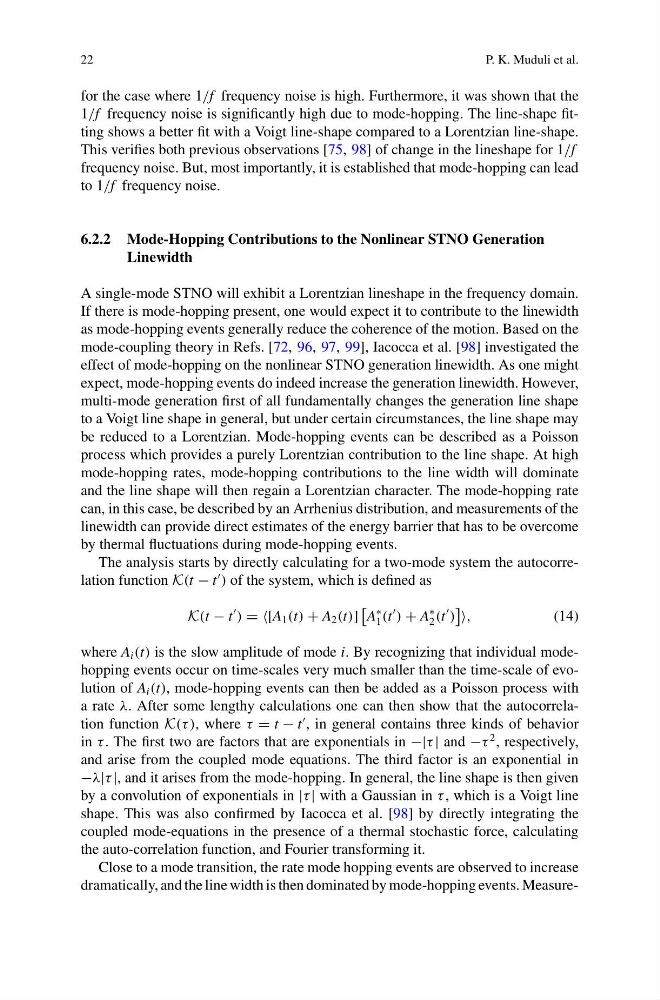
The analysis starts by directly calculating for a two-mode system the autocorrelation function K(t − t
) of the system, which is defined as
K(t − t
) = =[A 1 (t) + A 2 (t)]
A
∗
1 (t
) + A
∗
2 (t
)
,
(14)
where A i (t) is the slow amplitude of mode i. By recognizing that individual modehopping events occur on time-scales very much smaller than the time-scale of evolution of A i (t), mode-hopping events can then be added as a Poisson process with
a rate λ. After some lengthy calculations one can then show that the autocorrelation function K(τ ), where τ = t − t
, in general contains three kinds of behavior
in τ . The first two are factors that are exponentials in −|τ | and −τ
2 , respectively,
and arise from the coupled mode equations. The third factor is an exponential in
−λ|τ |, and it arises from the mode-hopping. In general, the line shape is then given
by a convolution of exponentials in |τ | with a Gaussian in τ , which is a Voigt line
shape. This was also confirmed by Iacocca et al. [98] by directly integrating the
coupled mode-equations in the presence of a thermal stochastic force, calculating
the auto-correlation function, and Fourier transforming it.
Close to a mode transition, the rate mode hopping events are observed to increase
dramatically, and the line width is then dominated by mode-hopping events. Measure-
P. K. Muduli et al.
for the case where 1/f frequency noise is high. Furthermore, it was shown that the
1/f frequency noise is significantly high due to mode-hopping. The line-shape fitting shows a better fit with a Voigt line-shape compared to a Lorentzian line-shape.
This verifies both previous observations [75, 98] of change in the lineshape for 1/f
frequency noise. But, most importantly, it is established that mode-hopping can lead
to 1/f frequency noise.
6.2.2 Mode-Hopping Contributions to the Nonlinear STNO Generation
Linewidth
A single-mode STNO will exhibit a Lorentzian lineshape in the frequency domain.
If there is mode-hopping present, one would expect it to contribute to the linewidth
as mode-hopping events generally reduce the coherence of the motion. Based on the
mode-coupling theory in Refs. [72, 96, 97, 99], Iacocca et al. [98] investigated the
effect of mode-hopping on the nonlinear STNO generation linewidth. As one might
expect, mode-hopping events do indeed increase the generation linewidth. However,
multi-mode generation first of all fundamentally changes the generation line shape
to a Voigt line shape in general, but under certain circumstances, the line shape may
be reduced to a Lorentzian. Mode-hopping events can be described as a Poisson
process which provides a purely Lorentzian contribution to the line shape. At high
mode-hopping rates, mode-hopping contributions to the line width will dominate
and the line shape will then regain a Lorentzian character. The mode-hopping rate
can, in this case, be described by an Arrhenius distribution, and measurements of the
linewidth can provide direct estimates of the energy barrier that has to be overcome
by thermal fluctuations during mode-hopping events.
The analysis starts by directly calculating for a two-mode system the autocorrelation function K(t − t
) of the system, which is defined as
K(t − t
) = =[A 1 (t) + A 2 (t)]
A
∗
1 (t
) + A
∗
2 (t
)
,
(14)
where A i (t) is the slow amplitude of mode i. By recognizing that individual modehopping events occur on time-scales very much smaller than the time-scale of evolution of A i (t), mode-hopping events can then be added as a Poisson process with
a rate λ. After some lengthy calculations one can then show that the autocorrelation function K(τ ), where τ = t − t
, in general contains three kinds of behavior
in τ . The first two are factors that are exponentials in −|τ | and −τ
2 , respectively,
and arise from the coupled mode equations. The third factor is an exponential in
−λ|τ |, and it arises from the mode-hopping. In general, the line shape is then given
by a convolution of exponentials in |τ | with a Gaussian in τ , which is a Voigt line
shape. This was also confirmed by Iacocca et al. [98] by directly integrating the
coupled mode-equations in the presence of a thermal stochastic force, calculating
the auto-correlation function, and Fourier transforming it.
Close to a mode transition, the rate mode hopping events are observed to increase
dramatically, and the line width is then dominated by mode-hopping events. Measure-