

280
M. Becherer
4.1 Complicated Signal Routing in 2D Arrangements
One of the most important aspect in 3D integration is signal routing. In principle,
electrical interconnects are superfluous in pNML as computation is executed by
field-coupling. The concept of field-coupling for computation is very much related to
cellular automata where only next neighbors are interacting for computing operations.
However, as DW conductors are used for signal routing, a 2D pNML layout is very
much complicating signal distribution, as line crossings are not possible. By contrast,
in CMOS, numerous metal layers allow for high flexibility and there are interconnects
on short-, medium- and long-range scale, organized in a strict hierarchical manner.
This is simply not feasible in 2D nanomagnetic logic circuits. But in principal,
as magnetic coupling fields are acting in all 3 dimensions of space, it is straight
forward to extend the 2D pNML system to logic gates and signals propagating in 3D
arrangements.
The basic idea to boost pNML technology is true monolithic 3D integration. It
means that 3D arrangements of pNML devices are interacting in a dense configuration but at the same time keeping the benefits of a top down planar technology.
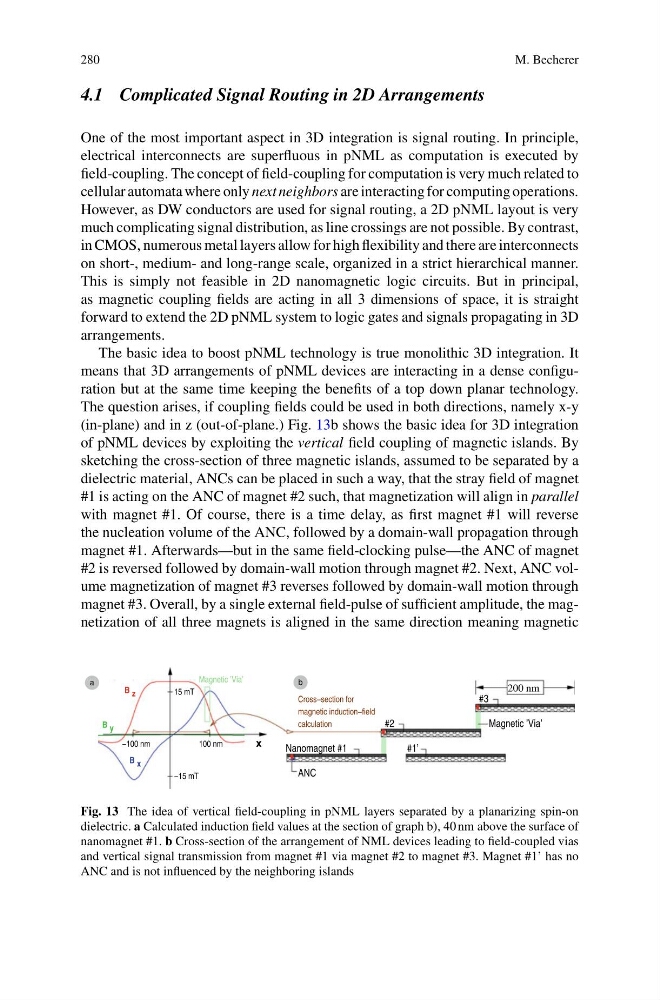
The question arises, if coupling fields could be used in both directions, namely x-y
(in-plane) and in z (out-of-plane.) Fig. 13b shows the basic idea for 3D integration
of pNML devices by exploiting the vertical field coupling of magnetic islands. By
sketching the cross-section of three magnetic islands, assumed to be separated by a
dielectric material, ANCs can be placed in such a way, that the stray field of magnet
#1 is acting on the ANC of magnet #2 such, that magnetization will align in parallel
with magnet #1. Of course, there is a time delay, as first magnet #1 will reverse
the nucleation volume of the ANC, followed by a domain-wall propagation through
magnet #1. Afterwards—but in the same field-clocking pulse—the ANC of magnet
#2 is reversed followed by domain-wall motion through magnet #2. Next, ANC volume magnetization of magnet #3 reverses followed by domain-wall motion through
magnet #3. Overall, by a single external field-pulse of sufficient amplitude, the magnetization of all three magnets is aligned in the same direction meaning magnetic
Fig. 13 The idea of vertical field-coupling in pNML layers separated by a planarizing spin-on
dielectric. a Calculated induction field values at the section of graph b), 40 nm above the surface of
nanomagnet #1. b Cross-section of the arrangement of NML devices leading to field-coupled vias
and vertical signal transmission from magnet #1 via magnet #2 to magnet #3. Magnet #1’ has no
ANC and is not influenced by the neighboring islands
M. Becherer
4.1 Complicated Signal Routing in 2D Arrangements
One of the most important aspect in 3D integration is signal routing. In principle,
electrical interconnects are superfluous in pNML as computation is executed by
field-coupling. The concept of field-coupling for computation is very much related to
cellular automata where only next neighbors are interacting for computing operations.
However, as DW conductors are used for signal routing, a 2D pNML layout is very
much complicating signal distribution, as line crossings are not possible. By contrast,
in CMOS, numerous metal layers allow for high flexibility and there are interconnects
on short-, medium- and long-range scale, organized in a strict hierarchical manner.
This is simply not feasible in 2D nanomagnetic logic circuits. But in principal,
as magnetic coupling fields are acting in all 3 dimensions of space, it is straight
forward to extend the 2D pNML system to logic gates and signals propagating in 3D
arrangements.
The basic idea to boost pNML technology is true monolithic 3D integration. It
means that 3D arrangements of pNML devices are interacting in a dense configuration but at the same time keeping the benefits of a top down planar technology.
The question arises, if coupling fields could be used in both directions, namely x-y
(in-plane) and in z (out-of-plane.) Fig. 13b shows the basic idea for 3D integration
of pNML devices by exploiting the vertical field coupling of magnetic islands. By
sketching the cross-section of three magnetic islands, assumed to be separated by a
dielectric material, ANCs can be placed in such a way, that the stray field of magnet
#1 is acting on the ANC of magnet #2 such, that magnetization will align in parallel
with magnet #1. Of course, there is a time delay, as first magnet #1 will reverse
the nucleation volume of the ANC, followed by a domain-wall propagation through
magnet #1. Afterwards—but in the same field-clocking pulse—the ANC of magnet
#2 is reversed followed by domain-wall motion through magnet #2. Next, ANC volume magnetization of magnet #3 reverses followed by domain-wall motion through
magnet #3. Overall, by a single external field-pulse of sufficient amplitude, the magnetization of all three magnets is aligned in the same direction meaning magnetic
Fig. 13 The idea of vertical field-coupling in pNML layers separated by a planarizing spin-on
dielectric. a Calculated induction field values at the section of graph b), 40 nm above the surface of
nanomagnet #1. b Cross-section of the arrangement of NML devices leading to field-coupled vias
and vertical signal transmission from magnet #1 via magnet #2 to magnet #3. Magnet #1’ has no
ANC and is not influenced by the neighboring islands