

278
M. Becherer
3.3 Verilog-A Models
With micromagnetic solvers, one is able to understand switching behavior in quite
good detail. However, such solvers are not capable for simulations of large pNML
systems due to the time-intensive evaluation of the LLG-equation. For that reason,
we developed physical-based compact models (as these are commonly used in circuit
design) in order to mimic the behavior of larger pNML arrangements [52, 53].
By micromagnetic modeling and accurate parameter extraction from sample structures in the experiment, e.g. magnetic layer composition, island geometries, local ion
irradiation, etc. (see e.g. [54] for measurement and modeling of the nucleation probability), the full design space for pNML can be explored and a basis for benchmarking
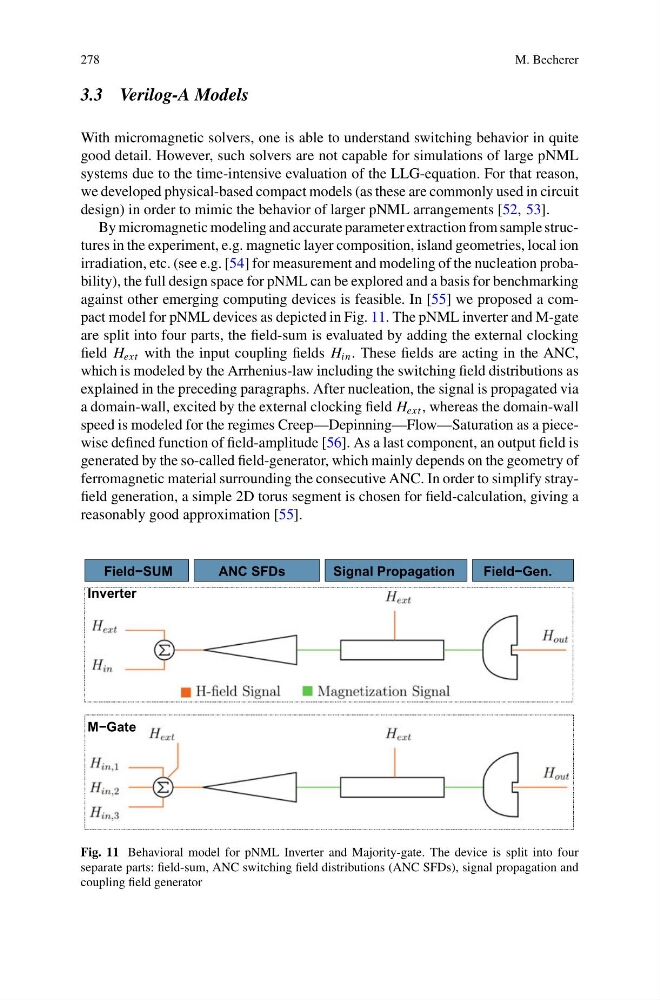
against other emerging computing devices is feasible. In [55] we proposed a compact model for pNML devices as depicted in Fig. 11. The pNML inverter and M-gate
are split into four parts, the field-sum is evaluated by adding the external clocking
field H ext with the input coupling fields H in . These fields are acting in the ANC,
which is modeled by the Arrhenius-law including the switching field distributions as
explained in the preceding paragraphs. After nucleation, the signal is propagated via
a domain-wall, excited by the external clocking field H ext , whereas the domain-wall
speed is modeled for the regimes Creep—Depinning—Flow—Saturation as a piecewise defined function of field-amplitude [56]. As a last component, an output field is
generated by the so-called field-generator, which mainly depends on the geometry of
ferromagnetic material surrounding the consecutive ANC. In order to simplify strayfield generation, a simple 2D torus segment is chosen for field-calculation, giving a
reasonably good approximation [55].
Field−SUM
ANC SFDs
Signal Propagation
Field−Gen.
Inverter
M−Gate
Fig. 11 Behavioral model for pNML Inverter and Majority-gate. The device is split into four
separate parts: field-sum, ANC switching field distributions (ANC SFDs), signal propagation and
coupling field generator
M. Becherer
3.3 Verilog-A Models
With micromagnetic solvers, one is able to understand switching behavior in quite
good detail. However, such solvers are not capable for simulations of large pNML
systems due to the time-intensive evaluation of the LLG-equation. For that reason,
we developed physical-based compact models (as these are commonly used in circuit
design) in order to mimic the behavior of larger pNML arrangements [52, 53].
By micromagnetic modeling and accurate parameter extraction from sample structures in the experiment, e.g. magnetic layer composition, island geometries, local ion
irradiation, etc. (see e.g. [54] for measurement and modeling of the nucleation probability), the full design space for pNML can be explored and a basis for benchmarking
against other emerging computing devices is feasible. In [55] we proposed a compact model for pNML devices as depicted in Fig. 11. The pNML inverter and M-gate
are split into four parts, the field-sum is evaluated by adding the external clocking
field H ext with the input coupling fields H in . These fields are acting in the ANC,
which is modeled by the Arrhenius-law including the switching field distributions as
explained in the preceding paragraphs. After nucleation, the signal is propagated via
a domain-wall, excited by the external clocking field H ext , whereas the domain-wall
speed is modeled for the regimes Creep—Depinning—Flow—Saturation as a piecewise defined function of field-amplitude [56]. As a last component, an output field is
generated by the so-called field-generator, which mainly depends on the geometry of
ferromagnetic material surrounding the consecutive ANC. In order to simplify strayfield generation, a simple 2D torus segment is chosen for field-calculation, giving a
reasonably good approximation [55].
Field−SUM
ANC SFDs
Signal Propagation
Field−Gen.
Inverter
M−Gate
Fig. 11 Behavioral model for pNML Inverter and Majority-gate. The device is split into four
separate parts: field-sum, ANC switching field distributions (ANC SFDs), signal propagation and
coupling field generator