

270
M. Becherer
3.1 Micromagnetics with OOMMF Finite Difference LLG
Solver
Commonly, small arrangements of nanomagnets are simulated in the micromagnetic domain, analyzing the dynamic behavior of macro-spins in applied fields by
solving the Landau-Lifshitz-Gilbert equation (LLG). From such simulations—e.g.
performed with the open-source LLG-solver OOMMF [36]—detailed knowledge
on DW motion, reversal mechanism and stray field generation can be obtained. In
the early work of Co/Pt research for NML application, it was found that a spatially
varying anisotropy can be linked to focused ion radiation [22, 37, 38]. For that, experiments with Extraordinary-Hall effect sensors of Co/Pt bilayer stacks were compared
with micromagnetic simulations in OOMMF [36]. Basically, the OOMMF simulation framework solves the ‘Landau-Lifshitz-Gilbert’ ordinary differential equation
by means of finite difference methods. For NML films, the multilayer is treated as a
2-D effective media where the saturation magnetization M s , anisotropy constant K u ,
and exchange stiffness A exch are kept constant in the direction perpendicular to the
film plane. It was found, that in order to model FIB irradiation, the anisotropy constant is varied for the lateral dimensions and experimental data are taken to validate
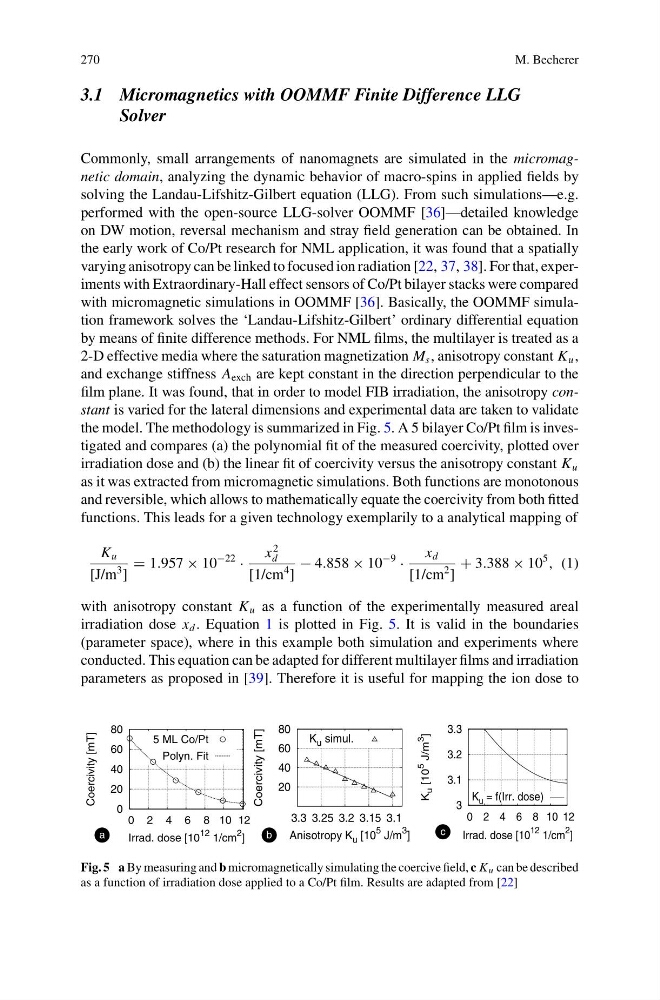
the model. The methodology is summarized in Fig. 5. A 5 bilayer Co/Pt film is investigated and compares (a) the polynomial fit of the measured coercivity, plotted over
irradiation dose and (b) the linear fit of coercivity versus the anisotropy constant K u
as it was extracted from micromagnetic simulations. Both functions are monotonous
and reversible, which allows to mathematically equate the coercivity from both fitted
functions. This leads for a given technology exemplarily to a analytical mapping of
K u
[J/m
3 ]
= 1.957 × 10
−22
·
x
2
d
[1/cm
4 ]
− 4.858 × 10
−9
·
x d
[1/cm
2 ]
+ 3.388 × 10
5
, (1)
with anisotropy constant K u as a function of the experimentally measured areal
irradiation dose x d . Equation 1 is plotted in Fig. 5. It is valid in the boundaries
(parameter space), where in this example both simulation and experiments where
conducted. This equation can be adapted for different multilayer films and irradiation
parameters as proposed in [39]. Therefore it is useful for mapping the ion dose to
0
20
40
60
80
0 2 4 6 8 10 12
Coercivity [mT]
Irrad. dose [10
12 1/cm
2
]
5 ML Co/Pt
Polyn. Fit
3
3.1
3.2
3.3
0 2 4 6 8 10 12
K
u [10
5
J/m
3
]
Irrad. dose [10
12 1/cm
2 ]
K u = f(Irr. dose)
20
40
60
80
3.1
3.15
3.2
3.25
3.3
Coercivity [mT]
Anisotropy K u [10
5 J/m
3 ]
K u simul.
c
a
b
Fig. 5 a By measuring and b micromagnetically simulating the coercive field, c K u can be described
as a function of irradiation dose applied to a Co/Pt film. Results are adapted from [22]
M. Becherer
3.1 Micromagnetics with OOMMF Finite Difference LLG
Solver
Commonly, small arrangements of nanomagnets are simulated in the micromagnetic domain, analyzing the dynamic behavior of macro-spins in applied fields by
solving the Landau-Lifshitz-Gilbert equation (LLG). From such simulations—e.g.
performed with the open-source LLG-solver OOMMF [36]—detailed knowledge
on DW motion, reversal mechanism and stray field generation can be obtained. In
the early work of Co/Pt research for NML application, it was found that a spatially
varying anisotropy can be linked to focused ion radiation [22, 37, 38]. For that, experiments with Extraordinary-Hall effect sensors of Co/Pt bilayer stacks were compared
with micromagnetic simulations in OOMMF [36]. Basically, the OOMMF simulation framework solves the ‘Landau-Lifshitz-Gilbert’ ordinary differential equation
by means of finite difference methods. For NML films, the multilayer is treated as a
2-D effective media where the saturation magnetization M s , anisotropy constant K u ,
and exchange stiffness A exch are kept constant in the direction perpendicular to the
film plane. It was found, that in order to model FIB irradiation, the anisotropy constant is varied for the lateral dimensions and experimental data are taken to validate
the model. The methodology is summarized in Fig. 5. A 5 bilayer Co/Pt film is investigated and compares (a) the polynomial fit of the measured coercivity, plotted over
irradiation dose and (b) the linear fit of coercivity versus the anisotropy constant K u
as it was extracted from micromagnetic simulations. Both functions are monotonous
and reversible, which allows to mathematically equate the coercivity from both fitted
functions. This leads for a given technology exemplarily to a analytical mapping of
K u
[J/m
3 ]
= 1.957 × 10
−22
·
x
2
d
[1/cm
4 ]
− 4.858 × 10
−9
·
x d
[1/cm
2 ]
+ 3.388 × 10
5
, (1)
with anisotropy constant K u as a function of the experimentally measured areal
irradiation dose x d . Equation 1 is plotted in Fig. 5. It is valid in the boundaries
(parameter space), where in this example both simulation and experiments where
conducted. This equation can be adapted for different multilayer films and irradiation
parameters as proposed in [39]. Therefore it is useful for mapping the ion dose to
0
20
40
60
80
0 2 4 6 8 10 12
Coercivity [mT]
Irrad. dose [10
12 1/cm
2
]
5 ML Co/Pt
Polyn. Fit
3
3.1
3.2
3.3
0 2 4 6 8 10 12
K
u [10
5
J/m
3
]
Irrad. dose [10
12 1/cm
2 ]
K u = f(Irr. dose)
20
40
60
80
3.1
3.15
3.2
3.25
3.3
Coercivity [mT]
Anisotropy K u [10
5 J/m
3 ]
K u simul.
c
a
b
Fig. 5 a By measuring and b micromagnetically simulating the coercive field, c K u can be described
as a function of irradiation dose applied to a Co/Pt film. Results are adapted from [22]