

240
S. Goolaup et al.
PU structure as well. The results indicate that the DW moves to the lower branch
independent of its assigned chirality. Thus, by introducing an asymmetry in the device
geometry, the VDW can be deterministically propagated in a specific trajectory.
From these results we can understand that the VDW can be selectively driven
towards one of the two branches in a branch structure irrespective of initial chirality
using asymmetric branch structure. One cannot perform the logic operations if the
VDW is always moving towards one branch. It brings in the necessity of additional
degree of control to selectively drive the VDW trajectory in to the branch structure.
2.4 Exploring the Domain Wall Charge Distribution
We have explored the transverse magnetic charge distribution of a TDW to impose
the additional control. We have calculated the magnetic volume pole along the TDW
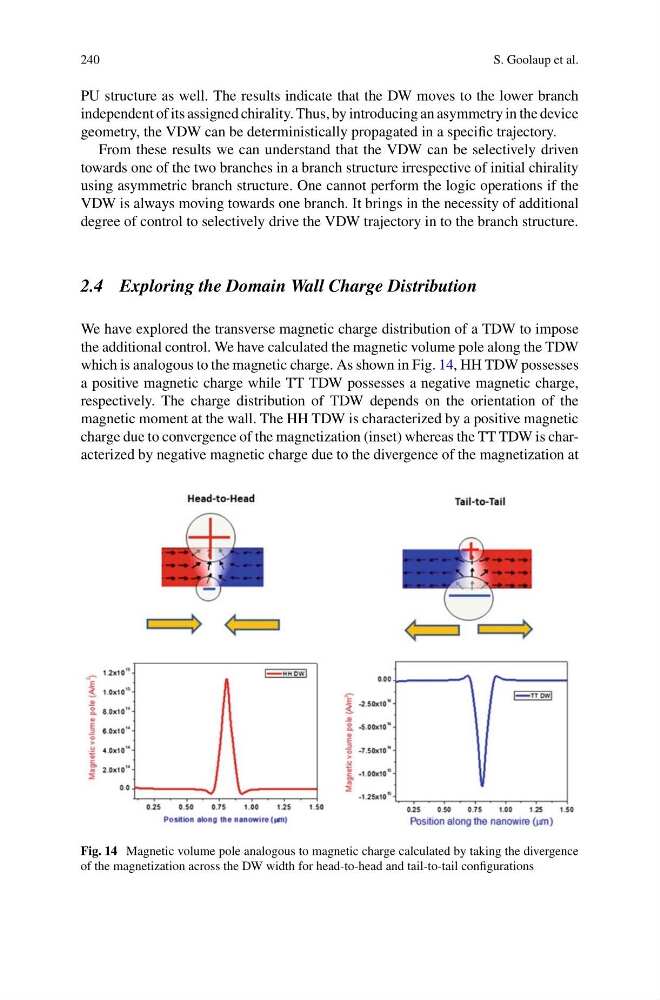
which is analogous to the magnetic charge. As shown in Fig. 14, HH TDW possesses
a positive magnetic charge while TT TDW possesses a negative magnetic charge,
respectively. The charge distribution of TDW depends on the orientation of the
magnetic moment at the wall. The HH TDW is characterized by a positive magnetic
charge due to convergence of the magnetization (inset) whereas the TT TDW is characterized by negative magnetic charge due to the divergence of the magnetization at
Fig. 14 Magnetic volume pole analogous to magnetic charge calculated by taking the divergence
of the magnetization across the DW width for head-to-head and tail-to-tail configurations
S. Goolaup et al.
PU structure as well. The results indicate that the DW moves to the lower branch
independent of its assigned chirality. Thus, by introducing an asymmetry in the device
geometry, the VDW can be deterministically propagated in a specific trajectory.
From these results we can understand that the VDW can be selectively driven
towards one of the two branches in a branch structure irrespective of initial chirality
using asymmetric branch structure. One cannot perform the logic operations if the
VDW is always moving towards one branch. It brings in the necessity of additional
degree of control to selectively drive the VDW trajectory in to the branch structure.
2.4 Exploring the Domain Wall Charge Distribution
We have explored the transverse magnetic charge distribution of a TDW to impose
the additional control. We have calculated the magnetic volume pole along the TDW
which is analogous to the magnetic charge. As shown in Fig. 14, HH TDW possesses
a positive magnetic charge while TT TDW possesses a negative magnetic charge,
respectively. The charge distribution of TDW depends on the orientation of the
magnetic moment at the wall. The HH TDW is characterized by a positive magnetic
charge due to convergence of the magnetization (inset) whereas the TT TDW is characterized by negative magnetic charge due to the divergence of the magnetization at
Fig. 14 Magnetic volume pole analogous to magnetic charge calculated by taking the divergence
of the magnetization across the DW width for head-to-head and tail-to-tail configurations