

Domain Wall Programmable Magnetic Logic
235
structure depending on its initial chirality [36]. This method is found to be robust
that sorting mechanism is insensitive to the angle between the two branches to the
strong topological protection coming from the topological edge defects constituted
within the VDW. However, this structure sorts the VDWs based on their chirality at
the bifurcation only.
If the VDW chirality is not stable and switches during its motion towards the
bifurcation, the VDW sorter may direct the VDW towards a wrong branch irrespective
of its initial chirality. The switching of the chirality during the DW driving can
happen due to the continuous precession of the DW structure when the driving field
is sufficiently higher due to Walker breakdown phenomenon.
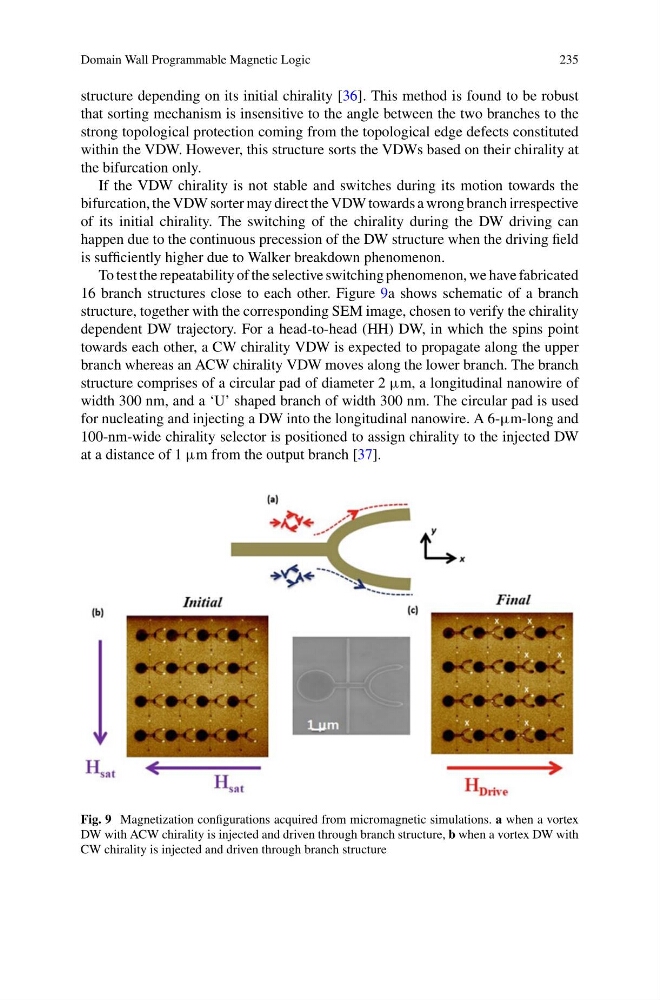
To test the repeatability of the selective switching phenomenon, we have fabricated
16 branch structures close to each other. Figure 9a shows schematic of a branch
structure, together with the corresponding SEM image, chosen to verify the chirality
dependent DW trajectory. For a head-to-head (HH) DW, in which the spins point
towards each other, a CW chirality VDW is expected to propagate along the upper
branch whereas an ACW chirality VDW moves along the lower branch. The branch
structure comprises of a circular pad of diameter 2 μm, a longitudinal nanowire of
width 300 nm, and a ‘U’ shaped branch of width 300 nm. The circular pad is used
for nucleating and injecting a DW into the longitudinal nanowire. A 6-μm-long and
100-nm-wide chirality selector is positioned to assign chirality to the injected DW
at a distance of 1 μm from the output branch [37].
Fig. 9 Magnetization configurations acquired from micromagnetic simulations. a when a vortex
DW with ACW chirality is injected and driven through branch structure, b when a vortex DW with
CW chirality is injected and driven through branch structure
235
structure depending on its initial chirality [36]. This method is found to be robust
that sorting mechanism is insensitive to the angle between the two branches to the
strong topological protection coming from the topological edge defects constituted
within the VDW. However, this structure sorts the VDWs based on their chirality at
the bifurcation only.
If the VDW chirality is not stable and switches during its motion towards the
bifurcation, the VDW sorter may direct the VDW towards a wrong branch irrespective
of its initial chirality. The switching of the chirality during the DW driving can
happen due to the continuous precession of the DW structure when the driving field
is sufficiently higher due to Walker breakdown phenomenon.
To test the repeatability of the selective switching phenomenon, we have fabricated
16 branch structures close to each other. Figure 9a shows schematic of a branch
structure, together with the corresponding SEM image, chosen to verify the chirality
dependent DW trajectory. For a head-to-head (HH) DW, in which the spins point
towards each other, a CW chirality VDW is expected to propagate along the upper
branch whereas an ACW chirality VDW moves along the lower branch. The branch
structure comprises of a circular pad of diameter 2 μm, a longitudinal nanowire of
width 300 nm, and a ‘U’ shaped branch of width 300 nm. The circular pad is used
for nucleating and injecting a DW into the longitudinal nanowire. A 6-μm-long and
100-nm-wide chirality selector is positioned to assign chirality to the injected DW
at a distance of 1 μm from the output branch [37].
Fig. 9 Magnetization configurations acquired from micromagnetic simulations. a when a vortex
DW with ACW chirality is injected and driven through branch structure, b when a vortex DW with
CW chirality is injected and driven through branch structure