

230
S. Goolaup et al.
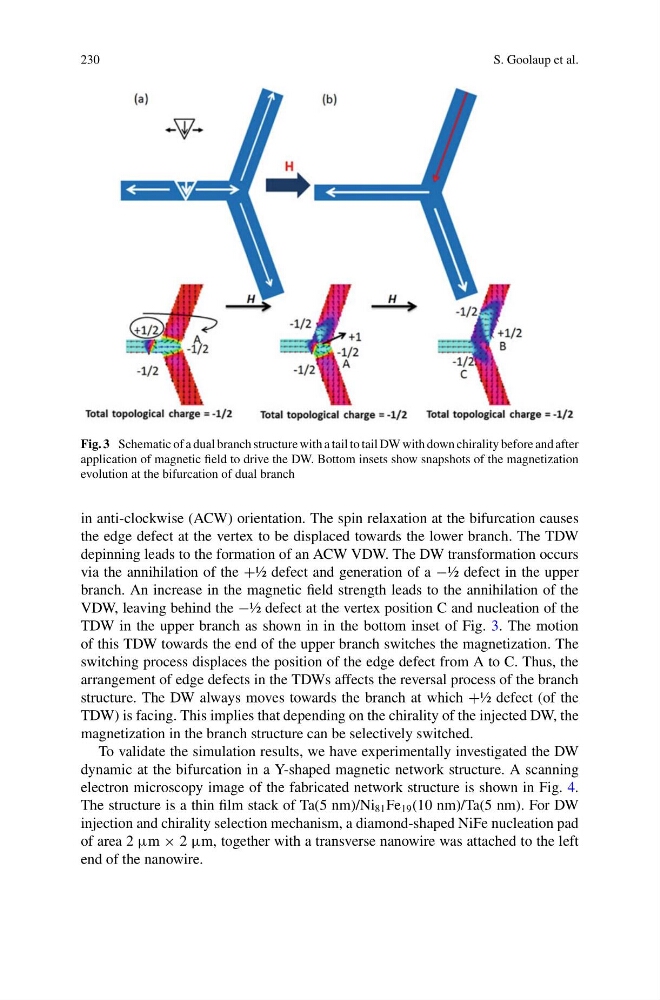
Fig. 3 Schematic of a dual branch structure with a tail to tail DW with down chirality before and after
application of magnetic field to drive the DW. Bottom insets show snapshots of the magnetization
evolution at the bifurcation of dual branch
in anti-clockwise (ACW) orientation. The spin relaxation at the bifurcation causes
the edge defect at the vertex to be displaced towards the lower branch. The TDW
depinning leads to the formation of an ACW VDW. The DW transformation occurs
via the annihilation of the +½ defect and generation of a −½ defect in the upper
branch. An increase in the magnetic field strength leads to the annihilation of the
VDW, leaving behind the −½ defect at the vertex position C and nucleation of the
TDW in the upper branch as shown in in the bottom inset of Fig. 3. The motion
of this TDW towards the end of the upper branch switches the magnetization. The
switching process displaces the position of the edge defect from A to C. Thus, the
arrangement of edge defects in the TDWs affects the reversal process of the branch
structure. The DW always moves towards the branch at which +½ defect (of the
TDW) is facing. This implies that depending on the chirality of the injected DW, the
magnetization in the branch structure can be selectively switched.
To validate the simulation results, we have experimentally investigated the DW
dynamic at the bifurcation in a Y-shaped magnetic network structure. A scanning
electron microscopy image of the fabricated network structure is shown in Fig. 4.
The structure is a thin film stack of Ta(5 nm)/Ni 81 Fe 19 (10 nm)/Ta(5 nm). For DW
injection and chirality selection mechanism, a diamond-shaped NiFe nucleation pad
of area 2 μm × 2 μm, together with a transverse nanowire was attached to the left
end of the nanowire.
S. Goolaup et al.
Fig. 3 Schematic of a dual branch structure with a tail to tail DW with down chirality before and after
application of magnetic field to drive the DW. Bottom insets show snapshots of the magnetization
evolution at the bifurcation of dual branch
in anti-clockwise (ACW) orientation. The spin relaxation at the bifurcation causes
the edge defect at the vertex to be displaced towards the lower branch. The TDW
depinning leads to the formation of an ACW VDW. The DW transformation occurs
via the annihilation of the +½ defect and generation of a −½ defect in the upper
branch. An increase in the magnetic field strength leads to the annihilation of the
VDW, leaving behind the −½ defect at the vertex position C and nucleation of the
TDW in the upper branch as shown in in the bottom inset of Fig. 3. The motion
of this TDW towards the end of the upper branch switches the magnetization. The
switching process displaces the position of the edge defect from A to C. Thus, the
arrangement of edge defects in the TDWs affects the reversal process of the branch
structure. The DW always moves towards the branch at which +½ defect (of the
TDW) is facing. This implies that depending on the chirality of the injected DW, the
magnetization in the branch structure can be selectively switched.
To validate the simulation results, we have experimentally investigated the DW
dynamic at the bifurcation in a Y-shaped magnetic network structure. A scanning
electron microscopy image of the fabricated network structure is shown in Fig. 4.
The structure is a thin film stack of Ta(5 nm)/Ni 81 Fe 19 (10 nm)/Ta(5 nm). For DW
injection and chirality selection mechanism, a diamond-shaped NiFe nucleation pad
of area 2 μm × 2 μm, together with a transverse nanowire was attached to the left
end of the nanowire.