

Domain Wall Programmable Magnetic Logic
227
2.1 Domain Wall Selective Switching
In thin film narrow magnetic nanowires, the TDW is the stable configuration. TDWs
are characterized by a magnetostatic charge; positive for head-to head (HH) DWs
where the magnetizations are pointing towards each other and negative for tail to tail
(TT) DWs when magnetizations are pointing away. In wider and thicker nanostructures, vortex DWs (VDW) are stable configurations and are characterized by the spins
curling around a vortex core. In narrow and thin nanostructures, TDWs are stabilized, with spins converging or diverging along a transverse orientation orthogonal
to the nanowire magnetization. Both VDW and TDW intrinsically possess a chirality
which determine the orientation of the spins as the magnetization changes from one
domain to another. The directionality (chirality) of the spin rotation can be either
clockwise (CW) or anti-clockwise (ACW). The transverse component of the TDW
gives the sense of rotation of the spins within the wall, leading the TDW chirality.
The chirality of the wall can be defined as either “UP” or “DOWN”, reflecting the
orientation of the transverse component of the wall. The spins within the TDW (along
y-direction) with 90° and 270° rotation with respect to the nanowire magnetization
(along +x), are referred to as “UP” (U) and “DOWN” (D) chirality, respectively.
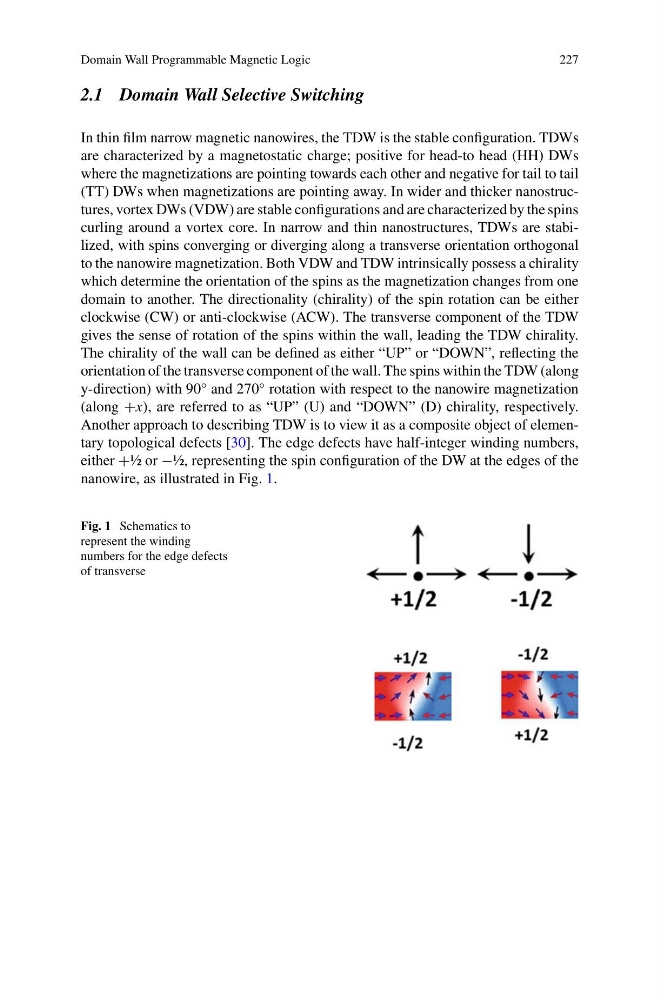
Another approach to describing TDW is to view it as a composite object of elementary topological defects [30]. The edge defects have half-integer winding numbers,
either +½ or −½, representing the spin configuration of the DW at the edges of the
nanowire, as illustrated in Fig. 1.
Fig. 1 Schematics to
represent the winding
numbers for the edge defects
of transverse
227
2.1 Domain Wall Selective Switching
In thin film narrow magnetic nanowires, the TDW is the stable configuration. TDWs
are characterized by a magnetostatic charge; positive for head-to head (HH) DWs
where the magnetizations are pointing towards each other and negative for tail to tail
(TT) DWs when magnetizations are pointing away. In wider and thicker nanostructures, vortex DWs (VDW) are stable configurations and are characterized by the spins
curling around a vortex core. In narrow and thin nanostructures, TDWs are stabilized, with spins converging or diverging along a transverse orientation orthogonal
to the nanowire magnetization. Both VDW and TDW intrinsically possess a chirality
which determine the orientation of the spins as the magnetization changes from one
domain to another. The directionality (chirality) of the spin rotation can be either
clockwise (CW) or anti-clockwise (ACW). The transverse component of the TDW
gives the sense of rotation of the spins within the wall, leading the TDW chirality.
The chirality of the wall can be defined as either “UP” or “DOWN”, reflecting the
orientation of the transverse component of the wall. The spins within the TDW (along
y-direction) with 90° and 270° rotation with respect to the nanowire magnetization
(along +x), are referred to as “UP” (U) and “DOWN” (D) chirality, respectively.
Another approach to describing TDW is to view it as a composite object of elementary topological defects [30]. The edge defects have half-integer winding numbers,
either +½ or −½, representing the spin configuration of the DW at the edges of the
nanowire, as illustrated in Fig. 1.
Fig. 1 Schematics to
represent the winding
numbers for the edge defects
of transverse