

196
K. Lee et al.
skyrmion along these two axes are given as:
˙
R x =
⎛
⎜
⎝
β
α
+
α − β
α 3
˜
D/G
2 + α
⎞
⎟
⎠u
(8)
˙
R y =
(α − β)( ˜
D/G)
α 2
˜
D/G
2 + 1
u
(9)
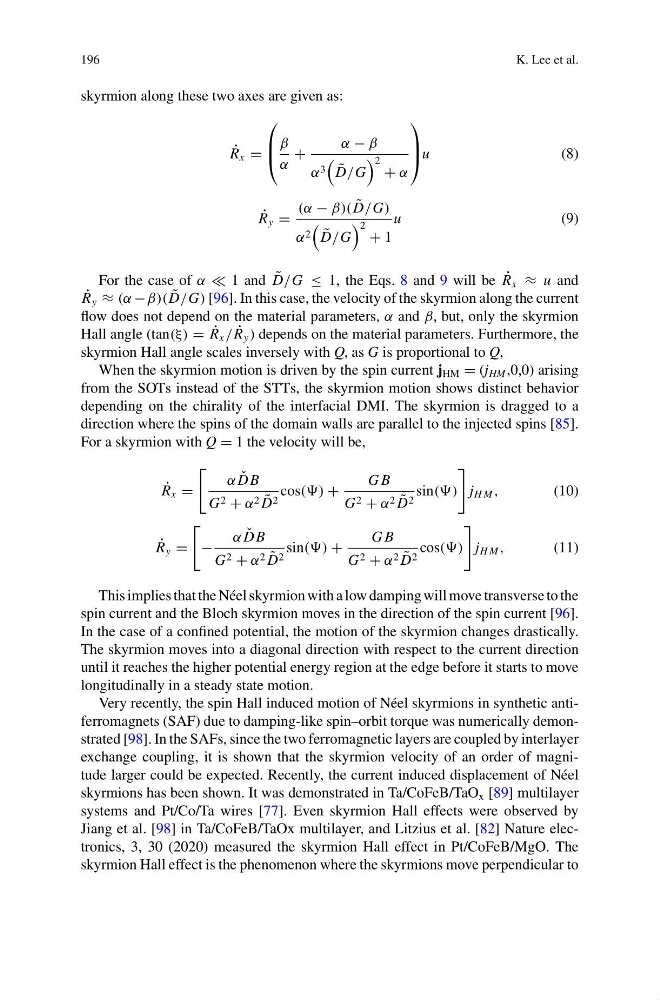
For the case of α 1 and ˜
D/G ≤ 1, the Eqs. 8 and 9 will be ˙
R x ≈ u and
˙
R y ≈ (α −β)( ˜
D/G) [96]. In this case, the velocity of the skyrmion along the current
flow does not depend on the material parameters, α and β, but, only the skyrmion
Hall angle (tan(ξ) = ˙
R x / ˙
R y ) depends on the material parameters. Furthermore, the
skyrmion Hall angle scales inversely with Q, as G is proportional to Q,
When the skyrmion motion is driven by the spin current j HM = (j HM ,0,0) arising
from the SOTs instead of the STTs, the skyrmion motion shows distinct behavior
depending on the chirality of the interfacial DMI. The skyrmion is dragged to a
direction where the spins of the domain walls are parallel to the injected spins [85].
For a skyrmion with Q = 1 the velocity will be,
˙
R x =
α ˇ
D B
G 2 + α 2 ˜
D 2
cos() +
G B
G 2 + α 2 ˜
D 2
sin(()
j H M ,
(10)
˙
R y =
−
α ˇ
D B
G 2 + α 2 ˜
D 2
sin() +
G B
G 2 + α 2 ˜
D 2
cos(()
j H M ,
(11)
This implies that the Néel skyrmion with a low damping will move transverse to the
spin current and the Bloch skyrmion moves in the direction of the spin current [96].
In the case of a confined potential, the motion of the skyrmion changes drastically.
The skyrmion moves into a diagonal direction with respect to the current direction
until it reaches the higher potential energy region at the edge before it starts to move
longitudinally in a steady state motion.
Very recently, the spin Hall induced motion of Néel skyrmions in synthetic antiferromagnets (SAF) due to damping-like spin–orbit torque was numerically demonstrated [98]. In the SAFs, since the two ferromagnetic layers are coupled by interlayer
exchange coupling, it is shown that the skyrmion velocity of an order of magnitude larger could be expected. Recently, the current induced displacement of Néel
skyrmions has been shown. It was demonstrated in Ta/CoFeB/TaO x [89] multilayer
systems and Pt/Co/Ta wires [77]. Even skyrmion Hall effects were observed by
Jiang et al. [98] in Ta/CoFeB/TaOx multilayer, and Litzius et al. [82] Nature electronics, 3, 30 (2020) measured the skyrmion Hall effect in Pt/CoFeB/MgO. The
skyrmion Hall effect is the phenomenon where the skyrmions move perpendicular to
K. Lee et al.
skyrmion along these two axes are given as:
˙
R x =
⎛
⎜
⎝
β
α
+
α − β
α 3
˜
D/G
2 + α
⎞
⎟
⎠u
(8)
˙
R y =
(α − β)( ˜
D/G)
α 2
˜
D/G
2 + 1
u
(9)
For the case of α 1 and ˜
D/G ≤ 1, the Eqs. 8 and 9 will be ˙
R x ≈ u and
˙
R y ≈ (α −β)( ˜
D/G) [96]. In this case, the velocity of the skyrmion along the current
flow does not depend on the material parameters, α and β, but, only the skyrmion
Hall angle (tan(ξ) = ˙
R x / ˙
R y ) depends on the material parameters. Furthermore, the
skyrmion Hall angle scales inversely with Q, as G is proportional to Q,
When the skyrmion motion is driven by the spin current j HM = (j HM ,0,0) arising
from the SOTs instead of the STTs, the skyrmion motion shows distinct behavior
depending on the chirality of the interfacial DMI. The skyrmion is dragged to a
direction where the spins of the domain walls are parallel to the injected spins [85].
For a skyrmion with Q = 1 the velocity will be,
˙
R x =
α ˇ
D B
G 2 + α 2 ˜
D 2
cos() +
G B
G 2 + α 2 ˜
D 2
sin(()
j H M ,
(10)
˙
R y =
−
α ˇ
D B
G 2 + α 2 ˜
D 2
sin() +
G B
G 2 + α 2 ˜
D 2
cos(()
j H M ,
(11)
This implies that the Néel skyrmion with a low damping will move transverse to the
spin current and the Bloch skyrmion moves in the direction of the spin current [96].
In the case of a confined potential, the motion of the skyrmion changes drastically.
The skyrmion moves into a diagonal direction with respect to the current direction
until it reaches the higher potential energy region at the edge before it starts to move
longitudinally in a steady state motion.
Very recently, the spin Hall induced motion of Néel skyrmions in synthetic antiferromagnets (SAF) due to damping-like spin–orbit torque was numerically demonstrated [98]. In the SAFs, since the two ferromagnetic layers are coupled by interlayer
exchange coupling, it is shown that the skyrmion velocity of an order of magnitude larger could be expected. Recently, the current induced displacement of Néel
skyrmions has been shown. It was demonstrated in Ta/CoFeB/TaO x [89] multilayer
systems and Pt/Co/Ta wires [77]. Even skyrmion Hall effects were observed by
Jiang et al. [98] in Ta/CoFeB/TaOx multilayer, and Litzius et al. [82] Nature electronics, 3, 30 (2020) measured the skyrmion Hall effect in Pt/CoFeB/MgO. The
skyrmion Hall effect is the phenomenon where the skyrmions move perpendicular to