

190
K. Lee et al.
of the Néel wall is determined by the growth order of the Fe/Ni thin films, supporting
the inversion-symmetry breaking mechanism of the DMI at the Fe/Ni interface.
3.2.2 Asymmetric Domain Wall Dynamics
In addition to the imaging techniques, there have been a lot of experimental effort
to discover the interfacial DMI and quantify its strength through other measurement
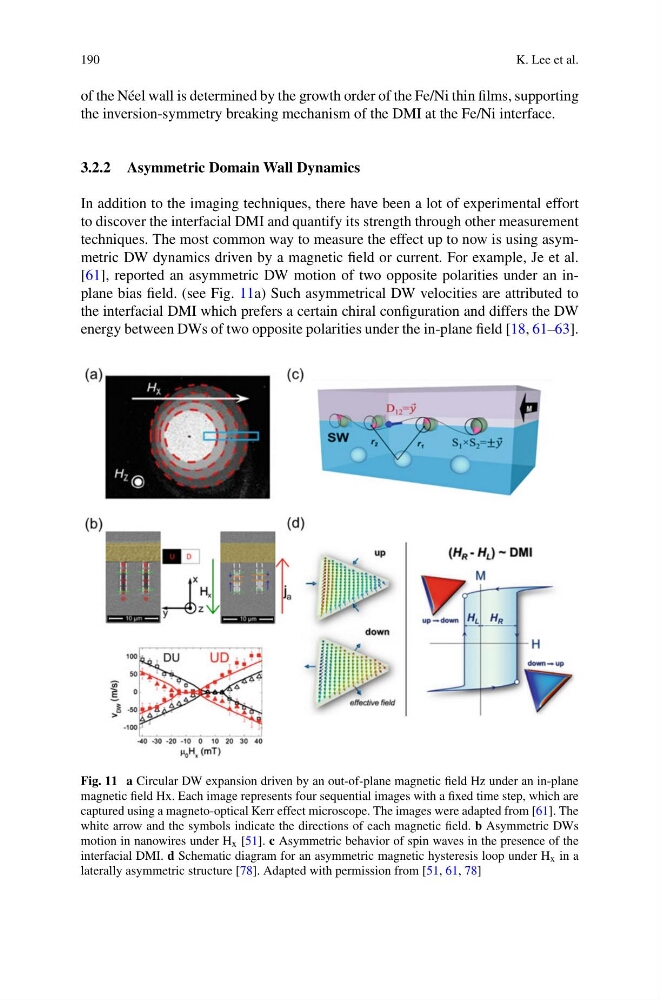
techniques. The most common way to measure the effect up to now is using asymmetric DW dynamics driven by a magnetic field or current. For example, Je et al.
[61], reported an asymmetric DW motion of two opposite polarities under an inplane bias field. (see Fig. 11a) Such asymmetrical DW velocities are attributed to
the interfacial DMI which prefers a certain chiral configuration and differs the DW
energy between DWs of two opposite polarities under the in-plane field [18, 61–63].
Fig. 11 a Circular DW expansion driven by an out-of-plane magnetic field Hz under an in-plane
magnetic field Hx. Each image represents four sequential images with a fixed time step, which are
captured using a magneto-optical Kerr effect microscope. The images were adapted from [61]. The
white arrow and the symbols indicate the directions of each magnetic field. b Asymmetric DWs
motion in nanowires under H x [51]. c Asymmetric behavior of spin waves in the presence of the
interfacial DMI. d Schematic diagram for an asymmetric magnetic hysteresis loop under H x in a
laterally asymmetric structure [78]. Adapted with permission from [51, 61, 78]
K. Lee et al.
of the Néel wall is determined by the growth order of the Fe/Ni thin films, supporting
the inversion-symmetry breaking mechanism of the DMI at the Fe/Ni interface.
3.2.2 Asymmetric Domain Wall Dynamics
In addition to the imaging techniques, there have been a lot of experimental effort
to discover the interfacial DMI and quantify its strength through other measurement
techniques. The most common way to measure the effect up to now is using asymmetric DW dynamics driven by a magnetic field or current. For example, Je et al.
[61], reported an asymmetric DW motion of two opposite polarities under an inplane bias field. (see Fig. 11a) Such asymmetrical DW velocities are attributed to
the interfacial DMI which prefers a certain chiral configuration and differs the DW
energy between DWs of two opposite polarities under the in-plane field [18, 61–63].
Fig. 11 a Circular DW expansion driven by an out-of-plane magnetic field Hz under an in-plane
magnetic field Hx. Each image represents four sequential images with a fixed time step, which are
captured using a magneto-optical Kerr effect microscope. The images were adapted from [61]. The
white arrow and the symbols indicate the directions of each magnetic field. b Asymmetric DWs
motion in nanowires under H x [51]. c Asymmetric behavior of spin waves in the presence of the
interfacial DMI. d Schematic diagram for an asymmetric magnetic hysteresis loop under H x in a
laterally asymmetric structure [78]. Adapted with permission from [51, 61, 78]