

12
P. K. Muduli et al.
4
6
8
0
10
20
30
Frequency [GHz]
FFT [arb.]
4
6
8
0
5
10
FFT [arb.]
Frequency [GHz]
(a)
(b)
(c)
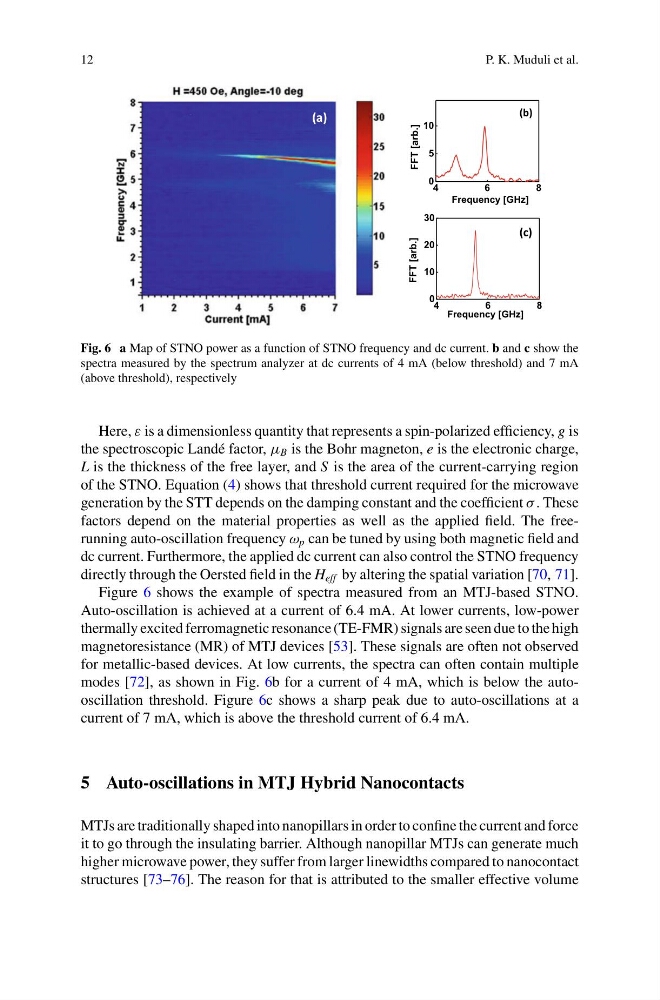
Fig. 6 a Map of STNO power as a function of STNO frequency and dc current. b and c show the
spectra measured by the spectrum analyzer at dc currents of 4 mA (below threshold) and 7 mA
(above threshold), respectively
Here, ε is a dimensionless quantity that represents a spin-polarized efficiency, g is
the spectroscopic Landé factor, μ B is the Bohr magneton, e is the electronic charge,
L is the thickness of the free layer, and S is the area of the current-carrying region
of the STNO. Equation (4) shows that threshold current required for the microwave
generation by the STT depends on the damping constant and the coefficient σ . These
factors depend on the material properties as well as the applied field. The freerunning auto-oscillation frequency ω p can be tuned by using both magnetic field and
dc current. Furthermore, the applied dc current can also control the STNO frequency
directly through the Oersted field in the H eff by altering the spatial variation [70, 71].
Figure 6 shows the example of spectra measured from an MTJ-based STNO.
Auto-oscillation is achieved at a current of 6.4 mA. At lower currents, low-power
thermally excited ferromagnetic resonance (TE-FMR) signals are seen due to the high
magnetoresistance (MR) of MTJ devices [53]. These signals are often not observed
for metallic-based devices. At low currents, the spectra can often contain multiple
modes [72], as shown in Fig. 6b for a current of 4 mA, which is below the autooscillation threshold. Figure 6c shows a sharp peak due to auto-oscillations at a
current of 7 mA, which is above the threshold current of 6.4 mA.
5 Auto-oscillations in MTJ Hybrid Nanocontacts
MTJs are traditionally shaped into nanopillars in order to confine the current and force
it to go through the insulating barrier. Although nanopillar MTJs can generate much
higher microwave power, they suffer from larger linewidths compared to nanocontact
structures [73–76]. The reason for that is attributed to the smaller effective volume
P. K. Muduli et al.
4
6
8
0
10
20
30
Frequency [GHz]
FFT [arb.]
4
6
8
0
5
10
FFT [arb.]
Frequency [GHz]
(a)
(b)
(c)
Fig. 6 a Map of STNO power as a function of STNO frequency and dc current. b and c show the
spectra measured by the spectrum analyzer at dc currents of 4 mA (below threshold) and 7 mA
(above threshold), respectively
Here, ε is a dimensionless quantity that represents a spin-polarized efficiency, g is
the spectroscopic Landé factor, μ B is the Bohr magneton, e is the electronic charge,
L is the thickness of the free layer, and S is the area of the current-carrying region
of the STNO. Equation (4) shows that threshold current required for the microwave
generation by the STT depends on the damping constant and the coefficient σ . These
factors depend on the material properties as well as the applied field. The freerunning auto-oscillation frequency ω p can be tuned by using both magnetic field and
dc current. Furthermore, the applied dc current can also control the STNO frequency
directly through the Oersted field in the H eff by altering the spatial variation [70, 71].
Figure 6 shows the example of spectra measured from an MTJ-based STNO.
Auto-oscillation is achieved at a current of 6.4 mA. At lower currents, low-power
thermally excited ferromagnetic resonance (TE-FMR) signals are seen due to the high
magnetoresistance (MR) of MTJ devices [53]. These signals are often not observed
for metallic-based devices. At low currents, the spectra can often contain multiple
modes [72], as shown in Fig. 6b for a current of 4 mA, which is below the autooscillation threshold. Figure 6c shows a sharp peak due to auto-oscillations at a
current of 7 mA, which is above the threshold current of 6.4 mA.
5 Auto-oscillations in MTJ Hybrid Nanocontacts
MTJs are traditionally shaped into nanopillars in order to confine the current and force
it to go through the insulating barrier. Although nanopillar MTJs can generate much
higher microwave power, they suffer from larger linewidths compared to nanocontact
structures [73–76]. The reason for that is attributed to the smaller effective volume