

Microwave Oscillators and Detectors Based …
11
4 Auto-oscillations in MTJ Nanopillar
The term “auto-oscillatory phenomenon” refers to the generation of periodic signals
when the input signal is not periodic [61]. In case of STNOs, input in the form of dc
bias leads to a nonideal sinusoidal signal that is periodic in nature and which shows
some phase deviation. Here, the auto-oscillations in STNOs are because of the STT,
which provides sufficient energy for the local magnetization of the free layers and
acts opposite to the natural damping force. Slavin and Tiberkevich [14] provided
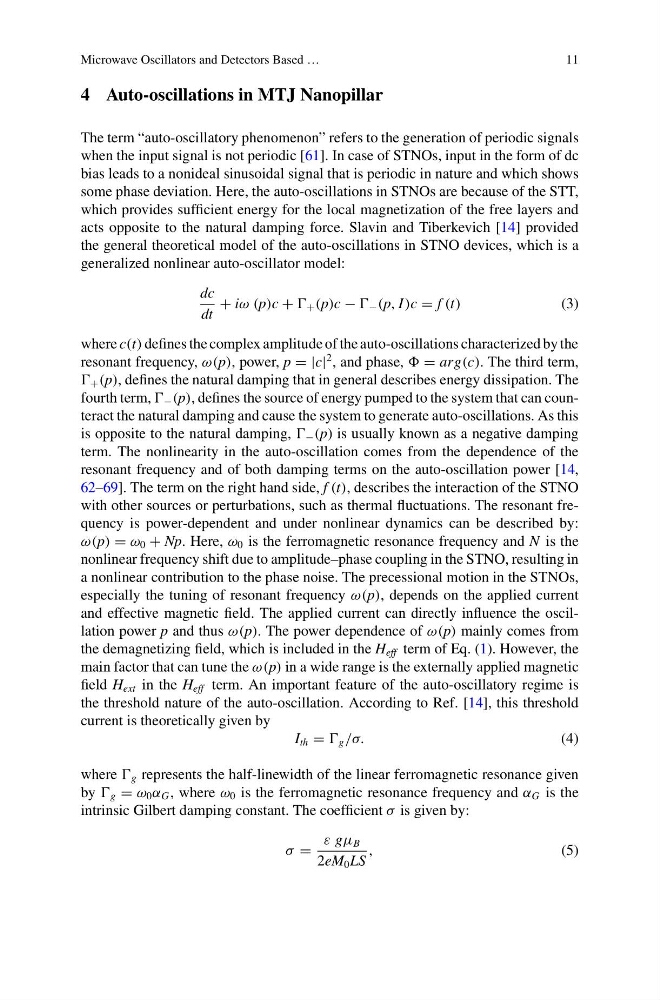
the general theoretical model of the auto-oscillations in STNO devices, which is a
generalized nonlinear auto-oscillator model:
dc
dt
+ iω (p)c + + (p)c − − (p, I )c = f (t)
(3)
where c(t) defines the complex amplitude of the auto-oscillations characterized by the
resonant frequency, ω(p), power, p = |c|
2 , and phase, = arg(c). The third term,
+ (p), defines the natural damping that in general describes energy dissipation. The
fourth term, − (p), defines the source of energy pumped to the system that can counteract the natural damping and cause the system to generate auto-oscillations. As this
is opposite to the natural damping, − (p) is usually known as a negative damping
term. The nonlinearity in the auto-oscillation comes from the dependence of the
resonant frequency and of both damping terms on the auto-oscillation power [14,
62–69]. The term on the right hand side, f (t), describes the interaction of the STNO
with other sources or perturbations, such as thermal fluctuations. The resonant frequency is power-dependent and under nonlinear dynamics can be described by:
ω(p) = ω 0 + Np. Here, ω 0 is the ferromagnetic resonance frequency and N is the
nonlinear frequency shift due to amplitude–phase coupling in the STNO, resulting in
a nonlinear contribution to the phase noise. The precessional motion in the STNOs,
especially the tuning of resonant frequency ω(p), depends on the applied current
and effective magnetic field. The applied current can directly influence the oscillation power p and thus ω(p). The power dependence of ω(p) mainly comes from
the demagnetizing field, which is included in the H eff term of Eq. (1). However, the
main factor that can tune the ω(p) in a wide range is the externally applied magnetic
field H ext in the H eff term. An important feature of the auto-oscillatory regime is
the threshold nature of the auto-oscillation. According to Ref. [14], this threshold
current is theoretically given by
I th = g /σ.
(4)
where g represents the half-linewidth of the linear ferromagnetic resonance given
by g = ω 0 α G , where ω 0 is the ferromagnetic resonance frequency and α G is the
intrinsic Gilbert damping constant. The coefficient σ is given by:
σ =
ε gμ B
2eM 0 LS
,
(5)
11
4 Auto-oscillations in MTJ Nanopillar
The term “auto-oscillatory phenomenon” refers to the generation of periodic signals
when the input signal is not periodic [61]. In case of STNOs, input in the form of dc
bias leads to a nonideal sinusoidal signal that is periodic in nature and which shows
some phase deviation. Here, the auto-oscillations in STNOs are because of the STT,
which provides sufficient energy for the local magnetization of the free layers and
acts opposite to the natural damping force. Slavin and Tiberkevich [14] provided
the general theoretical model of the auto-oscillations in STNO devices, which is a
generalized nonlinear auto-oscillator model:
dc
dt
+ iω (p)c + + (p)c − − (p, I )c = f (t)
(3)
where c(t) defines the complex amplitude of the auto-oscillations characterized by the
resonant frequency, ω(p), power, p = |c|
2 , and phase, = arg(c). The third term,
+ (p), defines the natural damping that in general describes energy dissipation. The
fourth term, − (p), defines the source of energy pumped to the system that can counteract the natural damping and cause the system to generate auto-oscillations. As this
is opposite to the natural damping, − (p) is usually known as a negative damping
term. The nonlinearity in the auto-oscillation comes from the dependence of the
resonant frequency and of both damping terms on the auto-oscillation power [14,
62–69]. The term on the right hand side, f (t), describes the interaction of the STNO
with other sources or perturbations, such as thermal fluctuations. The resonant frequency is power-dependent and under nonlinear dynamics can be described by:
ω(p) = ω 0 + Np. Here, ω 0 is the ferromagnetic resonance frequency and N is the
nonlinear frequency shift due to amplitude–phase coupling in the STNO, resulting in
a nonlinear contribution to the phase noise. The precessional motion in the STNOs,
especially the tuning of resonant frequency ω(p), depends on the applied current
and effective magnetic field. The applied current can directly influence the oscillation power p and thus ω(p). The power dependence of ω(p) mainly comes from
the demagnetizing field, which is included in the H eff term of Eq. (1). However, the
main factor that can tune the ω(p) in a wide range is the externally applied magnetic
field H ext in the H eff term. An important feature of the auto-oscillatory regime is
the threshold nature of the auto-oscillation. According to Ref. [14], this threshold
current is theoretically given by
I th = g /σ.
(4)
where g represents the half-linewidth of the linear ferromagnetic resonance given
by g = ω 0 α G , where ω 0 is the ferromagnetic resonance frequency and α G is the
intrinsic Gilbert damping constant. The coefficient σ is given by:
σ =
ε gμ B
2eM 0 LS
,
(5)