

Chiral Magnetic Domain Wall and Skyrmion Memory Devices
177
can be pushed forward or backward by shifting all DWs in the same direction by
the use of an external magnetic field [2] or electric currents [1]. Thus moving these
domain walls result in moving the bits as desired. Then the encoded bits can be read
by the stationary reading element which is a magnetoresistive tunnel junction (MTJ)
on the track (see Fig. 1c). The racetrack memories have many advantages compared
to the conventional memory devices. Compared to the conventional hard disk drive
there are no mechanically moving parts, thus possibly the racetrack memory can be
faster beyond the mechanical limitations, and the problems due to mechanical failure
do not exist. Another possible advantage of this racetrack memory is that it may allow
one to construct three-dimensional devices orienting the racetrack upwards and store
bits in a larger 3-dimensional space (see Fig. 1e), which may result in a high-storage
density while achieving high speed, robustness, and low power consumption similar
to the charge-based solid-state memory devices. To apply the racetrack memories,
first a full understanding of DW motion must be obtained
Given the promising technical aspects, great progress in the racetrack memory
has been made since its first proposal. A proof of concept for the racetrack memory
using fields was demonstrated in soft ferromagnets with an in-plane magnetization
at their remanent state [2, 3]. However, the DW motion driven by magnetic fields has
severe obstacles, especially in the aspect of applications. First, there is a limitation
to localize magnetic fields in small confined areas. This becomes more challenging
to manipulate a DW in a device while keeping the neighboring DWs intact, as the
devices are scaled down. Furthermore, when the DWs are driven by an in-plane
magnetic field, the two adjacent DWs move in opposite directions. Therefore, the
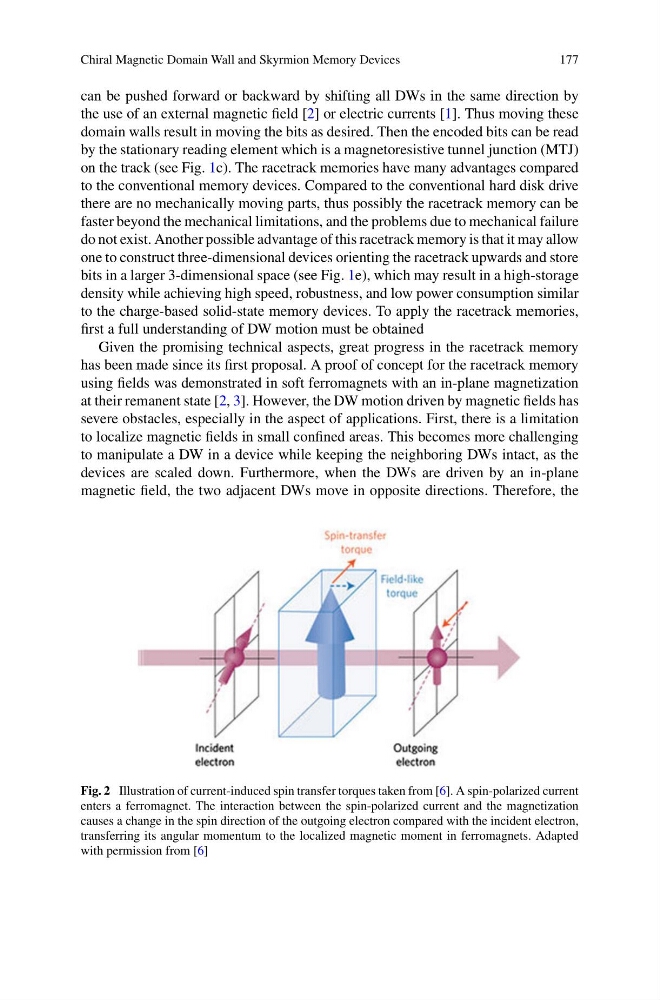
Fig. 2 Illustration of current-induced spin transfer torques taken from [6]. A spin-polarized current
enters a ferromagnet. The interaction between the spin-polarized current and the magnetization
causes a change in the spin direction of the outgoing electron compared with the incident electron,
transferring its angular momentum to the localized magnetic moment in ferromagnets. Adapted
with permission from [6]
177
can be pushed forward or backward by shifting all DWs in the same direction by
the use of an external magnetic field [2] or electric currents [1]. Thus moving these
domain walls result in moving the bits as desired. Then the encoded bits can be read
by the stationary reading element which is a magnetoresistive tunnel junction (MTJ)
on the track (see Fig. 1c). The racetrack memories have many advantages compared
to the conventional memory devices. Compared to the conventional hard disk drive
there are no mechanically moving parts, thus possibly the racetrack memory can be
faster beyond the mechanical limitations, and the problems due to mechanical failure
do not exist. Another possible advantage of this racetrack memory is that it may allow
one to construct three-dimensional devices orienting the racetrack upwards and store
bits in a larger 3-dimensional space (see Fig. 1e), which may result in a high-storage
density while achieving high speed, robustness, and low power consumption similar
to the charge-based solid-state memory devices. To apply the racetrack memories,
first a full understanding of DW motion must be obtained
Given the promising technical aspects, great progress in the racetrack memory
has been made since its first proposal. A proof of concept for the racetrack memory
using fields was demonstrated in soft ferromagnets with an in-plane magnetization
at their remanent state [2, 3]. However, the DW motion driven by magnetic fields has
severe obstacles, especially in the aspect of applications. First, there is a limitation
to localize magnetic fields in small confined areas. This becomes more challenging
to manipulate a DW in a device while keeping the neighboring DWs intact, as the
devices are scaled down. Furthermore, when the DWs are driven by an in-plane
magnetic field, the two adjacent DWs move in opposite directions. Therefore, the
Fig. 2 Illustration of current-induced spin transfer torques taken from [6]. A spin-polarized current
enters a ferromagnet. The interaction between the spin-polarized current and the magnetization
causes a change in the spin direction of the outgoing electron compared with the incident electron,
transferring its angular momentum to the localized magnetic moment in ferromagnets. Adapted
with permission from [6]