

176
K. Lee et al.
spin angular momentum. Particularly, memory storage technologies using magnetic
domain walls (DWs) have been under considerable interest for decades due to their
promising technological aspects, advantageous over the conventional memory technologies with high energy consumption, the volatility of static and dynamic random
access memory (RAM), and slow reading and writing operations. One example of
such an approach is a magnetic domain-wall racetrack memory which was first
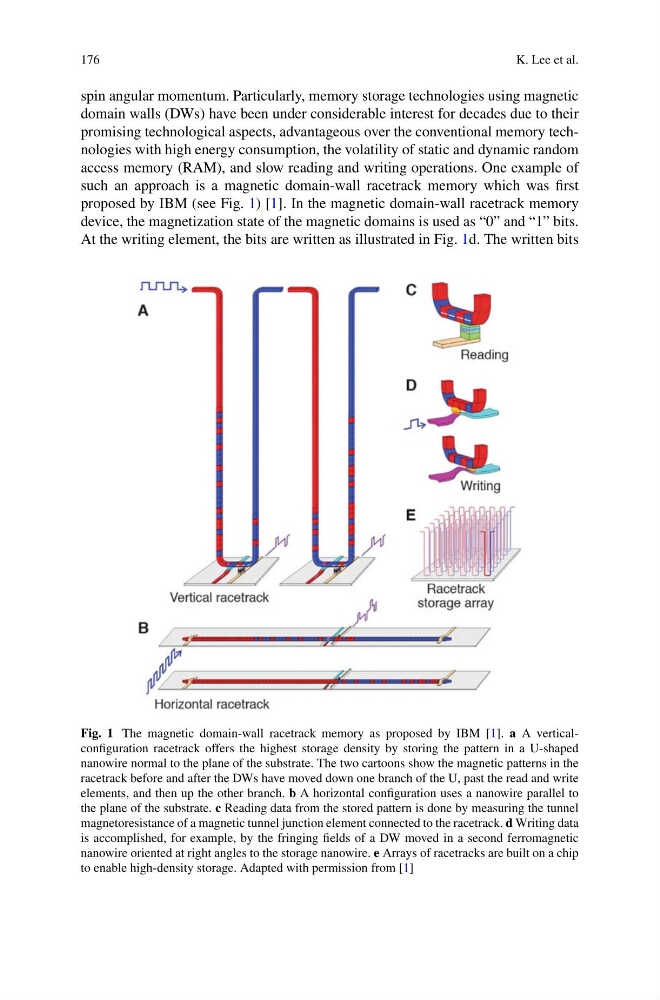
proposed by IBM (see Fig. 1) [1]. In the magnetic domain-wall racetrack memory
device, the magnetization state of the magnetic domains is used as “0” and “1” bits.
At the writing element, the bits are written as illustrated in Fig. 1d. The written bits
Fig. 1 The magnetic domain-wall racetrack memory as proposed by IBM [1]. a A verticalconfiguration racetrack offers the highest storage density by storing the pattern in a U-shaped
nanowire normal to the plane of the substrate. The two cartoons show the magnetic patterns in the
racetrack before and after the DWs have moved down one branch of the U, past the read and write
elements, and then up the other branch. b A horizontal configuration uses a nanowire parallel to
the plane of the substrate. c Reading data from the stored pattern is done by measuring the tunnel
magnetoresistance of a magnetic tunnel junction element connected to the racetrack. d Writing data
is accomplished, for example, by the fringing fields of a DW moved in a second ferromagnetic
nanowire oriented at right angles to the storage nanowire. e Arrays of racetracks are built on a chip
to enable high-density storage. Adapted with permission from [1]
K. Lee et al.
spin angular momentum. Particularly, memory storage technologies using magnetic
domain walls (DWs) have been under considerable interest for decades due to their
promising technological aspects, advantageous over the conventional memory technologies with high energy consumption, the volatility of static and dynamic random
access memory (RAM), and slow reading and writing operations. One example of
such an approach is a magnetic domain-wall racetrack memory which was first
proposed by IBM (see Fig. 1) [1]. In the magnetic domain-wall racetrack memory
device, the magnetization state of the magnetic domains is used as “0” and “1” bits.
At the writing element, the bits are written as illustrated in Fig. 1d. The written bits
Fig. 1 The magnetic domain-wall racetrack memory as proposed by IBM [1]. a A verticalconfiguration racetrack offers the highest storage density by storing the pattern in a U-shaped
nanowire normal to the plane of the substrate. The two cartoons show the magnetic patterns in the
racetrack before and after the DWs have moved down one branch of the U, past the read and write
elements, and then up the other branch. b A horizontal configuration uses a nanowire parallel to
the plane of the substrate. c Reading data from the stored pattern is done by measuring the tunnel
magnetoresistance of a magnetic tunnel junction element connected to the racetrack. d Writing data
is accomplished, for example, by the fringing fields of a DW moved in a second ferromagnetic
nanowire oriented at right angles to the storage nanowire. e Arrays of racetracks are built on a chip
to enable high-density storage. Adapted with permission from [1]