

168
J. Lourembam and J. Huang
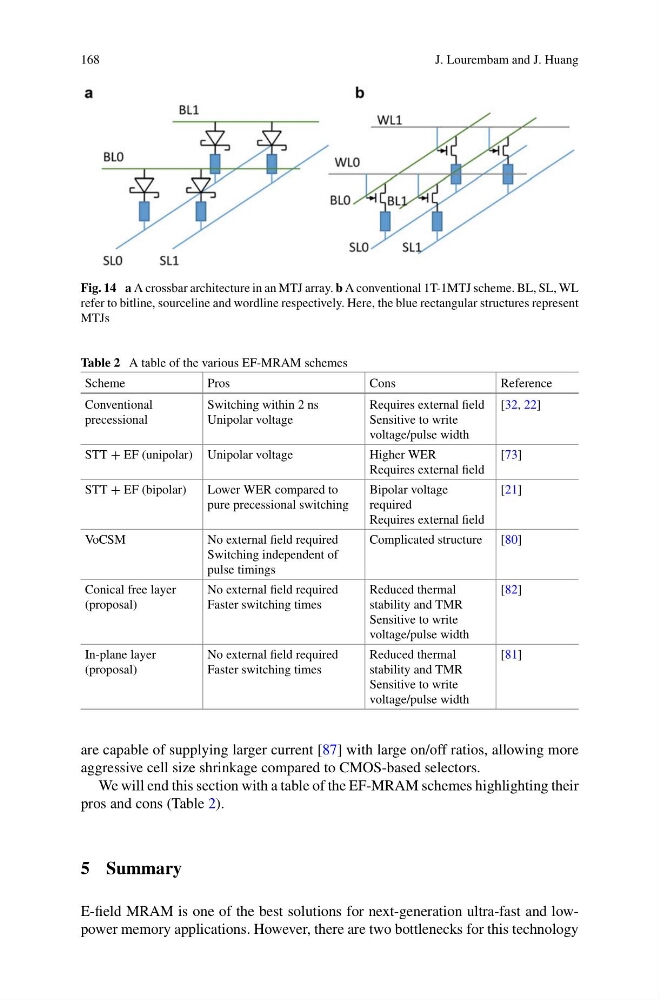
Fig. 14 a A crossbar architecture in an MTJ array. b A conventional 1T-1MTJ scheme. BL, SL, WL
refer to bitline, sourceline and wordline respectively. Here, the blue rectangular structures represent
MTJs
Table 2 A table of the various EF-MRAM schemes
Scheme
Pros
Cons
Reference
Conventional
precessional
Switching within 2 ns
Unipolar voltage
Requires external field
Sensitive to write
voltage/pulse width
[32, 22]
STT + EF (unipolar) Unipolar voltage
Higher WER
Requires external field
[73]
STT + EF (bipolar)
Lower WER compared to
pure precessional switching
Bipolar voltage
required
Requires external field
[21]
VoCSM
No external field required
Switching independent of
pulse timings
Complicated structure [80]
Conical free layer
(proposal)
No external field required
Faster switching times
Reduced thermal
stability and TMR
Sensitive to write
voltage/pulse width
[82]
In-plane layer
(proposal)
No external field required
Faster switching times
Reduced thermal
stability and TMR
Sensitive to write
voltage/pulse width
[81]
are capable of supplying larger current [87] with large on/off ratios, allowing more
aggressive cell size shrinkage compared to CMOS-based selectors.
We will end this section with a table of the EF-MRAM schemes highlighting their
pros and cons (Table 2).
5 Summary
E-field MRAM is one of the best solutions for next-generation ultra-fast and lowpower memory applications. However, there are two bottlenecks for this technology
J. Lourembam and J. Huang
Fig. 14 a A crossbar architecture in an MTJ array. b A conventional 1T-1MTJ scheme. BL, SL, WL
refer to bitline, sourceline and wordline respectively. Here, the blue rectangular structures represent
MTJs
Table 2 A table of the various EF-MRAM schemes
Scheme
Pros
Cons
Reference
Conventional
precessional
Switching within 2 ns
Unipolar voltage
Requires external field
Sensitive to write
voltage/pulse width
[32, 22]
STT + EF (unipolar) Unipolar voltage
Higher WER
Requires external field
[73]
STT + EF (bipolar)
Lower WER compared to
pure precessional switching
Bipolar voltage
required
Requires external field
[21]
VoCSM
No external field required
Switching independent of
pulse timings
Complicated structure [80]
Conical free layer
(proposal)
No external field required
Faster switching times
Reduced thermal
stability and TMR
Sensitive to write
voltage/pulse width
[82]
In-plane layer
(proposal)
No external field required
Faster switching times
Reduced thermal
stability and TMR
Sensitive to write
voltage/pulse width
[81]
are capable of supplying larger current [87] with large on/off ratios, allowing more
aggressive cell size shrinkage compared to CMOS-based selectors.
We will end this section with a table of the EF-MRAM schemes highlighting their
pros and cons (Table 2).
5 Summary
E-field MRAM is one of the best solutions for next-generation ultra-fast and lowpower memory applications. However, there are two bottlenecks for this technology