

Microwave Oscillators and Detectors Based …
9
by Kubota et al. [57]. The results of Sankey et al. [32] and Kubota et al. [57] are
summarized in Fig. 3.
On the other hand, Petit et al. [52] measured the change in resonance frequency
as a function of bias current in circular Al 2 O 3 -based MTJs and concluded from the
observed changes that the τ ⊥ is linearly proportional to the biasing current density,
and thus changes sign with bias voltage. This result was in qualitative agreement
with the measurement of Li et al. [50], who extracted the perpendicular torque by
measuring the switching current of MgO MTJs, and by carefully accounting for heating effects due to the rather large current densities required for switching. However,
since the measurements by Li et al. [50] were based on switching currents, the voltage
range used was necessarily higher, approximately 0.5 V–1.0 V, than those of Sankey
et al. [32] and Kubota et al. [57]. Measurements of the perpendicular spin-torque
effect in asymmetric MgO MTJs (where the fixed and free layers were not identical)
were carried out by Oh et al. [54]. The perpendicular spin torque τ ⊥ was obtained
by fitting plots of the FL magnetic configuration relative to that of the fixed layer as
function of applied external field and bias voltage, and showed that there is a linear
term in the dependence of perpendicular spin-torque effective field on bias voltage,
in addition to a quadratic one, in agreement with theoretical predictions [58].
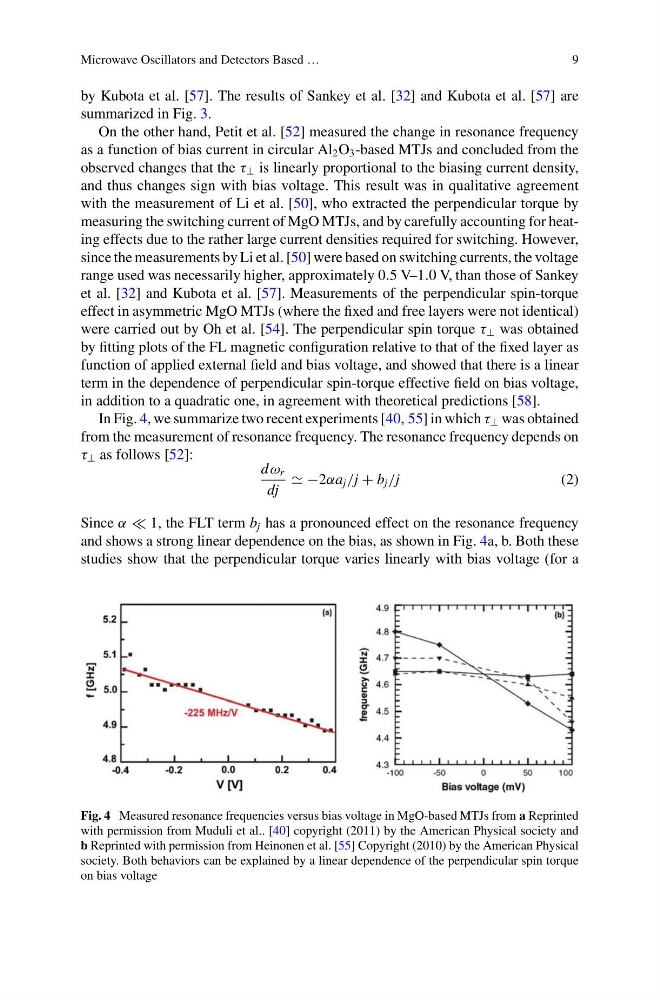
In Fig. 4, we summarize two recent experiments [40, 55] in which τ ⊥ was obtained
from the measurement of resonance frequency. The resonance frequency depends on
τ ⊥ as follows [52]:
d ω r
dj
−2αa j /j + b j /j
(2)
Since α 1, the FLT term b j has a pronounced effect on the resonance frequency
and shows a strong linear dependence on the bias, as shown in Fig. 4a, b. Both these
studies show that the perpendicular torque varies linearly with bias voltage (for a
Fig. 4 Measured resonance frequencies versus bias voltage in MgO-based MTJs from a Reprinted
with permission from Muduli et al.. [40] copyright (2011) by the American Physical society and
b Reprinted with permission from Heinonen et al. [55] Copyright (2010) by the American Physical
society. Both behaviors can be explained by a linear dependence of the perpendicular spin torque
on bias voltage
9
by Kubota et al. [57]. The results of Sankey et al. [32] and Kubota et al. [57] are
summarized in Fig. 3.
On the other hand, Petit et al. [52] measured the change in resonance frequency
as a function of bias current in circular Al 2 O 3 -based MTJs and concluded from the
observed changes that the τ ⊥ is linearly proportional to the biasing current density,
and thus changes sign with bias voltage. This result was in qualitative agreement
with the measurement of Li et al. [50], who extracted the perpendicular torque by
measuring the switching current of MgO MTJs, and by carefully accounting for heating effects due to the rather large current densities required for switching. However,
since the measurements by Li et al. [50] were based on switching currents, the voltage
range used was necessarily higher, approximately 0.5 V–1.0 V, than those of Sankey
et al. [32] and Kubota et al. [57]. Measurements of the perpendicular spin-torque
effect in asymmetric MgO MTJs (where the fixed and free layers were not identical)
were carried out by Oh et al. [54]. The perpendicular spin torque τ ⊥ was obtained
by fitting plots of the FL magnetic configuration relative to that of the fixed layer as
function of applied external field and bias voltage, and showed that there is a linear
term in the dependence of perpendicular spin-torque effective field on bias voltage,
in addition to a quadratic one, in agreement with theoretical predictions [58].
In Fig. 4, we summarize two recent experiments [40, 55] in which τ ⊥ was obtained
from the measurement of resonance frequency. The resonance frequency depends on
τ ⊥ as follows [52]:
d ω r
dj
−2αa j /j + b j /j
(2)
Since α 1, the FLT term b j has a pronounced effect on the resonance frequency
and shows a strong linear dependence on the bias, as shown in Fig. 4a, b. Both these
studies show that the perpendicular torque varies linearly with bias voltage (for a
Fig. 4 Measured resonance frequencies versus bias voltage in MgO-based MTJs from a Reprinted
with permission from Muduli et al.. [40] copyright (2011) by the American Physical society and
b Reprinted with permission from Heinonen et al. [55] Copyright (2010) by the American Physical
society. Both behaviors can be explained by a linear dependence of the perpendicular spin torque
on bias voltage