

8
P. K. Muduli et al.
d ˆ
m
dt
= −γ [ ˆ
m × ˆ
H eff ] + α
ˆ
m ×
d ˆ
m
dt
+
γ
μ 0 M S
[a j ( ˆ
m × ( ˆ
m × ˆ
p)) + b j ( ˆ
m × ˆ
p)]
(1)
where ˆ
m is the normalized magnetic moment (| ˆ
m| = M free /M sat ), γ is the gyromagnetic ratio of the electron, M sat is the saturation magnetization, ˆ
H eff is the effective
external field, and ˆ
p is the direction of the fixed layer with φ as the angle between
free and fixed layer. The coefficients a j and b j represent the strengths of τ and τ ⊥
respectively. When current is injected into the free layer, depending on the current
direction, τ will either support the damping or act opposite as an anti-damping
source. However, τ ⊥ can simulate the action of the field on M free , which can also
modify the energy variations in the free layer magnetization.
Measuring the spin-torque magnitude and direction in MTJ-STNOs, especially
as a function of bias voltage, is crucial for both fundamental understanding and for
applications. However, this is not a trivial task, since these measurements are often
subject to experimental artifacts. Despite significant progress, there is controversy
about the bias dependence of τ and τ ⊥ in MTJ-STNOs, with results so far disagreeing
both qualitatively and quantitatively [32, 33, 52–55]. Theoretical works are also far
from conclusive, as both quadratic [49, 51] and linear dependence [56] of the τ ⊥ on
bias voltage are predicted.
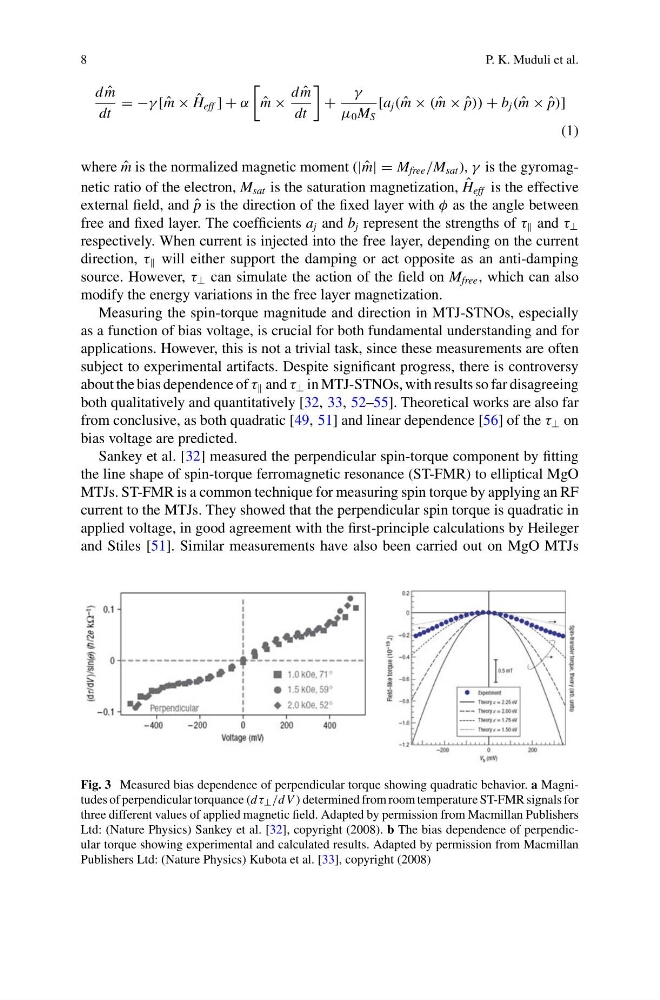
Sankey et al. [32] measured the perpendicular spin-torque component by fitting
the line shape of spin-torque ferromagnetic resonance (ST-FMR) to elliptical MgO
MTJs. ST-FMR is a common technique for measuring spin torque by applying an RF
current to the MTJs. They showed that the perpendicular spin torque is quadratic in
applied voltage, in good agreement with the first-principle calculations by Heileger
and Stiles [51]. Similar measurements have also been carried out on MgO MTJs
Fig. 3 Measured bias dependence of perpendicular torque showing quadratic behavior. a Magnitudes of perpendicular torquance (d τ ⊥ /d V ) determined from room temperature ST-FMR signals for
three different values of applied magnetic field. Adapted by permission from Macmillan Publishers
Ltd: (Nature Physics) Sankey et al. [32], copyright (2008). b The bias dependence of perpendicular torque showing experimental and calculated results. Adapted by permission from Macmillan
Publishers Ltd: (Nature Physics) Kubota et al. [33], copyright (2008)
P. K. Muduli et al.
d ˆ
m
dt
= −γ [ ˆ
m × ˆ
H eff ] + α
ˆ
m ×
d ˆ
m
dt
+
γ
μ 0 M S
[a j ( ˆ
m × ( ˆ
m × ˆ
p)) + b j ( ˆ
m × ˆ
p)]
(1)
where ˆ
m is the normalized magnetic moment (| ˆ
m| = M free /M sat ), γ is the gyromagnetic ratio of the electron, M sat is the saturation magnetization, ˆ
H eff is the effective
external field, and ˆ
p is the direction of the fixed layer with φ as the angle between
free and fixed layer. The coefficients a j and b j represent the strengths of τ and τ ⊥
respectively. When current is injected into the free layer, depending on the current
direction, τ will either support the damping or act opposite as an anti-damping
source. However, τ ⊥ can simulate the action of the field on M free , which can also
modify the energy variations in the free layer magnetization.
Measuring the spin-torque magnitude and direction in MTJ-STNOs, especially
as a function of bias voltage, is crucial for both fundamental understanding and for
applications. However, this is not a trivial task, since these measurements are often
subject to experimental artifacts. Despite significant progress, there is controversy
about the bias dependence of τ and τ ⊥ in MTJ-STNOs, with results so far disagreeing
both qualitatively and quantitatively [32, 33, 52–55]. Theoretical works are also far
from conclusive, as both quadratic [49, 51] and linear dependence [56] of the τ ⊥ on
bias voltage are predicted.
Sankey et al. [32] measured the perpendicular spin-torque component by fitting
the line shape of spin-torque ferromagnetic resonance (ST-FMR) to elliptical MgO
MTJs. ST-FMR is a common technique for measuring spin torque by applying an RF
current to the MTJs. They showed that the perpendicular spin torque is quadratic in
applied voltage, in good agreement with the first-principle calculations by Heileger
and Stiles [51]. Similar measurements have also been carried out on MgO MTJs
Fig. 3 Measured bias dependence of perpendicular torque showing quadratic behavior. a Magnitudes of perpendicular torquance (d τ ⊥ /d V ) determined from room temperature ST-FMR signals for
three different values of applied magnetic field. Adapted by permission from Macmillan Publishers
Ltd: (Nature Physics) Sankey et al. [32], copyright (2008). b The bias dependence of perpendicular torque showing experimental and calculated results. Adapted by permission from Macmillan
Publishers Ltd: (Nature Physics) Kubota et al. [33], copyright (2008)