

Current-Driven Domain Wall Dynamics in Magnetic …
133
DW velocities increase with the current for all the interlayer exchange couplings. The
effect of exchange torque on the DW dynamics can then be seen from the increases of
the DW velocity with higher exchange coupling strength. As shown in the Fig. 27, for
a fixed current density ~ 8 × 10
12 A/m
2 , the DW velocity is increased by ~ 190 m/s
when H ex is increased from 5550 to 8440 Oe.
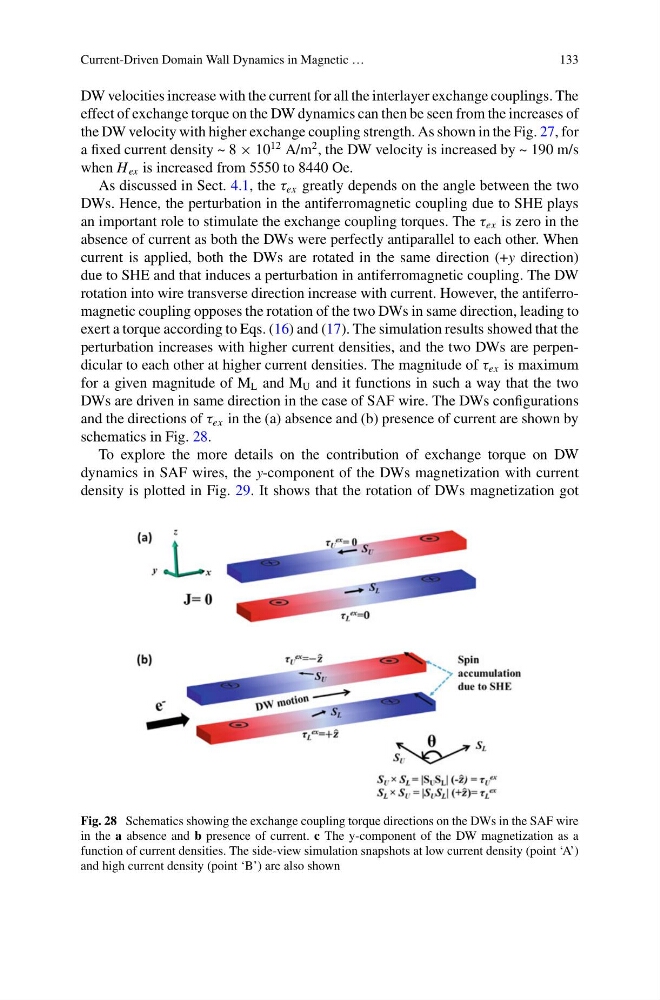
As discussed in Sect. 4.1, the τ ex greatly depends on the angle between the two
DWs. Hence, the perturbation in the antiferromagnetic coupling due to SHE plays
an important role to stimulate the exchange coupling torques. The τ ex is zero in the
absence of current as both the DWs were perfectly antiparallel to each other. When
current is applied, both the DWs are rotated in the same direction (+y direction)
due to SHE and that induces a perturbation in antiferromagnetic coupling. The DW
rotation into wire transverse direction increase with current. However, the antiferromagnetic coupling opposes the rotation of the two DWs in same direction, leading to
exert a torque according to Eqs. (16) and (17). The simulation results showed that the
perturbation increases with higher current densities, and the two DWs are perpendicular to each other at higher current densities. The magnitude of τ ex is maximum
for a given magnitude of M L and M U and it functions in such a way that the two
DWs are driven in same direction in the case of SAF wire. The DWs configurations
and the directions of τ ex in the (a) absence and (b) presence of current are shown by
schematics in Fig. 28.
To explore the more details on the contribution of exchange torque on DW
dynamics in SAF wires, the y-component of the DWs magnetization with current
density is plotted in Fig. 29. It shows that the rotation of DWs magnetization got
Fig. 28 Schematics showing the exchange coupling torque directions on the DWs in the SAF wire
in the a absence and b presence of current. c The y-component of the DW magnetization as a
function of current densities. The side-view simulation snapshots at low current density (point ‘A’)
and high current density (point ‘B’) are also shown
133
DW velocities increase with the current for all the interlayer exchange couplings. The
effect of exchange torque on the DW dynamics can then be seen from the increases of
the DW velocity with higher exchange coupling strength. As shown in the Fig. 27, for
a fixed current density ~ 8 × 10
12 A/m
2 , the DW velocity is increased by ~ 190 m/s
when H ex is increased from 5550 to 8440 Oe.
As discussed in Sect. 4.1, the τ ex greatly depends on the angle between the two
DWs. Hence, the perturbation in the antiferromagnetic coupling due to SHE plays
an important role to stimulate the exchange coupling torques. The τ ex is zero in the
absence of current as both the DWs were perfectly antiparallel to each other. When
current is applied, both the DWs are rotated in the same direction (+y direction)
due to SHE and that induces a perturbation in antiferromagnetic coupling. The DW
rotation into wire transverse direction increase with current. However, the antiferromagnetic coupling opposes the rotation of the two DWs in same direction, leading to
exert a torque according to Eqs. (16) and (17). The simulation results showed that the
perturbation increases with higher current densities, and the two DWs are perpendicular to each other at higher current densities. The magnitude of τ ex is maximum
for a given magnitude of M L and M U and it functions in such a way that the two
DWs are driven in same direction in the case of SAF wire. The DWs configurations
and the directions of τ ex in the (a) absence and (b) presence of current are shown by
schematics in Fig. 28.
To explore the more details on the contribution of exchange torque on DW
dynamics in SAF wires, the y-component of the DWs magnetization with current
density is plotted in Fig. 29. It shows that the rotation of DWs magnetization got
Fig. 28 Schematics showing the exchange coupling torque directions on the DWs in the SAF wire
in the a absence and b presence of current. c The y-component of the DW magnetization as a
function of current densities. The side-view simulation snapshots at low current density (point ‘A’)
and high current density (point ‘B’) are also shown