

Current-Driven Domain Wall Dynamics in Magnetic …
105
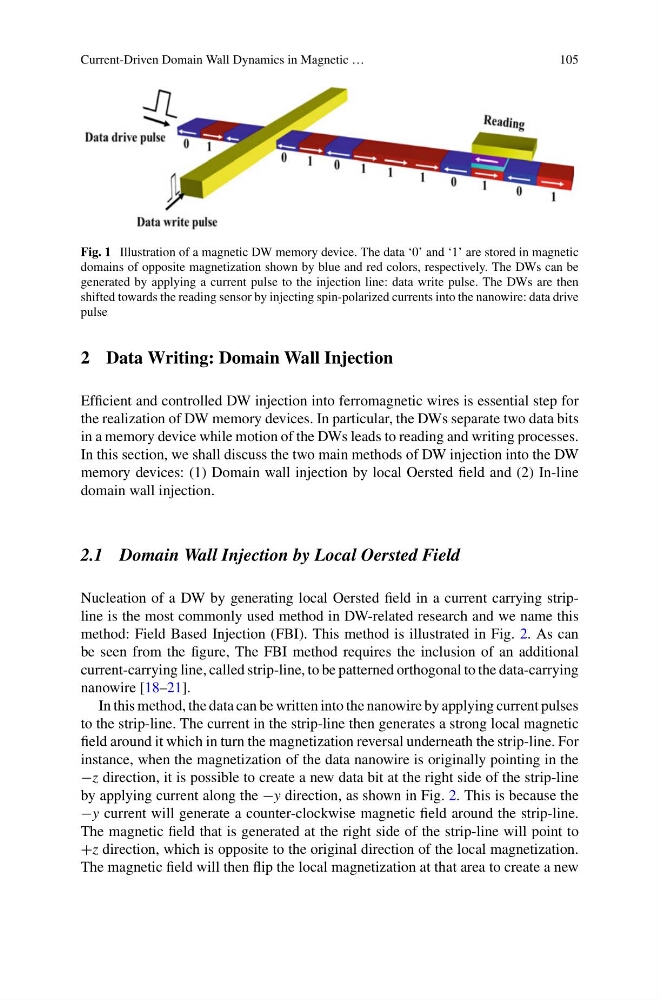
Fig. 1 Illustration of a magnetic DW memory device. The data ‘0’ and ‘1’ are stored in magnetic
domains of opposite magnetization shown by blue and red colors, respectively. The DWs can be
generated by applying a current pulse to the injection line: data write pulse. The DWs are then
shifted towards the reading sensor by injecting spin-polarized currents into the nanowire: data drive
pulse
2 Data Writing: Domain Wall Injection
Efficient and controlled DW injection into ferromagnetic wires is essential step for
the realization of DW memory devices. In particular, the DWs separate two data bits
in a memory device while motion of the DWs leads to reading and writing processes.
In this section, we shall discuss the two main methods of DW injection into the DW
memory devices: (1) Domain wall injection by local Oersted field and (2) In-line
domain wall injection.
2.1 Domain Wall Injection by Local Oersted Field
Nucleation of a DW by generating local Oersted field in a current carrying stripline is the most commonly used method in DW-related research and we name this
method: Field Based Injection (FBI). This method is illustrated in Fig. 2. As can
be seen from the figure, The FBI method requires the inclusion of an additional
current-carrying line, called strip-line, to be patterned orthogonal to the data-carrying
nanowire [18–21].
In this method, the data can be written into the nanowire by applying current pulses
to the strip-line. The current in the strip-line then generates a strong local magnetic
field around it which in turn the magnetization reversal underneath the strip-line. For
instance, when the magnetization of the data nanowire is originally pointing in the
−z direction, it is possible to create a new data bit at the right side of the strip-line
by applying current along the −y direction, as shown in Fig. 2. This is because the
−y current will generate a counter-clockwise magnetic field around the strip-line.
The magnetic field that is generated at the right side of the strip-line will point to
+z direction, which is opposite to the original direction of the local magnetization.
The magnetic field will then flip the local magnetization at that area to create a new
105
Fig. 1 Illustration of a magnetic DW memory device. The data ‘0’ and ‘1’ are stored in magnetic
domains of opposite magnetization shown by blue and red colors, respectively. The DWs can be
generated by applying a current pulse to the injection line: data write pulse. The DWs are then
shifted towards the reading sensor by injecting spin-polarized currents into the nanowire: data drive
pulse
2 Data Writing: Domain Wall Injection
Efficient and controlled DW injection into ferromagnetic wires is essential step for
the realization of DW memory devices. In particular, the DWs separate two data bits
in a memory device while motion of the DWs leads to reading and writing processes.
In this section, we shall discuss the two main methods of DW injection into the DW
memory devices: (1) Domain wall injection by local Oersted field and (2) In-line
domain wall injection.
2.1 Domain Wall Injection by Local Oersted Field
Nucleation of a DW by generating local Oersted field in a current carrying stripline is the most commonly used method in DW-related research and we name this
method: Field Based Injection (FBI). This method is illustrated in Fig. 2. As can
be seen from the figure, The FBI method requires the inclusion of an additional
current-carrying line, called strip-line, to be patterned orthogonal to the data-carrying
nanowire [18–21].
In this method, the data can be written into the nanowire by applying current pulses
to the strip-line. The current in the strip-line then generates a strong local magnetic
field around it which in turn the magnetization reversal underneath the strip-line. For
instance, when the magnetization of the data nanowire is originally pointing in the
−z direction, it is possible to create a new data bit at the right side of the strip-line
by applying current along the −y direction, as shown in Fig. 2. This is because the
−y current will generate a counter-clockwise magnetic field around the strip-line.
The magnetic field that is generated at the right side of the strip-line will point to
+z direction, which is opposite to the original direction of the local magnetization.
The magnetic field will then flip the local magnetization at that area to create a new