

72
3 Elasticity
discussed in subsequent chapters. Thereby, either the strain or the stress history will
be prescribed and the stress or strain history resulting thereof computed and analyzed.
Strain and Stress History: Zig-Zag
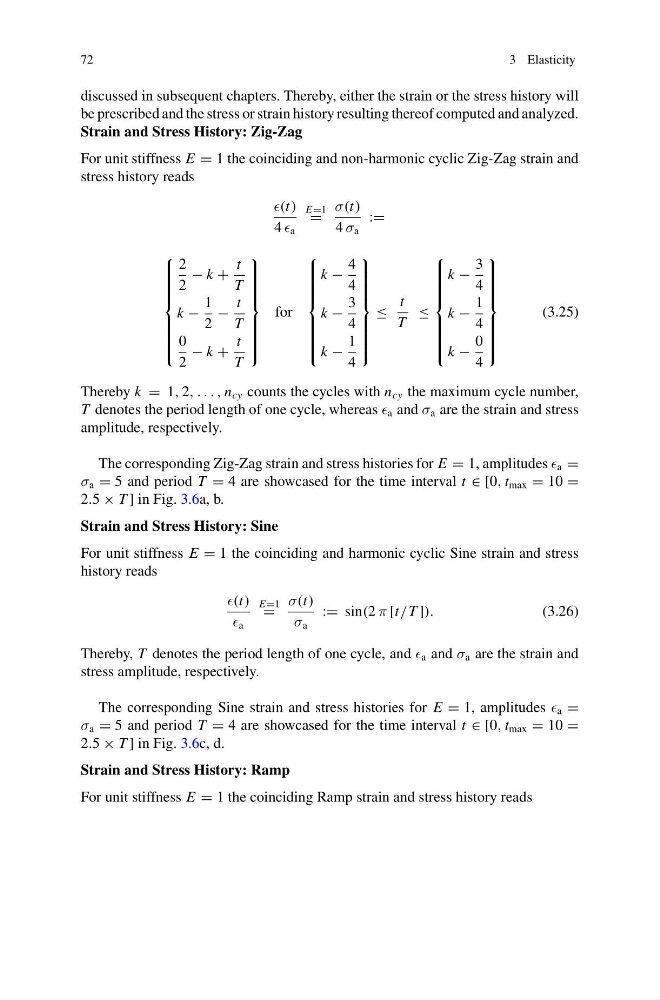
For unit stiffness E = 1 the coinciding and non-harmonic cyclic Zig-Zag strain and
stress history reads
(t)
4 a
E=1
=
σ(t)
4 σ a
:=
⎧
⎪ ⎪ ⎪ ⎪ ⎪ ⎪ ⎨
⎪ ⎪ ⎪ ⎪ ⎪ ⎪ ⎩
2
2
− k +
t
T
k −
1
2
−
t
T
0
2
− k +
t
T
⎫
⎪ ⎪ ⎪ ⎪ ⎪ ⎪ ⎬
⎪ ⎪ ⎪ ⎪ ⎪ ⎪ ⎭
for
⎧
⎪ ⎪ ⎪ ⎪ ⎪ ⎪ ⎨
⎪ ⎪ ⎪ ⎪ ⎪ ⎪ ⎩
k −
4
4
k −
3
4
k −
1
4
⎫
⎪ ⎪ ⎪ ⎪ ⎪ ⎪ ⎬
⎪ ⎪ ⎪ ⎪ ⎪ ⎪ ⎭
≤
t
T
≤
⎧
⎪ ⎪ ⎪ ⎪ ⎪ ⎪ ⎨
⎪ ⎪ ⎪ ⎪ ⎪ ⎪ ⎩
k −
3
4
k −
1
4
k −
0
4
⎫
⎪ ⎪ ⎪ ⎪ ⎪ ⎪ ⎬
⎪ ⎪ ⎪ ⎪ ⎪ ⎪ ⎭
(3.25)
Thereby k = 1, 2, . . . , n cy counts the cycles with n cy the maximum cycle number,
T denotes the period length of one cycle, whereas a and σ a are the strain and stress
amplitude, respectively.
The corresponding Zig-Zag strain and stress histories for E = 1, amplitudes a =
σ a = 5 and period T = 4 are showcased for the time interval t ∈ [0, t max = 10 =
2.5 × T ] in Fig. 3.6a, b.
Strain and Stress History: Sine
For unit stiffness E = 1 the coinciding and harmonic cyclic Sine strain and stress
history reads
(t)
a
E=1
=
σ(t)
σ a
:= sin(2 π [t/T ]).
(3.26)
Thereby, T denotes the period length of one cycle, and a and σ a are the strain and
stress amplitude, respectively.
The corresponding Sine strain and stress histories for E = 1, amplitudes a =
σ a = 5 and period T = 4 are showcased for the time interval t ∈ [0, t max = 10 =
2.5 × T ] in Fig. 3.6c, d.
Strain and Stress History: Ramp
For unit stiffness E = 1 the coinciding Ramp strain and stress history reads
3 Elasticity
discussed in subsequent chapters. Thereby, either the strain or the stress history will
be prescribed and the stress or strain history resulting thereof computed and analyzed.
Strain and Stress History: Zig-Zag
For unit stiffness E = 1 the coinciding and non-harmonic cyclic Zig-Zag strain and
stress history reads
(t)
4 a
E=1
=
σ(t)
4 σ a
:=
⎧
⎪ ⎪ ⎪ ⎪ ⎪ ⎪ ⎨
⎪ ⎪ ⎪ ⎪ ⎪ ⎪ ⎩
2
2
− k +
t
T
k −
1
2
−
t
T
0
2
− k +
t
T
⎫
⎪ ⎪ ⎪ ⎪ ⎪ ⎪ ⎬
⎪ ⎪ ⎪ ⎪ ⎪ ⎪ ⎭
for
⎧
⎪ ⎪ ⎪ ⎪ ⎪ ⎪ ⎨
⎪ ⎪ ⎪ ⎪ ⎪ ⎪ ⎩
k −
4
4
k −
3
4
k −
1
4
⎫
⎪ ⎪ ⎪ ⎪ ⎪ ⎪ ⎬
⎪ ⎪ ⎪ ⎪ ⎪ ⎪ ⎭
≤
t
T
≤
⎧
⎪ ⎪ ⎪ ⎪ ⎪ ⎪ ⎨
⎪ ⎪ ⎪ ⎪ ⎪ ⎪ ⎩
k −
3
4
k −
1
4
k −
0
4
⎫
⎪ ⎪ ⎪ ⎪ ⎪ ⎪ ⎬
⎪ ⎪ ⎪ ⎪ ⎪ ⎪ ⎭
(3.25)
Thereby k = 1, 2, . . . , n cy counts the cycles with n cy the maximum cycle number,
T denotes the period length of one cycle, whereas a and σ a are the strain and stress
amplitude, respectively.
The corresponding Zig-Zag strain and stress histories for E = 1, amplitudes a =
σ a = 5 and period T = 4 are showcased for the time interval t ∈ [0, t max = 10 =
2.5 × T ] in Fig. 3.6a, b.
Strain and Stress History: Sine
For unit stiffness E = 1 the coinciding and harmonic cyclic Sine strain and stress
history reads
(t)
a
E=1
=
σ(t)
σ a
:= sin(2 π [t/T ]).
(3.26)
Thereby, T denotes the period length of one cycle, and a and σ a are the strain and
stress amplitude, respectively.
The corresponding Sine strain and stress histories for E = 1, amplitudes a =
σ a = 5 and period T = 4 are showcased for the time interval t ∈ [0, t max = 10 =
2.5 × T ] in Fig. 3.6c, d.
Strain and Stress History: Ramp
For unit stiffness E = 1 the coinciding Ramp strain and stress history reads