

50
2 Preliminaries
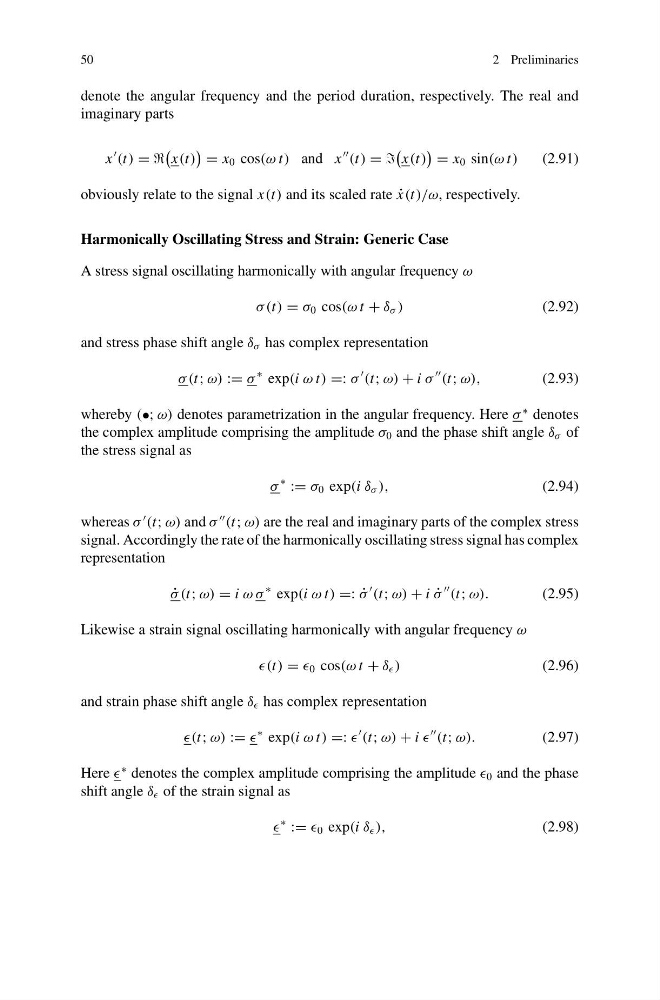
denote the angular frequency and the period duration, respectively. The real and
imaginary parts
x
(t) = =
x(t)
= x 0 cos(ω t) and x
(t) = =
x(t)
= x 0 sin(ω t)
(2.91)
obviously relate to the signal x(t) and its scaled rate ˙
x(t)/ω, respectively.
Harmonically Oscillating Stress and Strain: Generic Case
A stress signal oscillating harmonically with angular frequency ω
σ (t) = σ 0 cos(ω t + δ σ )
(2.92)
and stress phase shift angle δ σ has complex representation
σ (t; ω) := σ
∗ exp(i ω t) =: σ
(t; ω) + i σ
(t; ω),
(2.93)
whereby (•; ω) denotes parametrization in the angular frequency. Here σ
∗ denotes
the complex amplitude comprising the amplitude σ 0 and the phase shift angle δ σ of
the stress signal as
σ
∗
:= σ 0 exp(i δ σ ),
(2.94)
whereas σ
(t; ω) and σ
(t; ω) are the real and imaginary parts of the complex stress
signal. Accordingly the rate of the harmonically oscillating stress signal has complex
representation
˙
σ (t; ω) = i ω σ
∗ exp(i ω t) =: ˙
σ
(t; ω) + i ˙
σ
(t; ω).
(2.95)
Likewise a strain signal oscillating harmonically with angular frequency ω
(t) = 0 cos(ω t + δ )
(2.96)
and strain phase shift angle δ has complex representation
(t; ω) :=
∗ exp(i ω t) =:
(t; ω) + i
(t; ω).
(2.97)
Here
∗ denotes the complex amplitude comprising the amplitude 0 and the phase
shift angle δ of the strain signal as
∗
:= 0 exp(i δ ),
(2.98)
2 Preliminaries
denote the angular frequency and the period duration, respectively. The real and
imaginary parts
x
(t) = =
x(t)
= x 0 cos(ω t) and x
(t) = =
x(t)
= x 0 sin(ω t)
(2.91)
obviously relate to the signal x(t) and its scaled rate ˙
x(t)/ω, respectively.
Harmonically Oscillating Stress and Strain: Generic Case
A stress signal oscillating harmonically with angular frequency ω
σ (t) = σ 0 cos(ω t + δ σ )
(2.92)
and stress phase shift angle δ σ has complex representation
σ (t; ω) := σ
∗ exp(i ω t) =: σ
(t; ω) + i σ
(t; ω),
(2.93)
whereby (•; ω) denotes parametrization in the angular frequency. Here σ
∗ denotes
the complex amplitude comprising the amplitude σ 0 and the phase shift angle δ σ of
the stress signal as
σ
∗
:= σ 0 exp(i δ σ ),
(2.94)
whereas σ
(t; ω) and σ
(t; ω) are the real and imaginary parts of the complex stress
signal. Accordingly the rate of the harmonically oscillating stress signal has complex
representation
˙
σ (t; ω) = i ω σ
∗ exp(i ω t) =: ˙
σ
(t; ω) + i ˙
σ
(t; ω).
(2.95)
Likewise a strain signal oscillating harmonically with angular frequency ω
(t) = 0 cos(ω t + δ )
(2.96)
and strain phase shift angle δ has complex representation
(t; ω) :=
∗ exp(i ω t) =:
(t; ω) + i
(t; ω).
(2.97)
Here
∗ denotes the complex amplitude comprising the amplitude 0 and the phase
shift angle δ of the strain signal as
∗
:= 0 exp(i δ ),
(2.98)