

364
6 Visco-Plasticity
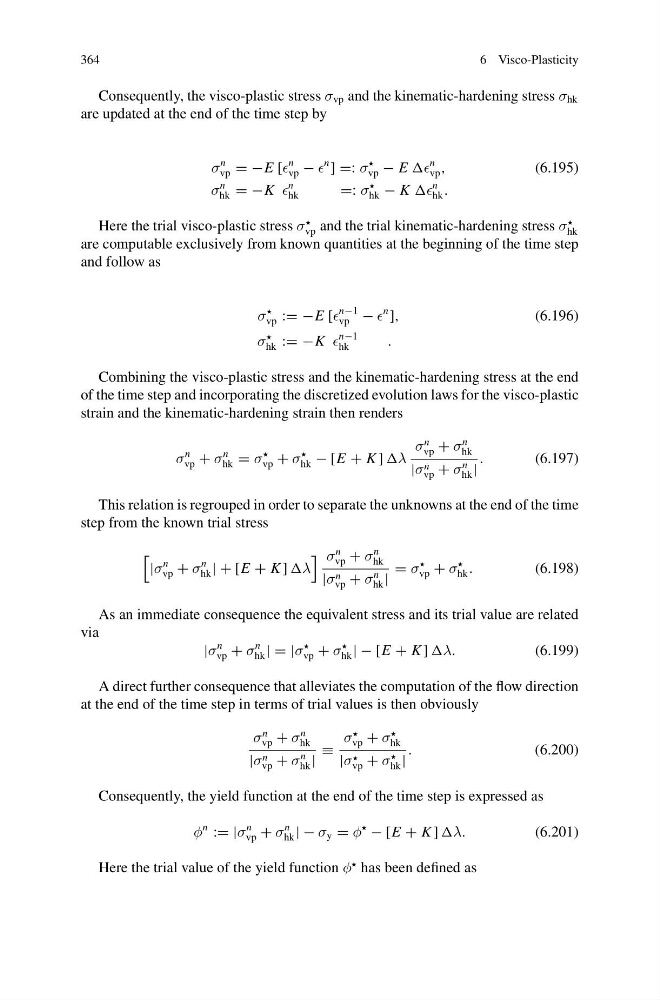
Consequently, the visco-plastic stress σ vp and the kinematic-hardening stress σ hk
are updated at the end of the time step by
σ
n
vp = −E [
n
vp −
n
] =: σ
vp − E
n
vp ,
(6.195)
σ
n
hk = −K
n
hk
=: σ
hk − K
n
hk .
Here the trial visco-plastic stress σ
vp and the trial kinematic-hardening stress σ
hk
are computable exclusively from known quantities at the beginning of the time step
and follow as
σ
vp := −E [
n−1
vp −
n
],
(6.196)
σ
hk := −K
n−1
hk
.
Combining the visco-plastic stress and the kinematic-hardening stress at the end
of the time step and incorporating the discretized evolution laws for the visco-plastic
strain and the kinematic-hardening strain then renders
σ
n
vp + σ
n
hk = σ
vp + σ
hk − [E + K ] λ
σ
n
vp + σ
n
hk
|σ n
vp + σ
n
hk |
.
(6.197)
This relation is regrouped in order to separate the unknowns at the end of the time
step from the known trial stress
|σ
n
vp + σ
n
hk | + [E + K ] λ
σ
n
vp + σ
n
hk
|σ n
vp + σ
n
hk |
= σ
vp + σ
hk .
(6.198)
As an immediate consequence the equivalent stress and its trial value are related
via
|σ
n
vp + σ
n
hk | = |σ
vp + σ
hk | − [E + K ] λ.
(6.199)
A direct further consequence that alleviates the computation of the flow direction
at the end of the time step in terms of trial values is then obviously
σ
n
vp + σ
n
hk
|σ n
vp + σ
n
hk |
≡
σ
vp + σ
hk
|σ
vp + σ
hk |
.
(6.200)
Consequently, the yield function at the end of the time step is expressed as
φ
n
:= |σ
n
vp + σ
n
hk | − σ y = φ
− [E + K ] λ.
(6.201)
Here the trial value of the yield function φ
has been defined as
6 Visco-Plasticity
Consequently, the visco-plastic stress σ vp and the kinematic-hardening stress σ hk
are updated at the end of the time step by
σ
n
vp = −E [
n
vp −
n
] =: σ
vp − E
n
vp ,
(6.195)
σ
n
hk = −K
n
hk
=: σ
hk − K
n
hk .
Here the trial visco-plastic stress σ
vp and the trial kinematic-hardening stress σ
hk
are computable exclusively from known quantities at the beginning of the time step
and follow as
σ
vp := −E [
n−1
vp −
n
],
(6.196)
σ
hk := −K
n−1
hk
.
Combining the visco-plastic stress and the kinematic-hardening stress at the end
of the time step and incorporating the discretized evolution laws for the visco-plastic
strain and the kinematic-hardening strain then renders
σ
n
vp + σ
n
hk = σ
vp + σ
hk − [E + K ] λ
σ
n
vp + σ
n
hk
|σ n
vp + σ
n
hk |
.
(6.197)
This relation is regrouped in order to separate the unknowns at the end of the time
step from the known trial stress
|σ
n
vp + σ
n
hk | + [E + K ] λ
σ
n
vp + σ
n
hk
|σ n
vp + σ
n
hk |
= σ
vp + σ
hk .
(6.198)
As an immediate consequence the equivalent stress and its trial value are related
via
|σ
n
vp + σ
n
hk | = |σ
vp + σ
hk | − [E + K ] λ.
(6.199)
A direct further consequence that alleviates the computation of the flow direction
at the end of the time step in terms of trial values is then obviously
σ
n
vp + σ
n
hk
|σ n
vp + σ
n
hk |
≡
σ
vp + σ
hk
|σ
vp + σ
hk |
.
(6.200)
Consequently, the yield function at the end of the time step is expressed as
φ
n
:= |σ
n
vp + σ
n
hk | − σ y = φ
− [E + K ] λ.
(6.201)
Here the trial value of the yield function φ
has been defined as