

6.3 Perzyna Hardening Model
363
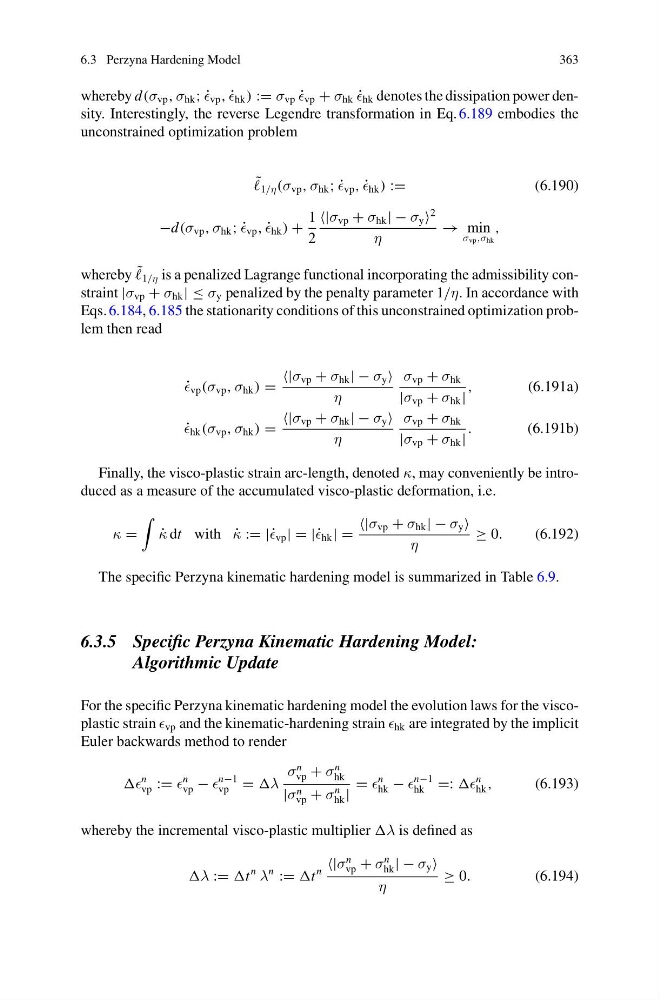
whereby d(σ vp , σ hk ; ˙
vp , ˙
hk ) := σ vp ˙
vp + σ hk ˙
hk denotes the dissipation power density. Interestingly, the reverse Legendre transformation in Eq. 6.189 embodies the
unconstrained optimization problem
˜
1/η (σ vp , σ hk ; ˙
vp , ˙
hk ) :=
(6.190)
−d(σ vp , σ hk ; ˙
vp , ˙
hk ) +
1
2
|σ vp + σ hk | − σ y
2
η
→ min
σ vp ,σ hk
,
whereby ˜
1/η is a penalized Lagrange functional incorporating the admissibility constraint |σ vp + σ hk | ≤ σ y penalized by the penalty parameter 1/η. In accordance with
Eqs. 6.184, 6.185 the stationarity conditions of this unconstrained optimization problem then read
˙
vp (σ vp , σ hk ) =
|σ vp + σ hk | − σ y
η
σ vp + σ hk
|σ vp + σ hk |
,
(6.191a)
˙
hk (σ vp , σ hk ) =
|σ vp + σ hk | − σ y
η
σ vp + σ hk
|σ vp + σ hk |
.
(6.191b)
Finally, the visco-plastic strain arc-length, denoted κ, may conveniently be introduced as a measure of the accumulated visco-plastic deformation, i.e.
κ =
˙
κ dt with ˙
κ := |˙ vp | = |˙ hk | =
|σ vp + σ hk | − σ y
η
≥ 0.
(6.192)
The specific Perzyna kinematic hardening model is summarized in Table 6.9.
6.3.5 Specific Perzyna Kinematic Hardening Model:
Algorithmic Update
For the specific Perzyna kinematic hardening model the evolution laws for the viscoplastic strain vp and the kinematic-hardening strain hk are integrated by the implicit
Euler backwards method to render
n
vp :=
n
vp −
n−1
vp = λ
σ
n
vp + σ
n
hk
|σ n
vp + σ
n
hk |
=
n
hk −
n−1
hk =:
n
hk ,
(6.193)
whereby the incremental visco-plastic multiplier λ is defined as
λ := t
n
λ
n
:= t
n
|σ
n
vp + σ
n
hk | − σ y
η
≥ 0.
(6.194)
363
whereby d(σ vp , σ hk ; ˙
vp , ˙
hk ) := σ vp ˙
vp + σ hk ˙
hk denotes the dissipation power density. Interestingly, the reverse Legendre transformation in Eq. 6.189 embodies the
unconstrained optimization problem
˜
1/η (σ vp , σ hk ; ˙
vp , ˙
hk ) :=
(6.190)
−d(σ vp , σ hk ; ˙
vp , ˙
hk ) +
1
2
|σ vp + σ hk | − σ y
2
η
→ min
σ vp ,σ hk
,
whereby ˜
1/η is a penalized Lagrange functional incorporating the admissibility constraint |σ vp + σ hk | ≤ σ y penalized by the penalty parameter 1/η. In accordance with
Eqs. 6.184, 6.185 the stationarity conditions of this unconstrained optimization problem then read
˙
vp (σ vp , σ hk ) =
|σ vp + σ hk | − σ y
η
σ vp + σ hk
|σ vp + σ hk |
,
(6.191a)
˙
hk (σ vp , σ hk ) =
|σ vp + σ hk | − σ y
η
σ vp + σ hk
|σ vp + σ hk |
.
(6.191b)
Finally, the visco-plastic strain arc-length, denoted κ, may conveniently be introduced as a measure of the accumulated visco-plastic deformation, i.e.
κ =
˙
κ dt with ˙
κ := |˙ vp | = |˙ hk | =
|σ vp + σ hk | − σ y
η
≥ 0.
(6.192)
The specific Perzyna kinematic hardening model is summarized in Table 6.9.
6.3.5 Specific Perzyna Kinematic Hardening Model:
Algorithmic Update
For the specific Perzyna kinematic hardening model the evolution laws for the viscoplastic strain vp and the kinematic-hardening strain hk are integrated by the implicit
Euler backwards method to render
n
vp :=
n
vp −
n−1
vp = λ
σ
n
vp + σ
n
hk
|σ n
vp + σ
n
hk |
=
n
hk −
n−1
hk =:
n
hk ,
(6.193)
whereby the incremental visco-plastic multiplier λ is defined as
λ := t
n
λ
n
:= t
n
|σ
n
vp + σ
n
hk | − σ y
η
≥ 0.
(6.194)