

26
2 Preliminaries
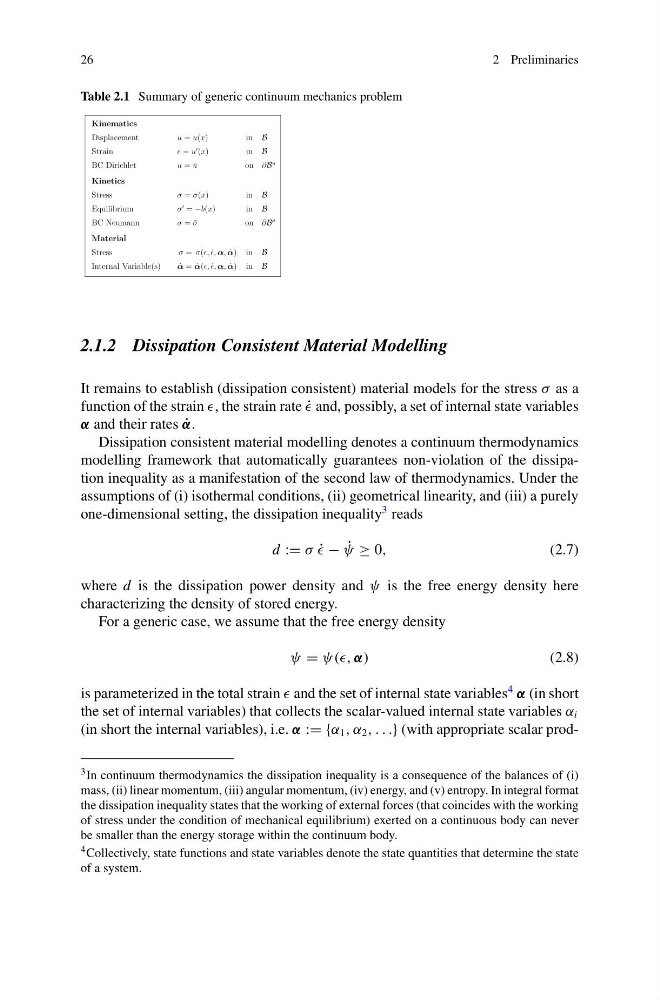
Table 2.1 Summary of generic continuum mechanics problem
2.1.2 Dissipation Consistent Material Modelling
It remains to establish (dissipation consistent) material models for the stress σ as a
function of the strain the strain rate ˙
and, possibly, a set of internal state variables
α and their rates ˙
α.
Dissipation consistent material modelling denotes a continuum thermodynamics
modelling framework that automatically guarantees non-violation of the dissipation inequality as a manifestation of the second law of thermodynamics. Under the
assumptions of (i) isothermal conditions, (ii) geometrical linearity, and (iii) a purely
one-dimensional setting, the dissipation inequality
3 reads
d := σ ˙
− ˙
ψ ≥ 0,
(2.7)
where d is the dissipation power density and ψ is the free energy density here
characterizing the density of stored energy.
For a generic case, we assume that the free energy density
ψ = ψ((, α)
(2.8)
is parameterized in the total strain and the set of internal state variables
4
α (in short
the set of internal variables) that collects the scalar-valued internal state variables α i
(in short the internal variables), i.e. α := {α 1 , α 2 , . . .} (with appropriate scalar prod3 In continuum thermodynamics the dissipation inequality is a consequence of the balances of (i)
mass, (ii) linear momentum, (iii) angular momentum, (iv) energy, and (v) entropy. In integral format
the dissipation inequality states that the working of external forces (that coincides with the working
of stress under the condition of mechanical equilibrium) exerted on a continuous body can never
be smaller than the energy storage within the continuum body.
4 Collectively, state functions and state variables denote the state quantities that determine the state
of a system.
2 Preliminaries
Table 2.1 Summary of generic continuum mechanics problem
2.1.2 Dissipation Consistent Material Modelling
It remains to establish (dissipation consistent) material models for the stress σ as a
function of the strain the strain rate ˙
and, possibly, a set of internal state variables
α and their rates ˙
α.
Dissipation consistent material modelling denotes a continuum thermodynamics
modelling framework that automatically guarantees non-violation of the dissipation inequality as a manifestation of the second law of thermodynamics. Under the
assumptions of (i) isothermal conditions, (ii) geometrical linearity, and (iii) a purely
one-dimensional setting, the dissipation inequality
3 reads
d := σ ˙
− ˙
ψ ≥ 0,
(2.7)
where d is the dissipation power density and ψ is the free energy density here
characterizing the density of stored energy.
For a generic case, we assume that the free energy density
ψ = ψ((, α)
(2.8)
is parameterized in the total strain and the set of internal state variables
4
α (in short
the set of internal variables) that collects the scalar-valued internal state variables α i
(in short the internal variables), i.e. α := {α 1 , α 2 , . . .} (with appropriate scalar prod3 In continuum thermodynamics the dissipation inequality is a consequence of the balances of (i)
mass, (ii) linear momentum, (iii) angular momentum, (iv) energy, and (v) entropy. In integral format
the dissipation inequality states that the working of external forces (that coincides with the working
of stress under the condition of mechanical equilibrium) exerted on a continuous body can never
be smaller than the energy storage within the continuum body.
4 Collectively, state functions and state variables denote the state quantities that determine the state
of a system.