

6.3 Perzyna Hardening Model
359
ing non-smooth constitutive relations σ p = σ p (˙ vp ) and ˙
vp = ˙
vp (σ p ) are similar to
those displayed in Fig. 5.3.
Visco-Plastic Stress
Alternatively, the Perzyna kinematic hardening model may be formulated further by
considering the visco-plastic stress. To this end the viscous and the plastic stress need
to be related to the visco-plastic stress.
Remarkably, since at yield the plastic stress satisfies |σ p + σ hk | = σ y , the viscous
overstress σ v = σ vp − σ p allows representation in terms of the yield condition that
is, however, evaluated in terms of the visco-plastic stress σ vp
σ v =
⎧
⎪ ⎪ ⎨
⎪ ⎪ ⎩
+|σ vp + σ hk | − σ y
0
−|σ vp + σ hk | + σ y
if
σ vp + σ hk > +σ y
else
σ vp + σ hk < −σ y
⎫
⎪ ⎪ ⎬
⎪ ⎪ ⎭
.
(6.182)
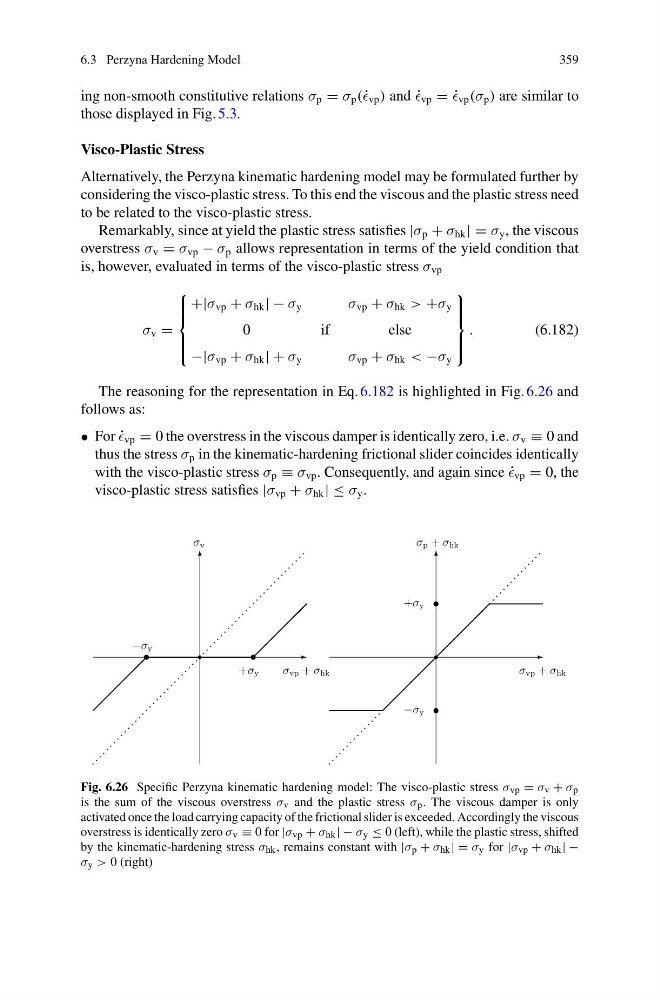
The reasoning for the representation in Eq. 6.182 is highlighted in Fig. 6.26 and
follows as:
• For ˙
vp = 0 the overstress in the viscous damper is identically zero, i.e. σ v ≡ 0 and
thus the stress σ p in the kinematic-hardening frictional slider coincides identically
with the visco-plastic stress σ p ≡ σ vp . Consequently, and again since ˙
vp = 0, the
visco-plastic stress satisfies |σ vp + σ hk | ≤ σ y .
σ vp + σ hk
σ v
−σ y
+σ y
σ vp + σ hk
σ p + σ hk
+σ y
−σ y
Fig. 6.26 Specific Perzyna kinematic hardening model: The visco-plastic stress σ vp = σ v + σ p
is the sum of the viscous overstress σ v and the plastic stress σ p . The viscous damper is only
activated once the load carrying capacity of the frictional slider is exceeded. Accordingly the viscous
overstress is identically zero σ v ≡ 0 for |σ vp + σ hk | − σ y ≤ 0 (left), while the plastic stress, shifted
by the kinematic-hardening stress σ hk , remains constant with |σ p + σ hk | = σ y for |σ vp + σ hk | −
σ y > 0 (right)
359
ing non-smooth constitutive relations σ p = σ p (˙ vp ) and ˙
vp = ˙
vp (σ p ) are similar to
those displayed in Fig. 5.3.
Visco-Plastic Stress
Alternatively, the Perzyna kinematic hardening model may be formulated further by
considering the visco-plastic stress. To this end the viscous and the plastic stress need
to be related to the visco-plastic stress.
Remarkably, since at yield the plastic stress satisfies |σ p + σ hk | = σ y , the viscous
overstress σ v = σ vp − σ p allows representation in terms of the yield condition that
is, however, evaluated in terms of the visco-plastic stress σ vp
σ v =
⎧
⎪ ⎪ ⎨
⎪ ⎪ ⎩
+|σ vp + σ hk | − σ y
0
−|σ vp + σ hk | + σ y
if
σ vp + σ hk > +σ y
else
σ vp + σ hk < −σ y
⎫
⎪ ⎪ ⎬
⎪ ⎪ ⎭
.
(6.182)
The reasoning for the representation in Eq. 6.182 is highlighted in Fig. 6.26 and
follows as:
• For ˙
vp = 0 the overstress in the viscous damper is identically zero, i.e. σ v ≡ 0 and
thus the stress σ p in the kinematic-hardening frictional slider coincides identically
with the visco-plastic stress σ p ≡ σ vp . Consequently, and again since ˙
vp = 0, the
visco-plastic stress satisfies |σ vp + σ hk | ≤ σ y .
σ vp + σ hk
σ v
−σ y
+σ y
σ vp + σ hk
σ p + σ hk
+σ y
−σ y
Fig. 6.26 Specific Perzyna kinematic hardening model: The visco-plastic stress σ vp = σ v + σ p
is the sum of the viscous overstress σ v and the plastic stress σ p . The viscous damper is only
activated once the load carrying capacity of the frictional slider is exceeded. Accordingly the viscous
overstress is identically zero σ v ≡ 0 for |σ vp + σ hk | − σ y ≤ 0 (left), while the plastic stress, shifted
by the kinematic-hardening stress σ hk , remains constant with |σ p + σ hk | = σ y for |σ vp + σ hk | −
σ y > 0 (right)