

358
6 Visco-Plasticity
π
∗
v (σ v
) =
1
2
1
η
|σ v |
2
(6.179a)
π
∗
p (σ p , σ hk ) = I A (σ p , σ hk ) :=
⎧
⎨
⎩
0
|σ p + σ hk | ≤ σ y
for
∞
|σ p + σ hk | > σ y
⎫
⎬
⎭
,
(6.179b)
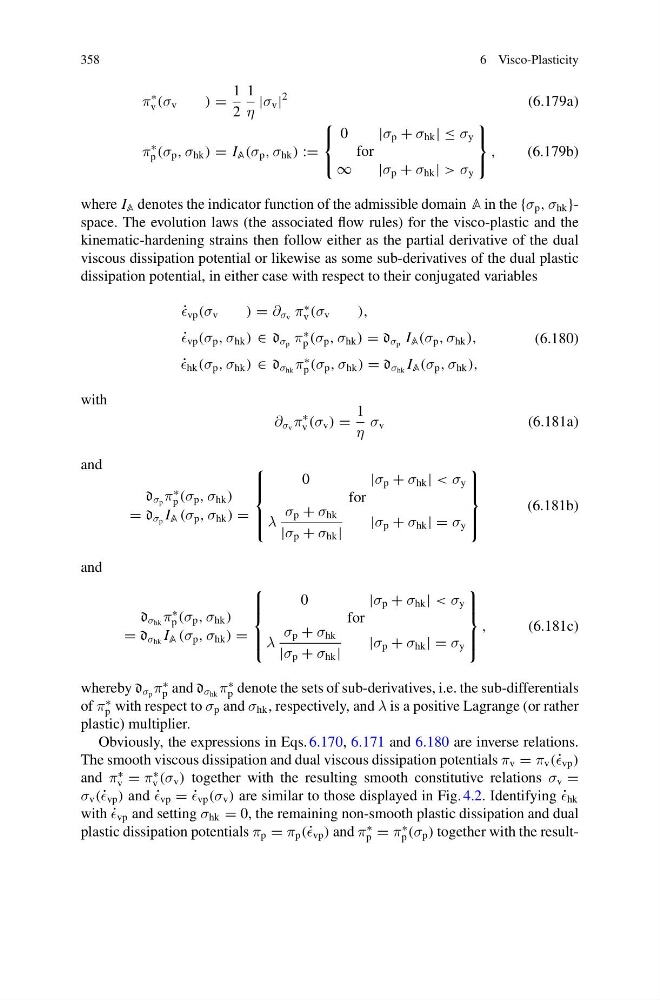
where I A denotes the indicator function of the admissible domain A in the {σ p , σ hk }space. The evolution laws (the associated flow rules) for the visco-plastic and the
kinematic-hardening strains then follow either as the partial derivative of the dual
viscous dissipation potential or likewise as some sub-derivatives of the dual plastic
dissipation potential, in either case with respect to their conjugated variables
˙
vp (σ v
) = ∂ σ v π
∗
v (σ v
),
˙
vp (σ p , σ hk ) ∈ d σ p π
∗
p (σ p , σ hk ) = d σ p I A (σ p , σ hk ),
˙
hk (σ p , σ hk ) ∈ d σ hk π
∗
p (σ p , σ hk ) = d σ hk I A (σ p , σ hk ),
(6.180)
with
∂ σ v π
∗
v (σ v ) =
1
η
σ v
(6.181a)
and
d σ p π
∗
p (σ p , σ hk )
= d σ p I A (σ p , σ hk ) =
⎧
⎪ ⎪ ⎨
⎪ ⎪ ⎩
0
|σ p + σ hk | < σ y
for
λ
σ p + σ hk
|σ p + σ hk |
|σ p + σ hk | = σ y
⎫
⎪ ⎪ ⎬
⎪ ⎪ ⎭
(6.181b)
and
d σ hk π
∗
p (σ p , σ hk )
= d σ hk I A (σ p , σ hk ) =
⎧
⎪ ⎪ ⎨
⎪ ⎪ ⎩
0
|σ p + σ hk | < σ y
for
λ
σ p + σ hk
|σ p + σ hk |
|σ p + σ hk | = σ y
⎫
⎪ ⎪ ⎬
⎪ ⎪ ⎭
,
(6.181c)
whereby d σ p π
∗
p and d σ hk π
∗
p denote the sets of sub-derivatives, i.e. the sub-differentials
of π
∗
p with respect to σ p and σ hk , respectively, and λ is a positive Lagrange (or rather
plastic) multiplier.
Obviously, the expressions in Eqs. 6.170, 6.171 and 6.180 are inverse relations.
The smooth viscous dissipation and dual viscous dissipation potentials π v = π v (˙ vp )
and π
∗
v = π
∗
v (σ v ) together with the resulting smooth constitutive relations σ v =
σ v (˙ vp ) and ˙
vp = ˙
vp (σ v ) are similar to those displayed in Fig. 4.2. Identifying ˙
hk
with ˙
vp and setting σ hk = 0, the remaining non-smooth plastic dissipation and dual
plastic dissipation potentials π p = π p (˙ vp ) and π
∗
p = π
∗
p (σ p ) together with the result-
6 Visco-Plasticity
π
∗
v (σ v
) =
1
2
1
η
|σ v |
2
(6.179a)
π
∗
p (σ p , σ hk ) = I A (σ p , σ hk ) :=
⎧
⎨
⎩
0
|σ p + σ hk | ≤ σ y
for
∞
|σ p + σ hk | > σ y
⎫
⎬
⎭
,
(6.179b)
where I A denotes the indicator function of the admissible domain A in the {σ p , σ hk }space. The evolution laws (the associated flow rules) for the visco-plastic and the
kinematic-hardening strains then follow either as the partial derivative of the dual
viscous dissipation potential or likewise as some sub-derivatives of the dual plastic
dissipation potential, in either case with respect to their conjugated variables
˙
vp (σ v
) = ∂ σ v π
∗
v (σ v
),
˙
vp (σ p , σ hk ) ∈ d σ p π
∗
p (σ p , σ hk ) = d σ p I A (σ p , σ hk ),
˙
hk (σ p , σ hk ) ∈ d σ hk π
∗
p (σ p , σ hk ) = d σ hk I A (σ p , σ hk ),
(6.180)
with
∂ σ v π
∗
v (σ v ) =
1
η
σ v
(6.181a)
and
d σ p π
∗
p (σ p , σ hk )
= d σ p I A (σ p , σ hk ) =
⎧
⎪ ⎪ ⎨
⎪ ⎪ ⎩
0
|σ p + σ hk | < σ y
for
λ
σ p + σ hk
|σ p + σ hk |
|σ p + σ hk | = σ y
⎫
⎪ ⎪ ⎬
⎪ ⎪ ⎭
(6.181b)
and
d σ hk π
∗
p (σ p , σ hk )
= d σ hk I A (σ p , σ hk ) =
⎧
⎪ ⎪ ⎨
⎪ ⎪ ⎩
0
|σ p + σ hk | < σ y
for
λ
σ p + σ hk
|σ p + σ hk |
|σ p + σ hk | = σ y
⎫
⎪ ⎪ ⎬
⎪ ⎪ ⎭
,
(6.181c)
whereby d σ p π
∗
p and d σ hk π
∗
p denote the sets of sub-derivatives, i.e. the sub-differentials
of π
∗
p with respect to σ p and σ hk , respectively, and λ is a positive Lagrange (or rather
plastic) multiplier.
Obviously, the expressions in Eqs. 6.170, 6.171 and 6.180 are inverse relations.
The smooth viscous dissipation and dual viscous dissipation potentials π v = π v (˙ vp )
and π
∗
v = π
∗
v (σ v ) together with the resulting smooth constitutive relations σ v =
σ v (˙ vp ) and ˙
vp = ˙
vp (σ v ) are similar to those displayed in Fig. 4.2. Identifying ˙
hk
with ˙
vp and setting σ hk = 0, the remaining non-smooth plastic dissipation and dual
plastic dissipation potentials π p = π p (˙ vp ) and π
∗
p = π
∗
p (σ p ) together with the result-