

6.3 Perzyna Hardening Model
335
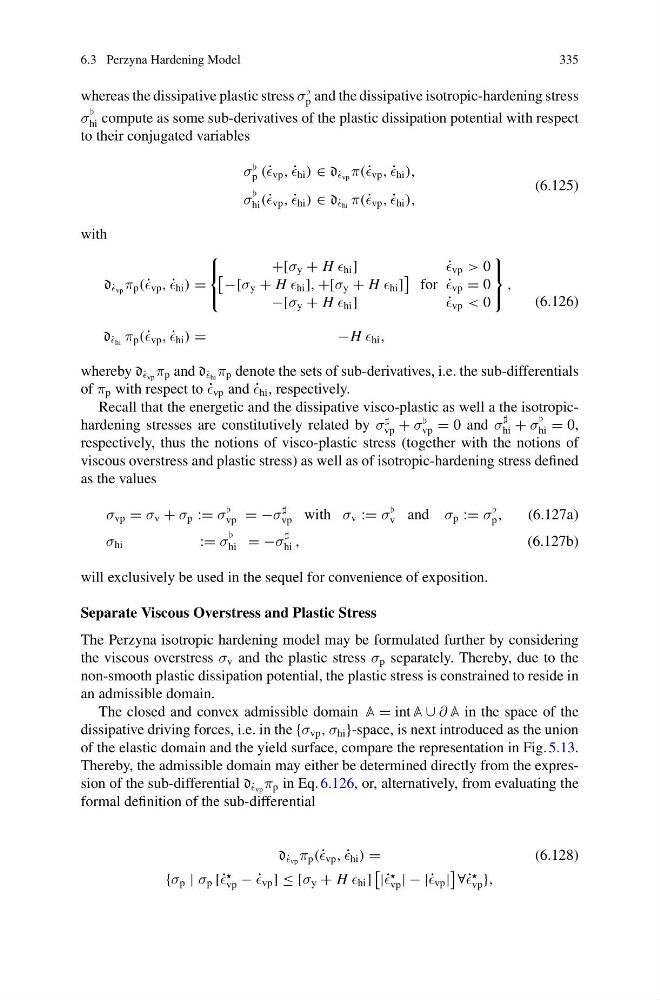
whereas the dissipative plastic stress σ
p and the dissipative isotropic-hardening stress
σ
hi compute as some sub-derivatives of the plastic dissipation potential with respect
to their conjugated variables
σ
p (˙ vp , ˙
hi ) ∈ d ˙
vp π(˙ vp , ˙
hi ),
σ
hi (˙ vp , ˙
hi ) ∈ d ˙
hi π(˙ vp , ˙
hi ),
(6.125)
with
d ˙
vp π p (˙ vp , ˙
hi ) =
⎧
⎨
⎩
+[σ y + H hi ]
˙
vp > 0
−[σ y + H hi ], +[σ y + H hi ]
for ˙
vp = 0
−[σ y + H hi ]
˙
vp < 0
⎫
⎬
⎭
,
d ˙
hi π p (˙ vp , ˙
hi ) =
− H hi ,
(6.126)
whereby d ˙
vp π p and d ˙
hi π p denote the sets of sub-derivatives, i.e. the sub-differentials
of π p with respect to ˙
vp and ˙
hi , respectively.
Recall that the energetic and the dissipative visco-plastic as well a the isotropichardening stresses are constitutively related by σ
vp + σ
vp = 0 and σ
hi + σ
hi = 0,
respectively, thus the notions of visco-plastic stress (together with the notions of
viscous overstress and plastic stress) as well as of isotropic-hardening stress defined
as the values
σ vp = σ v + σ p := σ
vp = −σ
vp with σ v := σ
v and σ p := σ
p ,
(6.127a)
σ hi
:= σ
hi = −σ
hi ,
(6.127b)
will exclusively be used in the sequel for convenience of exposition.
Separate Viscous Overstress and Plastic Stress
The Perzyna isotropic hardening model may be formulated further by considering
the viscous overstress σ v and the plastic stress σ p separately. Thereby, due to the
non-smooth plastic dissipation potential, the plastic stress is constrained to reside in
an admissible domain.
The closed and convex admissible domain A = int A ∪ ∂ A in the space of the
dissipative driving forces, i.e. in the {σ vp , σ hi }-space, is next introduced as the union
of the elastic domain and the yield surface, compare the representation in Fig. 5.13.
Thereby, the admissible domain may either be determined directly from the expression of the sub-differential d ˙
vp π p in Eq. 6.126, or, alternatively, from evaluating the
formal definition of the sub-differential
d ˙
vp π p (˙ vp , ˙
hi ) =
(6.128)
{σ p | σ p [˙
vp − ˙
vp ] ≤ [σ y + H hi ]
|˙
vp | − |˙ vp |
∀˙
vp },
335
whereas the dissipative plastic stress σ
p and the dissipative isotropic-hardening stress
σ
hi compute as some sub-derivatives of the plastic dissipation potential with respect
to their conjugated variables
σ
p (˙ vp , ˙
hi ) ∈ d ˙
vp π(˙ vp , ˙
hi ),
σ
hi (˙ vp , ˙
hi ) ∈ d ˙
hi π(˙ vp , ˙
hi ),
(6.125)
with
d ˙
vp π p (˙ vp , ˙
hi ) =
⎧
⎨
⎩
+[σ y + H hi ]
˙
vp > 0
−[σ y + H hi ], +[σ y + H hi ]
for ˙
vp = 0
−[σ y + H hi ]
˙
vp < 0
⎫
⎬
⎭
,
d ˙
hi π p (˙ vp , ˙
hi ) =
− H hi ,
(6.126)
whereby d ˙
vp π p and d ˙
hi π p denote the sets of sub-derivatives, i.e. the sub-differentials
of π p with respect to ˙
vp and ˙
hi , respectively.
Recall that the energetic and the dissipative visco-plastic as well a the isotropichardening stresses are constitutively related by σ
vp + σ
vp = 0 and σ
hi + σ
hi = 0,
respectively, thus the notions of visco-plastic stress (together with the notions of
viscous overstress and plastic stress) as well as of isotropic-hardening stress defined
as the values
σ vp = σ v + σ p := σ
vp = −σ
vp with σ v := σ
v and σ p := σ
p ,
(6.127a)
σ hi
:= σ
hi = −σ
hi ,
(6.127b)
will exclusively be used in the sequel for convenience of exposition.
Separate Viscous Overstress and Plastic Stress
The Perzyna isotropic hardening model may be formulated further by considering
the viscous overstress σ v and the plastic stress σ p separately. Thereby, due to the
non-smooth plastic dissipation potential, the plastic stress is constrained to reside in
an admissible domain.
The closed and convex admissible domain A = int A ∪ ∂ A in the space of the
dissipative driving forces, i.e. in the {σ vp , σ hi }-space, is next introduced as the union
of the elastic domain and the yield surface, compare the representation in Fig. 5.13.
Thereby, the admissible domain may either be determined directly from the expression of the sub-differential d ˙
vp π p in Eq. 6.126, or, alternatively, from evaluating the
formal definition of the sub-differential
d ˙
vp π p (˙ vp , ˙
hi ) =
(6.128)
{σ p | σ p [˙
vp − ˙
vp ] ≤ [σ y + H hi ]
|˙
vp | − |˙ vp |
∀˙
vp },