

334
6 Visco-Plasticity
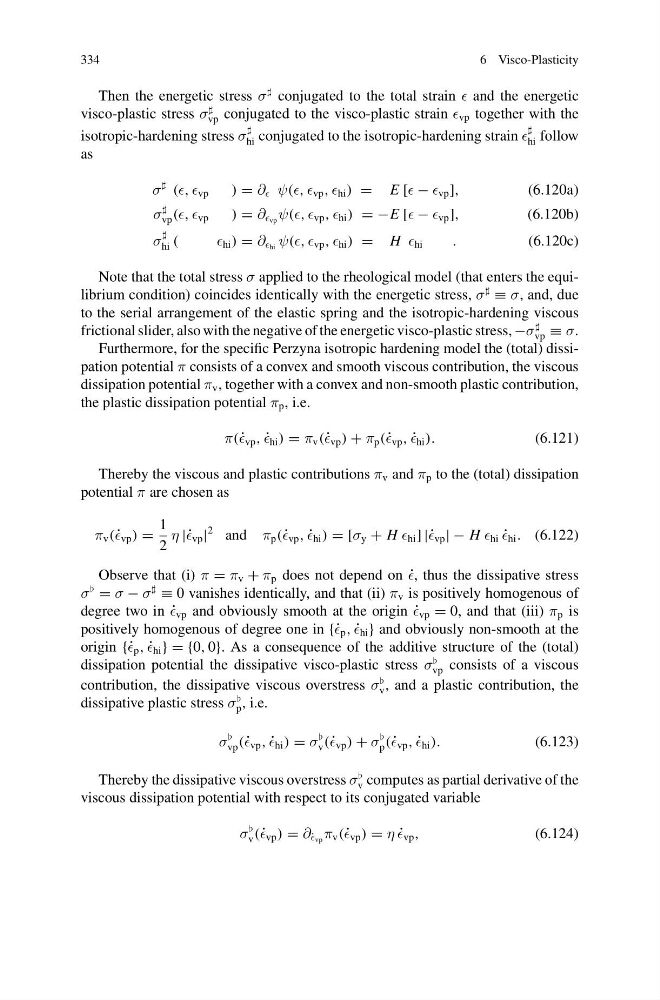
Then the energetic stress σ
conjugated to the total strain and the energetic
visco-plastic stress σ
vp conjugated to the visco-plastic strain vp together with the
isotropic-hardening stress σ
hi conjugated to the isotropic-hardening strain
hi follow
as
σ
(, vp
) = ∂ ψ(, vp , hi ) = E [ − vp ],
(6.120a)
σ
vp (, vp
) = ∂ vp ψ(, vp , hi ) = −E [ − vp ],
(6.120b)
σ
hi (
hi ) = ∂ hi ψ(, vp , hi ) = H hi
.
(6.120c)
Note that the total stress σ applied to the rheological model (that enters the equilibrium condition) coincides identically with the energetic stress, σ
≡ σ, and, due
to the serial arrangement of the elastic spring and the isotropic-hardening viscous
frictional slider, also with the negative of the energetic visco-plastic stress, −σ
vp ≡ σ.
Furthermore, for the specific Perzyna isotropic hardening model the (total) dissipation potential π consists of a convex and smooth viscous contribution, the viscous
dissipation potential π v , together with a convex and non-smooth plastic contribution,
the plastic dissipation potential π p , i.e.
π(˙ vp , ˙
hi ) = π v (˙ vp ) + π p (˙ vp , ˙
hi ).
(6.121)
Thereby the viscous and plastic contributions π v and π p to the (total) dissipation
potential π are chosen as
π v (˙ vp ) =
1
2
η |˙ vp |
2 and π p (˙ vp , ˙
hi ) = [σ y + H hi ] |˙ vp | − H hi ˙
hi . (6.122)
Observe that (i) π = π v + π p does not depend on ˙
, thus the dissipative stress
σ
= σ − σ
≡ 0 vanishes identically, and that (ii) π v is positively homogenous of
degree two in ˙
vp and obviously smooth at the origin ˙
vp = 0, and that (iii) π p is
positively homogenous of degree one in {˙ p , ˙
hi } and obviously non-smooth at the
origin {˙ p , ˙
hi } = {0, 0}. As a consequence of the additive structure of the (total)
dissipation potential the dissipative visco-plastic stress σ
vp consists of a viscous
contribution, the dissipative viscous overstress σ
v , and a plastic contribution, the
dissipative plastic stress σ
p , i.e.
σ
vp (˙ vp , ˙
hi ) = σ
v (˙ vp ) + σ
p (˙ vp , ˙
hi ).
(6.123)
Thereby the dissipative viscous overstress σ
v computes as partial derivative of the
viscous dissipation potential with respect to its conjugated variable
σ
v (˙ vp ) = ∂ ˙
vp π v (˙ vp ) = η ˙
vp ,
(6.124)
6 Visco-Plasticity
Then the energetic stress σ
conjugated to the total strain and the energetic
visco-plastic stress σ
vp conjugated to the visco-plastic strain vp together with the
isotropic-hardening stress σ
hi conjugated to the isotropic-hardening strain
hi follow
as
σ
(, vp
) = ∂ ψ(, vp , hi ) = E [ − vp ],
(6.120a)
σ
vp (, vp
) = ∂ vp ψ(, vp , hi ) = −E [ − vp ],
(6.120b)
σ
hi (
hi ) = ∂ hi ψ(, vp , hi ) = H hi
.
(6.120c)
Note that the total stress σ applied to the rheological model (that enters the equilibrium condition) coincides identically with the energetic stress, σ
≡ σ, and, due
to the serial arrangement of the elastic spring and the isotropic-hardening viscous
frictional slider, also with the negative of the energetic visco-plastic stress, −σ
vp ≡ σ.
Furthermore, for the specific Perzyna isotropic hardening model the (total) dissipation potential π consists of a convex and smooth viscous contribution, the viscous
dissipation potential π v , together with a convex and non-smooth plastic contribution,
the plastic dissipation potential π p , i.e.
π(˙ vp , ˙
hi ) = π v (˙ vp ) + π p (˙ vp , ˙
hi ).
(6.121)
Thereby the viscous and plastic contributions π v and π p to the (total) dissipation
potential π are chosen as
π v (˙ vp ) =
1
2
η |˙ vp |
2 and π p (˙ vp , ˙
hi ) = [σ y + H hi ] |˙ vp | − H hi ˙
hi . (6.122)
Observe that (i) π = π v + π p does not depend on ˙
, thus the dissipative stress
σ
= σ − σ
≡ 0 vanishes identically, and that (ii) π v is positively homogenous of
degree two in ˙
vp and obviously smooth at the origin ˙
vp = 0, and that (iii) π p is
positively homogenous of degree one in {˙ p , ˙
hi } and obviously non-smooth at the
origin {˙ p , ˙
hi } = {0, 0}. As a consequence of the additive structure of the (total)
dissipation potential the dissipative visco-plastic stress σ
vp consists of a viscous
contribution, the dissipative viscous overstress σ
v , and a plastic contribution, the
dissipative plastic stress σ
p , i.e.
σ
vp (˙ vp , ˙
hi ) = σ
v (˙ vp ) + σ
p (˙ vp , ˙
hi ).
(6.123)
Thereby the dissipative viscous overstress σ
v computes as partial derivative of the
viscous dissipation potential with respect to its conjugated variable
σ
v (˙ vp ) = ∂ ˙
vp π v (˙ vp ) = η ˙
vp ,
(6.124)