

6.2 Perzyna Model
311
6.2.1 Specific Perzyna Model: Formulation
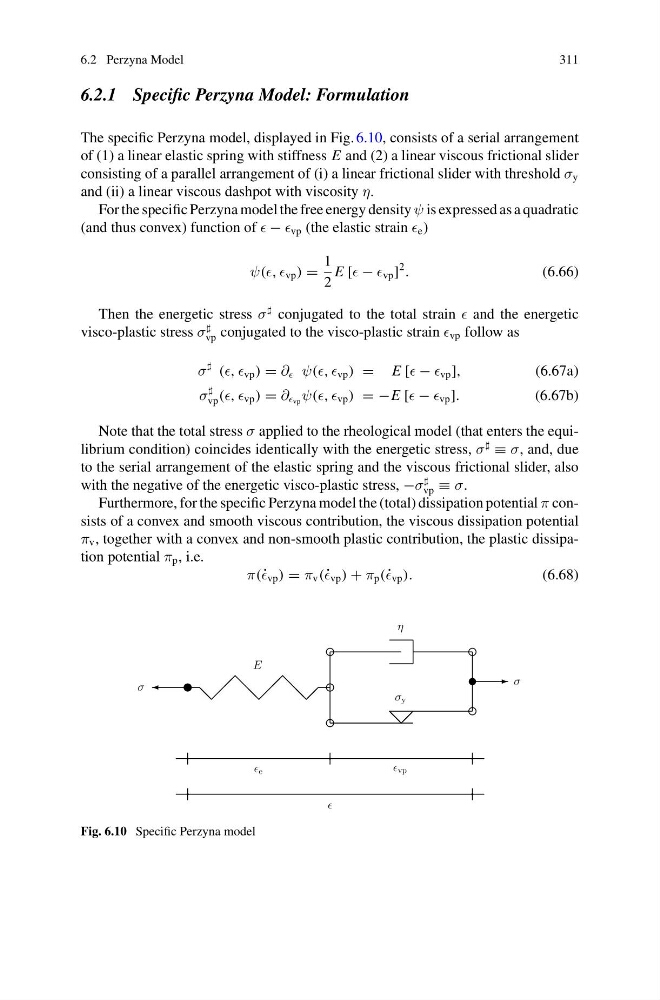
The specific Perzyna model, displayed in Fig. 6.10, consists of a serial arrangement
of (1) a linear elastic spring with stiffness E and (2) a linear viscous frictional slider
consisting of a parallel arrangement of (i) a linear frictional slider with threshold σ y
and (ii) a linear viscous dashpot with viscosity η.
For the specific Perzyna model the free energy density ψ is expressed as a quadratic
(and thus convex) function of − vp (the elastic strain e )
ψ( vp ) =
1
2
E [ − vp ]
2
.
(6.66)
Then the energetic stress σ
conjugated to the total strain and the energetic
visco-plastic stress σ
vp conjugated to the visco-plastic strain vp follow as
σ
( vp ) = ∂ ψ( vp ) = E [ − vp ],
(6.67a)
σ
vp ( vp ) = ∂ vp ψ( vp ) = −E [ − vp ].
(6.67b)
Note that the total stress σ applied to the rheological model (that enters the equilibrium condition) coincides identically with the energetic stress, σ
≡ σ, and, due
to the serial arrangement of the elastic spring and the viscous frictional slider, also
with the negative of the energetic visco-plastic stress, −σ
vp ≡ σ.
Furthermore, for the specific Perzyna model the (total) dissipation potential π consists of a convex and smooth viscous contribution, the viscous dissipation potential
π v , together with a convex and non-smooth plastic contribution, the plastic dissipation potential π p , i.e.
π(˙ vp ) = π v (˙ vp ) + π p (˙ vp ).
(6.68)
σ
σ
e
vp
E
η
σ y
Fig. 6.10 Specific Perzyna model
311
6.2.1 Specific Perzyna Model: Formulation
The specific Perzyna model, displayed in Fig. 6.10, consists of a serial arrangement
of (1) a linear elastic spring with stiffness E and (2) a linear viscous frictional slider
consisting of a parallel arrangement of (i) a linear frictional slider with threshold σ y
and (ii) a linear viscous dashpot with viscosity η.
For the specific Perzyna model the free energy density ψ is expressed as a quadratic
(and thus convex) function of − vp (the elastic strain e )
ψ( vp ) =
1
2
E [ − vp ]
2
.
(6.66)
Then the energetic stress σ
conjugated to the total strain and the energetic
visco-plastic stress σ
vp conjugated to the visco-plastic strain vp follow as
σ
( vp ) = ∂ ψ( vp ) = E [ − vp ],
(6.67a)
σ
vp ( vp ) = ∂ vp ψ( vp ) = −E [ − vp ].
(6.67b)
Note that the total stress σ applied to the rheological model (that enters the equilibrium condition) coincides identically with the energetic stress, σ
≡ σ, and, due
to the serial arrangement of the elastic spring and the viscous frictional slider, also
with the negative of the energetic visco-plastic stress, −σ
vp ≡ σ.
Furthermore, for the specific Perzyna model the (total) dissipation potential π consists of a convex and smooth viscous contribution, the viscous dissipation potential
π v , together with a convex and non-smooth plastic contribution, the plastic dissipation potential π p , i.e.
π(˙ vp ) = π v (˙ vp ) + π p (˙ vp ).
(6.68)
σ
σ
e
vp
E
η
σ y
Fig. 6.10 Specific Perzyna model