

310
6 Visco-Plasticity
Table 6.3 Summary of the generic Bingham model
(1) Strain
= vp
(2) Potential π = π(˙ )
(3) Stress
σ ∈ d ˙
π σ
or
(2) Potential π ∗ =
1
2 φ(σ) 2 /η
(3) Evolution ˙
= λ ∂ σ φ with λ : = =φ(σ)/η
6.2 Perzyna Model
The Perzyna model of a perfect elasto-visco-plastic solid (in short the Perzyna model)
consists of a serial arrangement of (1) an elastic spring and (2) a viscous frictional
slider consisting of a parallel arrangement of (i) a frictional slider and (ii) a viscous
dashpot (see the sketch of the specific Perzyna model in Fig. 6.10).
The basic kinematic assumption of the Perzyna model is the additive decomposition of the total strain into the elastic strain e (representing the elongation of
the elastic spring) and the visco-plastic strain vp (representing the elongation of the
viscous frictional slider), i.e.
= e + vp .
(6.65)
Note that the visco-plastic strain vp denotes the only element contained in the set of
internal variables α = { vp } for the Perzyna model.
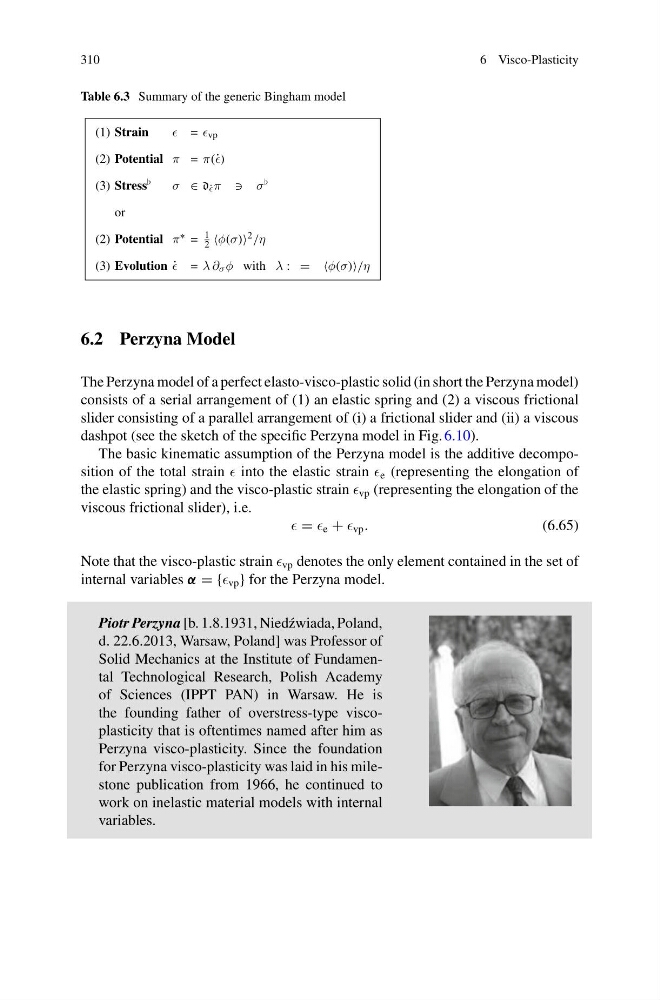
Piotr Perzyna [b. 1.8.1931, Nied´ zwiada, Poland,
d. 22.6.2013, Warsaw, Poland] was Professor of
Solid Mechanics at the Institute of Fundamental Technological Research, Polish Academy
of Sciences (IPPT PAN) in Warsaw. He is
the founding father of overstress-type viscoplasticity that is oftentimes named after him as
Perzyna visco-plasticity. Since the foundation
for Perzyna visco-plasticity was laid in his milestone publication from 1966, he continued to
work on inelastic material models with internal
variables.
6 Visco-Plasticity
Table 6.3 Summary of the generic Bingham model
(1) Strain
= vp
(2) Potential π = π(˙ )
(3) Stress
σ ∈ d ˙
π σ
or
(2) Potential π ∗ =
1
2 φ(σ) 2 /η
(3) Evolution ˙
= λ ∂ σ φ with λ : = =φ(σ)/η
6.2 Perzyna Model
The Perzyna model of a perfect elasto-visco-plastic solid (in short the Perzyna model)
consists of a serial arrangement of (1) an elastic spring and (2) a viscous frictional
slider consisting of a parallel arrangement of (i) a frictional slider and (ii) a viscous
dashpot (see the sketch of the specific Perzyna model in Fig. 6.10).
The basic kinematic assumption of the Perzyna model is the additive decomposition of the total strain into the elastic strain e (representing the elongation of
the elastic spring) and the visco-plastic strain vp (representing the elongation of the
viscous frictional slider), i.e.
= e + vp .
(6.65)
Note that the visco-plastic strain vp denotes the only element contained in the set of
internal variables α = { vp } for the Perzyna model.
Piotr Perzyna [b. 1.8.1931, Nied´ zwiada, Poland,
d. 22.6.2013, Warsaw, Poland] was Professor of
Solid Mechanics at the Institute of Fundamental Technological Research, Polish Academy
of Sciences (IPPT PAN) in Warsaw. He is
the founding father of overstress-type viscoplasticity that is oftentimes named after him as
Perzyna visco-plasticity. Since the foundation
for Perzyna visco-plasticity was laid in his milestone publication from 1966, he continued to
work on inelastic material models with internal
variables.