

6.1 Bingham Model
295
σ vp = E ˙
e = E [˙ − ˙
vp ].
(6.33)
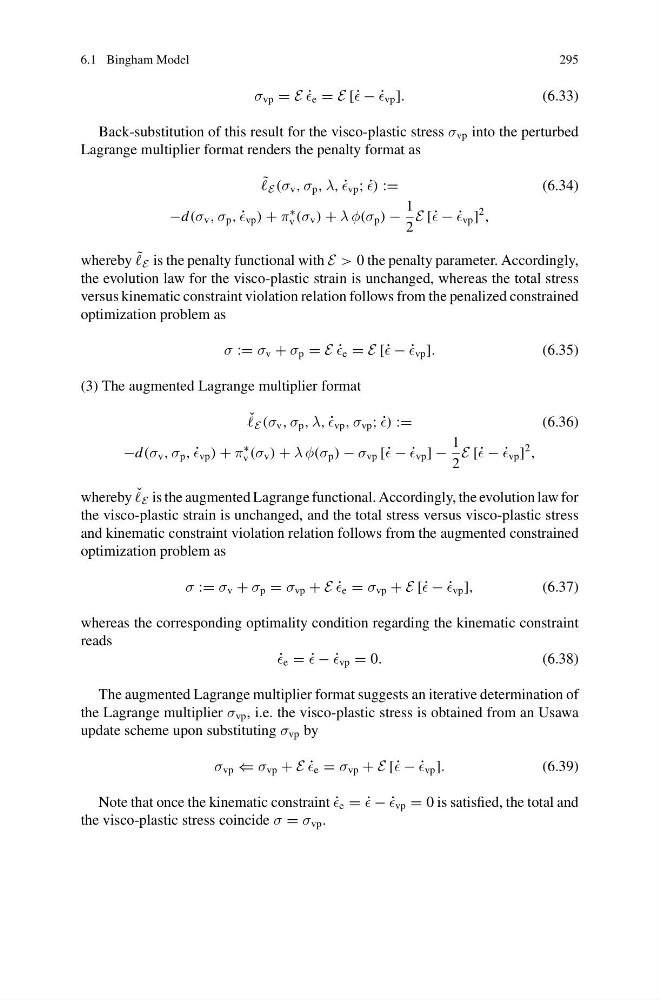
Back-substitution of this result for the visco-plastic stress σ vp into the perturbed
Lagrange multiplier format renders the penalty format as
˜
E (σ v , σ p , λ, ˙
vp ; ˙
) :=
(6.34)
−d(σ v , σ p , ˙
vp ) + π
∗
v (σ v ) + λ φ(σ p ) −
1
2
E [˙ − ˙
vp ]
2
,
whereby ˜
E is the penalty functional with E > 0 the penalty parameter. Accordingly,
the evolution law for the visco-plastic strain is unchanged, whereas the total stress
versus kinematic constraint violation relation follows from the penalized constrained
optimization problem as
σ := σ v + σ p = E ˙
e = E [˙ − ˙
vp ].
(6.35)
(3) The augmented Lagrange multiplier format
ˇ
E (σ v , σ p , λ, ˙
vp , σ vp ; ˙
) :=
(6.36)
−d(σ v , σ p , ˙
vp ) + π
∗
v (σ v ) + λ φ(σ p ) − σ vp [˙ − ˙
vp ] −
1
2
E [˙ − ˙
vp ]
2
,
whereby ˇ
E is the augmented Lagrange functional. Accordingly, the evolution law for
the visco-plastic strain is unchanged, and the total stress versus visco-plastic stress
and kinematic constraint violation relation follows from the augmented constrained
optimization problem as
σ := σ v + σ p = σ vp + E ˙
e = σ vp + E [˙ − ˙
vp ],
(6.37)
whereas the corresponding optimality condition regarding the kinematic constraint
reads
˙
e = ˙
− ˙
vp = 0.
(6.38)
The augmented Lagrange multiplier format suggests an iterative determination of
the Lagrange multiplier σ vp , i.e. the visco-plastic stress is obtained from an Usawa
update scheme upon substituting σ vp by
σ vp ⇐ σ vp + E ˙
e = σ vp + E [˙ − ˙
vp ].
(6.39)
Note that once the kinematic constraint ˙
e = ˙
− ˙
vp = 0 is satisfied, the total and
the visco-plastic stress coincide σ = σ vp .
295
σ vp = E ˙
e = E [˙ − ˙
vp ].
(6.33)
Back-substitution of this result for the visco-plastic stress σ vp into the perturbed
Lagrange multiplier format renders the penalty format as
˜
E (σ v , σ p , λ, ˙
vp ; ˙
) :=
(6.34)
−d(σ v , σ p , ˙
vp ) + π
∗
v (σ v ) + λ φ(σ p ) −
1
2
E [˙ − ˙
vp ]
2
,
whereby ˜
E is the penalty functional with E > 0 the penalty parameter. Accordingly,
the evolution law for the visco-plastic strain is unchanged, whereas the total stress
versus kinematic constraint violation relation follows from the penalized constrained
optimization problem as
σ := σ v + σ p = E ˙
e = E [˙ − ˙
vp ].
(6.35)
(3) The augmented Lagrange multiplier format
ˇ
E (σ v , σ p , λ, ˙
vp , σ vp ; ˙
) :=
(6.36)
−d(σ v , σ p , ˙
vp ) + π
∗
v (σ v ) + λ φ(σ p ) − σ vp [˙ − ˙
vp ] −
1
2
E [˙ − ˙
vp ]
2
,
whereby ˇ
E is the augmented Lagrange functional. Accordingly, the evolution law for
the visco-plastic strain is unchanged, and the total stress versus visco-plastic stress
and kinematic constraint violation relation follows from the augmented constrained
optimization problem as
σ := σ v + σ p = σ vp + E ˙
e = σ vp + E [˙ − ˙
vp ],
(6.37)
whereas the corresponding optimality condition regarding the kinematic constraint
reads
˙
e = ˙
− ˙
vp = 0.
(6.38)
The augmented Lagrange multiplier format suggests an iterative determination of
the Lagrange multiplier σ vp , i.e. the visco-plastic stress is obtained from an Usawa
update scheme upon substituting σ vp by
σ vp ⇐ σ vp + E ˙
e = σ vp + E [˙ − ˙
vp ].
(6.39)
Note that once the kinematic constraint ˙
e = ˙
− ˙
vp = 0 is satisfied, the total and
the visco-plastic stress coincide σ = σ vp .