

294
6 Visco-Plasticity
Determination of Total Stress
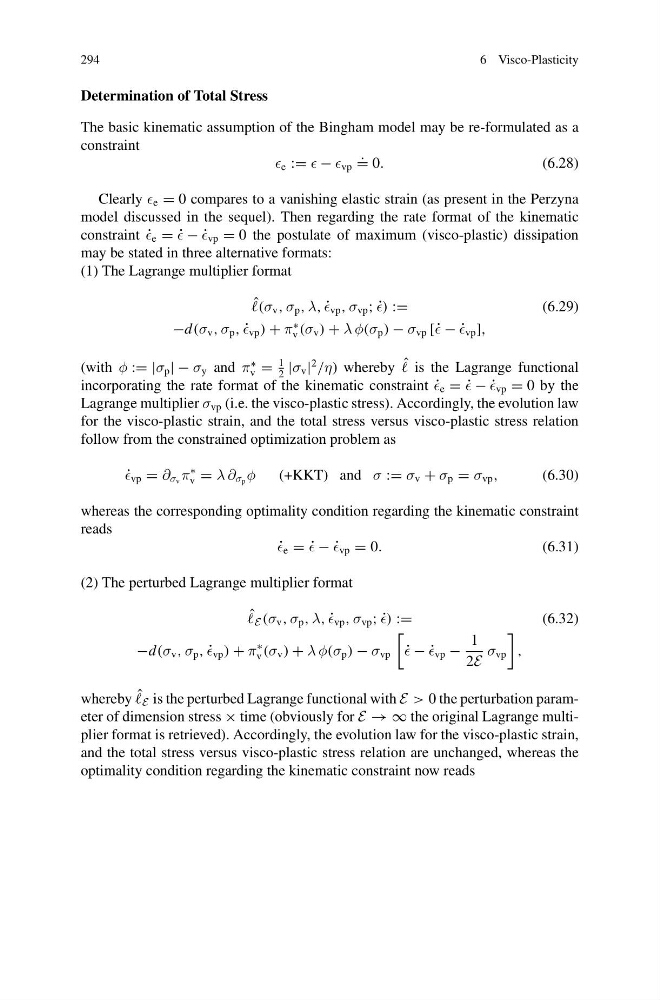
The basic kinematic assumption of the Bingham model may be re-formulated as a
constraint
e := − vp
.
= 0.
(6.28)
Clearly e = 0 compares to a vanishing elastic strain (as present in the Perzyna
model discussed in the sequel). Then regarding the rate format of the kinematic
constraint ˙
e = ˙
− ˙
vp = 0 the postulate of maximum (visco-plastic) dissipation
may be stated in three alternative formats:
(1) The Lagrange multiplier format
ˆ
(σ v , σ p , λ, ˙
vp , σ vp ; ˙
) :=
(6.29)
−d(σ v , σ p , ˙
vp ) + π
∗
v (σ v ) + λ φ(σ p ) − σ vp [˙ − ˙
vp ],
(with φ := |σ p | − σ y and π
∗
v =
1
2
|σ v |
2
/η) whereby ˆ
is the Lagrange functional
incorporating the rate format of the kinematic constraint ˙
e = ˙
− ˙
vp = 0 by the
Lagrange multiplier σ vp (i.e. the visco-plastic stress). Accordingly, the evolution law
for the visco-plastic strain, and the total stress versus visco-plastic stress relation
follow from the constrained optimization problem as
˙
vp = ∂ σ v π
∗
v = λ ∂ σ p φ
(+KKT) and σ := σ v + σ p = σ vp ,
(6.30)
whereas the corresponding optimality condition regarding the kinematic constraint
reads
˙
e = ˙
− ˙
vp = 0.
(6.31)
(2) The perturbed Lagrange multiplier format
ˆ
E (σ v , σ p , λ, ˙
vp , σ vp ; ˙
) :=
(6.32)
−d(σ v , σ p , ˙
vp ) + π
∗
v (σ v ) + λ φ(σ p ) − σ vp
˙
− ˙
vp −
1
2E
σ vp
,
whereby ˆ
E is the perturbed Lagrange functional with E > 0 the perturbation parameter of dimension stress × time (obviously for E → ∞ the original Lagrange multiplier format is retrieved). Accordingly, the evolution law for the visco-plastic strain,
and the total stress versus visco-plastic stress relation are unchanged, whereas the
optimality condition regarding the kinematic constraint now reads
6 Visco-Plasticity
Determination of Total Stress
The basic kinematic assumption of the Bingham model may be re-formulated as a
constraint
e := − vp
.
= 0.
(6.28)
Clearly e = 0 compares to a vanishing elastic strain (as present in the Perzyna
model discussed in the sequel). Then regarding the rate format of the kinematic
constraint ˙
e = ˙
− ˙
vp = 0 the postulate of maximum (visco-plastic) dissipation
may be stated in three alternative formats:
(1) The Lagrange multiplier format
ˆ
(σ v , σ p , λ, ˙
vp , σ vp ; ˙
) :=
(6.29)
−d(σ v , σ p , ˙
vp ) + π
∗
v (σ v ) + λ φ(σ p ) − σ vp [˙ − ˙
vp ],
(with φ := |σ p | − σ y and π
∗
v =
1
2
|σ v |
2
/η) whereby ˆ
is the Lagrange functional
incorporating the rate format of the kinematic constraint ˙
e = ˙
− ˙
vp = 0 by the
Lagrange multiplier σ vp (i.e. the visco-plastic stress). Accordingly, the evolution law
for the visco-plastic strain, and the total stress versus visco-plastic stress relation
follow from the constrained optimization problem as
˙
vp = ∂ σ v π
∗
v = λ ∂ σ p φ
(+KKT) and σ := σ v + σ p = σ vp ,
(6.30)
whereas the corresponding optimality condition regarding the kinematic constraint
reads
˙
e = ˙
− ˙
vp = 0.
(6.31)
(2) The perturbed Lagrange multiplier format
ˆ
E (σ v , σ p , λ, ˙
vp , σ vp ; ˙
) :=
(6.32)
−d(σ v , σ p , ˙
vp ) + π
∗
v (σ v ) + λ φ(σ p ) − σ vp
˙
− ˙
vp −
1
2E
σ vp
,
whereby ˆ
E is the perturbed Lagrange functional with E > 0 the perturbation parameter of dimension stress × time (obviously for E → ∞ the original Lagrange multiplier format is retrieved). Accordingly, the evolution law for the visco-plastic strain,
and the total stress versus visco-plastic stress relation are unchanged, whereas the
optimality condition regarding the kinematic constraint now reads