

6.1 Bingham Model
287
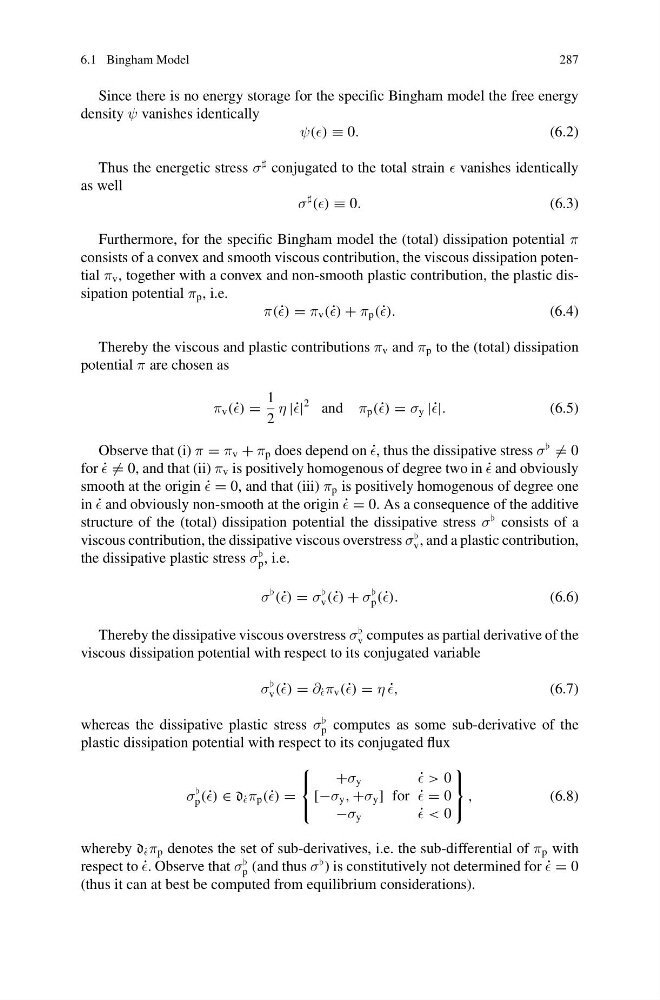
Since there is no energy storage for the specific Bingham model the free energy
density ψ vanishes identically
ψ() ≡ 0.
(6.2)
Thus the energetic stress σ
conjugated to the total strain vanishes identically
as well
σ
() ≡ 0.
(6.3)
Furthermore, for the specific Bingham model the (total) dissipation potential π
consists of a convex and smooth viscous contribution, the viscous dissipation potential π v , together with a convex and non-smooth plastic contribution, the plastic dissipation potential π p , i.e.
π(˙ ) = π v (˙ ) + π p (˙ ).
(6.4)
Thereby the viscous and plastic contributions π v and π p to the (total) dissipation
potential π are chosen as
π v (˙ ) =
1
2
η |˙ |
2 and π p (˙ ) = σ y |˙ |.
(6.5)
Observe that (i) π = π v + π p does depend on ˙
, thus the dissipative stress σ
= 0
for ˙
= 0, and that (ii) π v is positively homogenous of degree two in ˙
and obviously
smooth at the origin ˙
= 0, and that (iii) π p is positively homogenous of degree one
in ˙
and obviously non-smooth at the origin ˙
= 0. As a consequence of the additive
structure of the (total) dissipation potential the dissipative stress σ
consists of a
viscous contribution, the dissipative viscous overstress σ
v , and a plastic contribution,
the dissipative plastic stress σ
p , i.e.
σ
(˙ ) = σ
v (˙ ) + σ
p (˙ ).
(6.6)
Thereby the dissipative viscous overstress σ
v computes as partial derivative of the
viscous dissipation potential with respect to its conjugated variable
σ
v (˙ ) = ∂ ˙
π v (˙ ) = η ˙
,
(6.7)
whereas the dissipative plastic stress σ
p computes as some sub-derivative of the
plastic dissipation potential with respect to its conjugated flux
σ
p (˙ ) ∈ d ˙
π p (˙ ) =
⎧
⎨
⎩
+σ y
˙
> 0
[−σ y , +σ y ] for ˙
= 0
−σ y
˙
< 0
⎫
⎬
⎭
,
(6.8)
whereby d ˙
π p denotes the set of sub-derivatives, i.e. the sub-differential of π p with
respect to ˙
. Observe that σ
p (and thus σ
) is constitutively not determined for ˙
= 0
(thus it can at best be computed from equilibrium considerations).
287
Since there is no energy storage for the specific Bingham model the free energy
density ψ vanishes identically
ψ() ≡ 0.
(6.2)
Thus the energetic stress σ
conjugated to the total strain vanishes identically
as well
σ
() ≡ 0.
(6.3)
Furthermore, for the specific Bingham model the (total) dissipation potential π
consists of a convex and smooth viscous contribution, the viscous dissipation potential π v , together with a convex and non-smooth plastic contribution, the plastic dissipation potential π p , i.e.
π(˙ ) = π v (˙ ) + π p (˙ ).
(6.4)
Thereby the viscous and plastic contributions π v and π p to the (total) dissipation
potential π are chosen as
π v (˙ ) =
1
2
η |˙ |
2 and π p (˙ ) = σ y |˙ |.
(6.5)
Observe that (i) π = π v + π p does depend on ˙
, thus the dissipative stress σ
= 0
for ˙
= 0, and that (ii) π v is positively homogenous of degree two in ˙
and obviously
smooth at the origin ˙
= 0, and that (iii) π p is positively homogenous of degree one
in ˙
and obviously non-smooth at the origin ˙
= 0. As a consequence of the additive
structure of the (total) dissipation potential the dissipative stress σ
consists of a
viscous contribution, the dissipative viscous overstress σ
v , and a plastic contribution,
the dissipative plastic stress σ
p , i.e.
σ
(˙ ) = σ
v (˙ ) + σ
p (˙ ).
(6.6)
Thereby the dissipative viscous overstress σ
v computes as partial derivative of the
viscous dissipation potential with respect to its conjugated variable
σ
v (˙ ) = ∂ ˙
π v (˙ ) = η ˙
,
(6.7)
whereas the dissipative plastic stress σ
p computes as some sub-derivative of the
plastic dissipation potential with respect to its conjugated flux
σ
p (˙ ) ∈ d ˙
π p (˙ ) =
⎧
⎨
⎩
+σ y
˙
> 0
[−σ y , +σ y ] for ˙
= 0
−σ y
˙
< 0
⎫
⎬
⎭
,
(6.8)
whereby d ˙
π p denotes the set of sub-derivatives, i.e. the sub-differential of π p with
respect to ˙
. Observe that σ
p (and thus σ
) is constitutively not determined for ˙
= 0
(thus it can at best be computed from equilibrium considerations).