

286
6 Visco-Plasticity
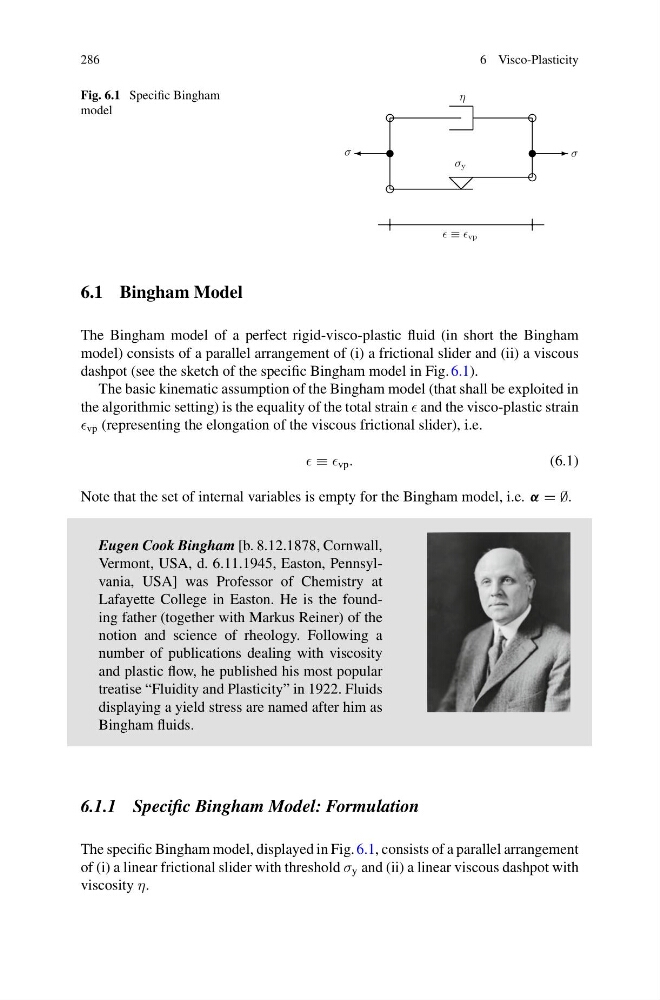
Fig. 6.1 Specific Bingham
model
σ
σ
≡ vp
η
σ y
6.1 Bingham Model
The Bingham model of a perfect rigid-visco-plastic fluid (in short the Bingham
model) consists of a parallel arrangement of (i) a frictional slider and (ii) a viscous
dashpot (see the sketch of the specific Bingham model in Fig. 6.1).
The basic kinematic assumption of the Bingham model (that shall be exploited in
the algorithmic setting) is the equality of the total strain and the visco-plastic strain
vp (representing the elongation of the viscous frictional slider), i.e.
≡ vp .
(6.1)
Note that the set of internal variables is empty for the Bingham model, i.e. α = ∅.
Eugen Cook Bingham [b. 8.12.1878, Cornwall,
Vermont, USA, d. 6.11.1945, Easton, Pennsylvania, USA] was Professor of Chemistry at
Lafayette College in Easton. He is the founding father (together with Markus Reiner) of the
notion and science of rheology. Following a
number of publications dealing with viscosity
and plastic flow, he published his most popular
treatise “Fluidity and Plasticity” in 1922. Fluids
displaying a yield stress are named after him as
Bingham fluids.
6.1.1 Specific Bingham Model: Formulation
The specific Bingham model, displayed in Fig. 6.1, consists of a parallel arrangement
of (i) a linear frictional slider with threshold σ y and (ii) a linear viscous dashpot with
viscosity η.
6 Visco-Plasticity
Fig. 6.1 Specific Bingham
model
σ
σ
≡ vp
η
σ y
6.1 Bingham Model
The Bingham model of a perfect rigid-visco-plastic fluid (in short the Bingham
model) consists of a parallel arrangement of (i) a frictional slider and (ii) a viscous
dashpot (see the sketch of the specific Bingham model in Fig. 6.1).
The basic kinematic assumption of the Bingham model (that shall be exploited in
the algorithmic setting) is the equality of the total strain and the visco-plastic strain
vp (representing the elongation of the viscous frictional slider), i.e.
≡ vp .
(6.1)
Note that the set of internal variables is empty for the Bingham model, i.e. α = ∅.
Eugen Cook Bingham [b. 8.12.1878, Cornwall,
Vermont, USA, d. 6.11.1945, Easton, Pennsylvania, USA] was Professor of Chemistry at
Lafayette College in Easton. He is the founding father (together with Markus Reiner) of the
notion and science of rheology. Following a
number of publications dealing with viscosity
and plastic flow, he published his most popular
treatise “Fluidity and Plasticity” in 1922. Fluids
displaying a yield stress are named after him as
Bingham fluids.
6.1.1 Specific Bingham Model: Formulation
The specific Bingham model, displayed in Fig. 6.1, consists of a parallel arrangement
of (i) a linear frictional slider with threshold σ y and (ii) a linear viscous dashpot with
viscosity η.