

266
5 Plasticity
with
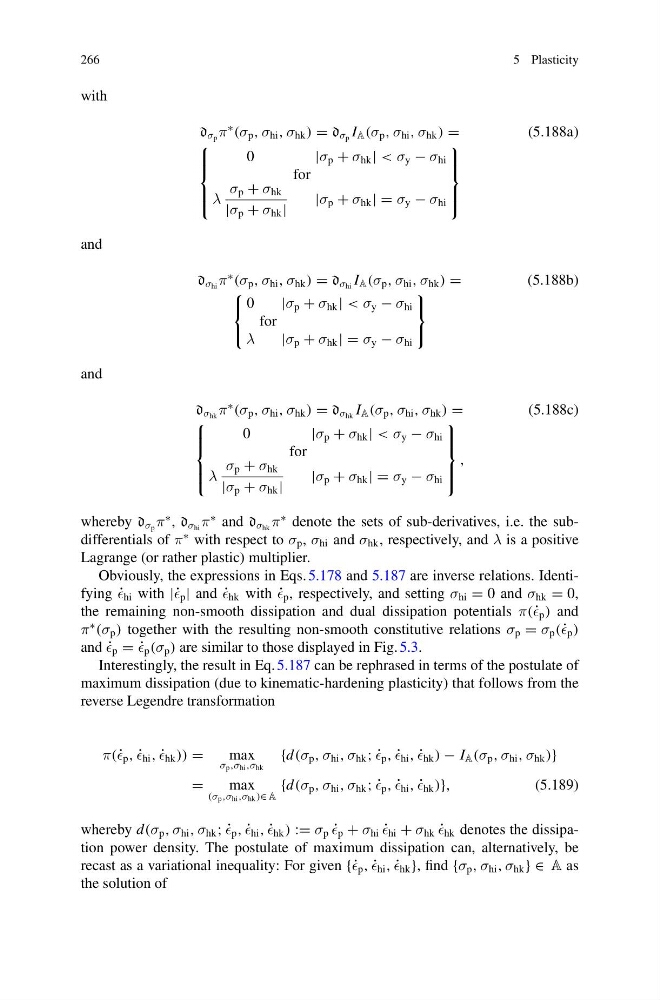
d σ p π
∗
(σ p , σ hi , σ hk ) = d σ p I A (σ p , σ hi , σ hk ) =
(5.188a)
⎧
⎪ ⎪ ⎨
⎪ ⎪ ⎩
0
|σ p + σ hk | < σ y − σ hi
for
λ
σ p + σ hk
|σ p + σ hk |
|σ p + σ hk | = σ y − σ hi
⎫
⎪ ⎪ ⎬
⎪ ⎪ ⎭
and
d σ hi π
∗
(σ p , σ hi , σ hk ) = d σ hi I A (σ p , σ hi , σ hk ) =
(5.188b)
⎧
⎨
⎩
0
|σ p + σ hk | < σ y − σ hi
for
λ
|σ p + σ hk | = σ y − σ hi
⎫
⎬
⎭
and
d σ hk π
∗
(σ p , σ hi , σ hk ) = d σ hk I A (σ p , σ hi , σ hk ) =
(5.188c)
⎧
⎪ ⎪ ⎨
⎪ ⎪ ⎩
0
|σ p + σ hk | < σ y − σ hi
for
λ
σ p + σ hk
|σ p + σ hk |
|σ p + σ hk | = σ y − σ hi
⎫
⎪ ⎪ ⎬
⎪ ⎪ ⎭
,
whereby d σ p π
∗ , d σ hi π
∗ and d σ hk π
∗ denote the sets of sub-derivatives, i.e. the subdifferentials of π
∗ with respect to σ p , σ hi and σ hk , respectively, and λ is a positive
Lagrange (or rather plastic) multiplier.
Obviously, the expressions in Eqs. 5.178 and 5.187 are inverse relations. Identifying ˙
hi with |˙ p | and ˙
hk with ˙
p , respectively, and setting σ hi = 0 and σ hk = 0,
the remaining non-smooth dissipation and dual dissipation potentials π(˙ p ) and
π
∗
(σ p ) together with the resulting non-smooth constitutive relations σ p = σ p (˙ p )
and ˙
p = ˙
p (σ p ) are similar to those displayed in Fig. 5.3.
Interestingly, the result in Eq. 5.187 can be rephrased in terms of the postulate of
maximum dissipation (due to kinematic-hardening plasticity) that follows from the
reverse Legendre transformation
π(˙ p , ˙
hi , ˙
hk )) =
max
σ p ,σ hi ,σ hk
{d(σ p , σ hi , σ hk ; ˙
p , ˙
hi , ˙
hk ) − I A (σ p , σ hi , σ hk )}
=
max
(σ p ,σ hi ,σ hk )∈ A
{d(σ p , σ hi , σ hk ; ˙
p , ˙
hi , ˙
hk )},
(5.189)
whereby d(σ p , σ hi , σ hk ; ˙
p , ˙
hi , ˙
hk ) := σ p ˙
p + σ hi ˙
hi + σ hk ˙
hk denotes the dissipation power density. The postulate of maximum dissipation can, alternatively, be
recast as a variational inequality: For given {˙ p , ˙
hi , ˙
hk }, find {σ p , σ hi , σ hk } ∈ A as
the solution of
5 Plasticity
with
d σ p π
∗
(σ p , σ hi , σ hk ) = d σ p I A (σ p , σ hi , σ hk ) =
(5.188a)
⎧
⎪ ⎪ ⎨
⎪ ⎪ ⎩
0
|σ p + σ hk | < σ y − σ hi
for
λ
σ p + σ hk
|σ p + σ hk |
|σ p + σ hk | = σ y − σ hi
⎫
⎪ ⎪ ⎬
⎪ ⎪ ⎭
and
d σ hi π
∗
(σ p , σ hi , σ hk ) = d σ hi I A (σ p , σ hi , σ hk ) =
(5.188b)
⎧
⎨
⎩
0
|σ p + σ hk | < σ y − σ hi
for
λ
|σ p + σ hk | = σ y − σ hi
⎫
⎬
⎭
and
d σ hk π
∗
(σ p , σ hi , σ hk ) = d σ hk I A (σ p , σ hi , σ hk ) =
(5.188c)
⎧
⎪ ⎪ ⎨
⎪ ⎪ ⎩
0
|σ p + σ hk | < σ y − σ hi
for
λ
σ p + σ hk
|σ p + σ hk |
|σ p + σ hk | = σ y − σ hi
⎫
⎪ ⎪ ⎬
⎪ ⎪ ⎭
,
whereby d σ p π
∗ , d σ hi π
∗ and d σ hk π
∗ denote the sets of sub-derivatives, i.e. the subdifferentials of π
∗ with respect to σ p , σ hi and σ hk , respectively, and λ is a positive
Lagrange (or rather plastic) multiplier.
Obviously, the expressions in Eqs. 5.178 and 5.187 are inverse relations. Identifying ˙
hi with |˙ p | and ˙
hk with ˙
p , respectively, and setting σ hi = 0 and σ hk = 0,
the remaining non-smooth dissipation and dual dissipation potentials π(˙ p ) and
π
∗
(σ p ) together with the resulting non-smooth constitutive relations σ p = σ p (˙ p )
and ˙
p = ˙
p (σ p ) are similar to those displayed in Fig. 5.3.
Interestingly, the result in Eq. 5.187 can be rephrased in terms of the postulate of
maximum dissipation (due to kinematic-hardening plasticity) that follows from the
reverse Legendre transformation
π(˙ p , ˙
hi , ˙
hk )) =
max
σ p ,σ hi ,σ hk
{d(σ p , σ hi , σ hk ; ˙
p , ˙
hi , ˙
hk ) − I A (σ p , σ hi , σ hk )}
=
max
(σ p ,σ hi ,σ hk )∈ A
{d(σ p , σ hi , σ hk ; ˙
p , ˙
hi , ˙
hk )},
(5.189)
whereby d(σ p , σ hi , σ hk ; ˙
p , ˙
hi , ˙
hk ) := σ p ˙
p + σ hi ˙
hi + σ hk ˙
hk denotes the dissipation power density. The postulate of maximum dissipation can, alternatively, be
recast as a variational inequality: For given {˙ p , ˙
hi , ˙
hk }, find {σ p , σ hi , σ hk } ∈ A as
the solution of