

226
5 Plasticity
σ
σ
ε h
e
p
E
σ y
H
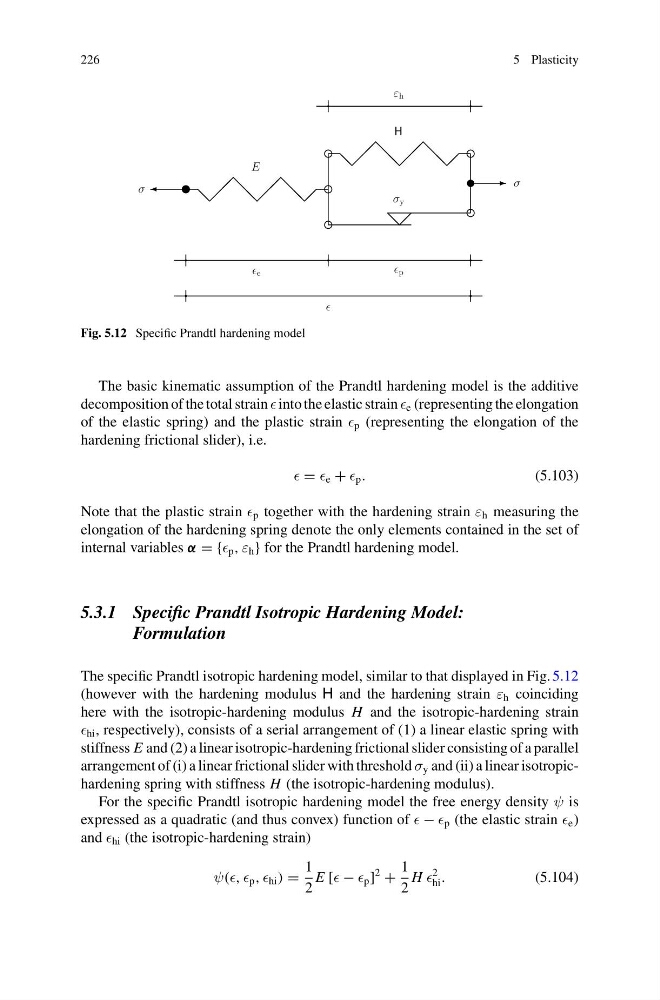
Fig. 5.12 Specific Prandtl hardening model
The basic kinematic assumption of the Prandtl hardening model is the additive
decomposition of the total strain into the elastic strain e (representing the elongation
of the elastic spring) and the plastic strain p (representing the elongation of the
hardening frictional slider), i.e.
= e + p .
(5.103)
Note that the plastic strain p together with the hardening strain ε h measuring the
elongation of the hardening spring denote the only elements contained in the set of
internal variables α = { p , ε h } for the Prandtl hardening model.
5.3.1 Specific Prandtl Isotropic Hardening Model:
Formulation
The specific Prandtl isotropic hardening model, similar to that displayed in Fig. 5.12
(however with the hardening modulus H and the hardening strain ε h coinciding
here with the isotropic-hardening modulus H and the isotropic-hardening strain
hi , respectively), consists of a serial arrangement of (1) a linear elastic spring with
stiffness E and (2) a linear isotropic-hardening frictional slider consisting of a parallel
arrangement of (i) a linear frictional slider with threshold σ y and (ii) a linear isotropichardening spring with stiffness H (the isotropic-hardening modulus).
For the specific Prandtl isotropic hardening model the free energy density ψ is
expressed as a quadratic (and thus convex) function of − p (the elastic strain e )
and hi (the isotropic-hardening strain)
ψ( p , hi ) =
1
2
E [ − p ]
2
+
1
2
H
2
hi .
(5.104)
5 Plasticity
σ
σ
ε h
e
p
E
σ y
H
Fig. 5.12 Specific Prandtl hardening model
The basic kinematic assumption of the Prandtl hardening model is the additive
decomposition of the total strain into the elastic strain e (representing the elongation
of the elastic spring) and the plastic strain p (representing the elongation of the
hardening frictional slider), i.e.
= e + p .
(5.103)
Note that the plastic strain p together with the hardening strain ε h measuring the
elongation of the hardening spring denote the only elements contained in the set of
internal variables α = { p , ε h } for the Prandtl hardening model.
5.3.1 Specific Prandtl Isotropic Hardening Model:
Formulation
The specific Prandtl isotropic hardening model, similar to that displayed in Fig. 5.12
(however with the hardening modulus H and the hardening strain ε h coinciding
here with the isotropic-hardening modulus H and the isotropic-hardening strain
hi , respectively), consists of a serial arrangement of (1) a linear elastic spring with
stiffness E and (2) a linear isotropic-hardening frictional slider consisting of a parallel
arrangement of (i) a linear frictional slider with threshold σ y and (ii) a linear isotropichardening spring with stiffness H (the isotropic-hardening modulus).
For the specific Prandtl isotropic hardening model the free energy density ψ is
expressed as a quadratic (and thus convex) function of − p (the elastic strain e )
and hi (the isotropic-hardening strain)
ψ( p , hi ) =
1
2
E [ − p ]
2
+
1
2
H
2
hi .
(5.104)