

5.2 Prandtl Model
225
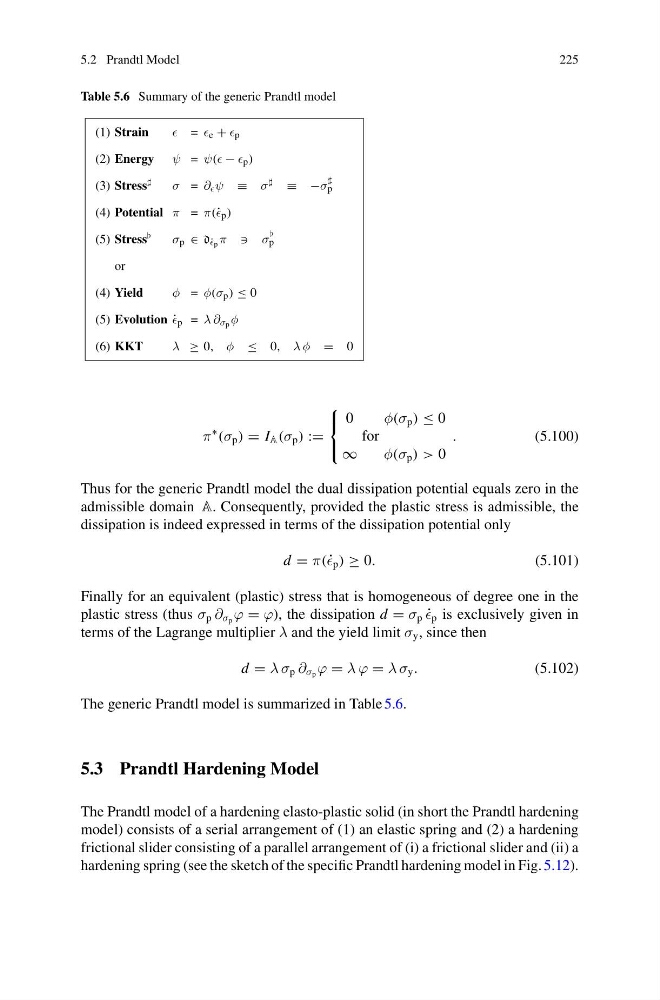
Table 5.6 Summary of the generic Prandtl model
(1) Strain
= e + p
(2) Energy ψ = ψ( − p )
(3) Stress
σ = ∂ ψ ≡ σ ≡ −σ
p
(4) Potential π = π(˙ p )
(5) Stress
σ p ∈ d ˙
p π σ
p
or
(4) Yield
φ = φ(σ p ) ≤ 0
(5) Evolution ˙
p = λ ∂ σp φ
(6) KKT
λ ≥ 0, φ ≤ 0, λ φ = 0
π
∗
(σ p ) = I A (σ p ) :=
⎧
⎨
⎩
0
φ(σ p ) ≤ 0
for
∞
φ(σ p ) > 0
.
(5.100)
Thus for the generic Prandtl model the dual dissipation potential equals zero in the
admissible domain A. Consequently, provided the plastic stress is admissible, the
dissipation is indeed expressed in terms of the dissipation potential only
d = π(˙ p ) ≥ 0.
(5.101)
Finally for an equivalent (plastic) stress that is homogeneous of degree one in the
plastic stress (thus σ p ∂ σ p ϕ = ϕ), the dissipation d = σ p ˙
p is exclusively given in
terms of the Lagrange multiplier λ and the yield limit σ y , since then
d = λ σ p ∂ σ p ϕ = λ ϕ = λ σ y .
(5.102)
The generic Prandtl model is summarized in Table 5.6.
5.3 Prandtl Hardening Model
The Prandtl model of a hardening elasto-plastic solid (in short the Prandtl hardening
model) consists of a serial arrangement of (1) an elastic spring and (2) a hardening
frictional slider consisting of a parallel arrangement of (i) a frictional slider and (ii) a
hardening spring (see the sketch of the specific Prandtl hardening model in Fig. 5.12).
225
Table 5.6 Summary of the generic Prandtl model
(1) Strain
= e + p
(2) Energy ψ = ψ( − p )
(3) Stress
σ = ∂ ψ ≡ σ ≡ −σ
p
(4) Potential π = π(˙ p )
(5) Stress
σ p ∈ d ˙
p π σ
p
or
(4) Yield
φ = φ(σ p ) ≤ 0
(5) Evolution ˙
p = λ ∂ σp φ
(6) KKT
λ ≥ 0, φ ≤ 0, λ φ = 0
π
∗
(σ p ) = I A (σ p ) :=
⎧
⎨
⎩
0
φ(σ p ) ≤ 0
for
∞
φ(σ p ) > 0
.
(5.100)
Thus for the generic Prandtl model the dual dissipation potential equals zero in the
admissible domain A. Consequently, provided the plastic stress is admissible, the
dissipation is indeed expressed in terms of the dissipation potential only
d = π(˙ p ) ≥ 0.
(5.101)
Finally for an equivalent (plastic) stress that is homogeneous of degree one in the
plastic stress (thus σ p ∂ σ p ϕ = ϕ), the dissipation d = σ p ˙
p is exclusively given in
terms of the Lagrange multiplier λ and the yield limit σ y , since then
d = λ σ p ∂ σ p ϕ = λ ϕ = λ σ y .
(5.102)
The generic Prandtl model is summarized in Table 5.6.
5.3 Prandtl Hardening Model
The Prandtl model of a hardening elasto-plastic solid (in short the Prandtl hardening
model) consists of a serial arrangement of (1) an elastic spring and (2) a hardening
frictional slider consisting of a parallel arrangement of (i) a frictional slider and (ii) a
hardening spring (see the sketch of the specific Prandtl hardening model in Fig. 5.12).