

4.3 Generalized-Kelvin Model
129
10
−3 10
−2 10
−1 10
0 10
1 10
2 10
3
10
0
10
0.1
10
0.2
10
0.3
ω
E a
E ∞
τ = 10
2
, 10
1
, 10
0
, 10
−1
, 10
−2
1 + τ 2 ω 2
1 + c 2 τ 2 ω 2
10
−3 10
−2 10
−1 10
0 10
1 10
2 10
3
10
−5
10
−4
10
−3
10
−2
10
−1
10
0
ω
E
E
τ = 10
2
, 10
1
, 10
0
, 10
−1
, 10
−2
[1 − c] ωτ
1 + c τ 2 ω 2
10
−3 10
−2 10
−1 10
0 10
1 10
2 10
3
10
−0.3
10
−0.2
10
−0.1
10
0
ω
C a
C ∞
τ = 10
2
, 10
1
, 10
0
, 10
−1
, 10
−2
1 + c 2 τ 2 ω 2
1 + ω 2 τ 2
10
−3 10
−2 10
−1 10
0 10
1 10
2 10
3
10
−5
10
−4
10
−3
10
−2
10
−1
10
0
ω
C
C
τ = 10
2
, 10
1
, 10
0
, 10
−1
, 10
−2
[1 − c] ωτ
1 + c τ 2 ω 2
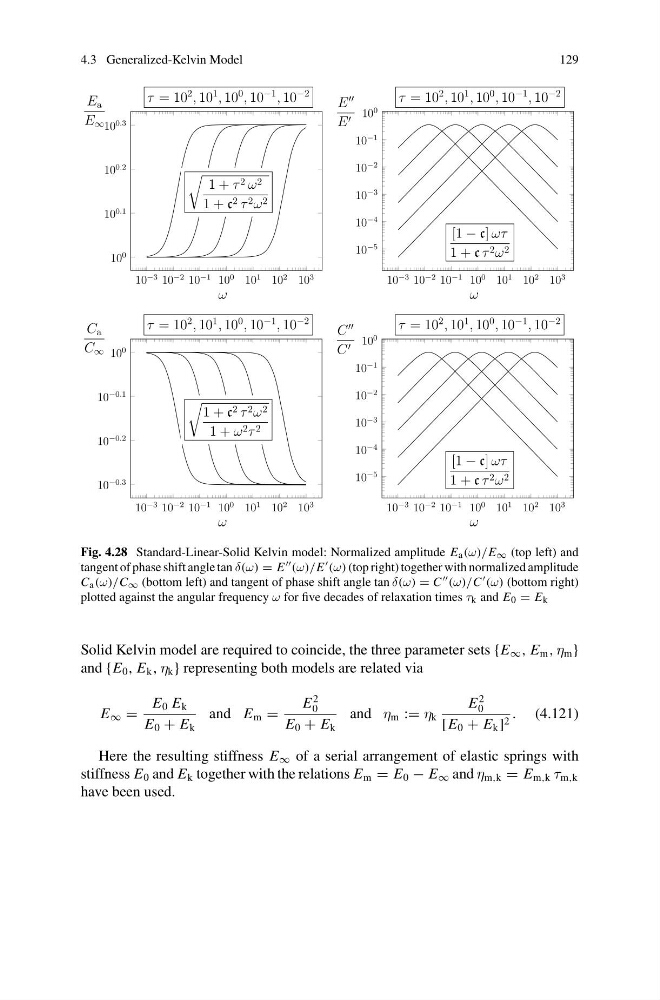
Fig. 4.28 Standard-Linear-Solid Kelvin model: Normalized amplitude E a (ω)/E ∞ (top left) and
tangent of phase shift angle tan δ(ω) = E (ω)/E (ω) (top right) together with normalized amplitude
C a (ω)/C ∞ (bottom left) and tangent of phase shift angle tan δ(ω) = C (ω)/C (ω) (bottom right)
plotted against the angular frequency ω for five decades of relaxation times τ k and E 0 = E k
Solid Kelvin model are required to coincide, the three parameter sets {E ∞ , E m , η m }
and {E 0 , E k , η k } representing both models are related via
E ∞ =
E 0 E k
E 0 + E k
and E m =
E
2
0
E 0 + E k
and η m := η k
E
2
0
[E 0 + E k ] 2 . (4.121)
Here the resulting stiffness E ∞ of a serial arrangement of elastic springs with
stiffness E 0 and E k together with the relations E m = E 0 − E ∞ and η m,k = E m,k τ m,k
have been used.
129
10
−3 10
−2 10
−1 10
0 10
1 10
2 10
3
10
0
10
0.1
10
0.2
10
0.3
ω
E a
E ∞
τ = 10
2
, 10
1
, 10
0
, 10
−1
, 10
−2
1 + τ 2 ω 2
1 + c 2 τ 2 ω 2
10
−3 10
−2 10
−1 10
0 10
1 10
2 10
3
10
−5
10
−4
10
−3
10
−2
10
−1
10
0
ω
E
E
τ = 10
2
, 10
1
, 10
0
, 10
−1
, 10
−2
[1 − c] ωτ
1 + c τ 2 ω 2
10
−3 10
−2 10
−1 10
0 10
1 10
2 10
3
10
−0.3
10
−0.2
10
−0.1
10
0
ω
C a
C ∞
τ = 10
2
, 10
1
, 10
0
, 10
−1
, 10
−2
1 + c 2 τ 2 ω 2
1 + ω 2 τ 2
10
−3 10
−2 10
−1 10
0 10
1 10
2 10
3
10
−5
10
−4
10
−3
10
−2
10
−1
10
0
ω
C
C
τ = 10
2
, 10
1
, 10
0
, 10
−1
, 10
−2
[1 − c] ωτ
1 + c τ 2 ω 2
Fig. 4.28 Standard-Linear-Solid Kelvin model: Normalized amplitude E a (ω)/E ∞ (top left) and
tangent of phase shift angle tan δ(ω) = E (ω)/E (ω) (top right) together with normalized amplitude
C a (ω)/C ∞ (bottom left) and tangent of phase shift angle tan δ(ω) = C (ω)/C (ω) (bottom right)
plotted against the angular frequency ω for five decades of relaxation times τ k and E 0 = E k
Solid Kelvin model are required to coincide, the three parameter sets {E ∞ , E m , η m }
and {E 0 , E k , η k } representing both models are related via
E ∞ =
E 0 E k
E 0 + E k
and E m =
E
2
0
E 0 + E k
and η m := η k
E
2
0
[E 0 + E k ] 2 . (4.121)
Here the resulting stiffness E ∞ of a serial arrangement of elastic springs with
stiffness E 0 and E k together with the relations E m = E 0 − E ∞ and η m,k = E m,k τ m,k
have been used.