

87
Besides these commonly used archival loggers, there are
a variety of alternative devices, which record very specific
behaviors or physiological processes. Jaw movement sensors
are able to detect mouth-opening-events, and can therefore
provide a proxy for prey capture attempts (Wilson et al.
2002; Ropert-Coudert et al. 2004; Liebsch et al. 2007).
Another measurement used to detect prey capture can be the
drop in internal body temperature when relatively cold prey
is ingested by marine endotherms. As such, esophagus or
stomach temperature loggers have been regularly deployed
in seabirds and marine mammals to record feeding activities
(Wilson et al. 1992; Ropert-Coudert et al. 2001; Austin et al.
2006a; Ropert-Coudert and Kato 2006). Other sensors are
able to record heart rate (Woakes et al. 1995; Hindell and Lea
1998; Froget et al. 2004; Chaise et al. 2017) or flipper strokes
(Sato et al. 2003; Insley et al. 2008; Jeanniard-du-Dot et al.
2017) to study field metabolic rates and energy expenditures.
There are certainly many more archival loggers available for
various applications and research questions, however, a discussion of those is beyond the scope of this review.
Argos Satellite Tags
The Argos satellite system was initiated in the late 1970s and
represents a cooperative project between Centre National
d’Études Spatiales (CNES) in France, and the National
Oceanic and Atmospheric Administration (NOAA) and
National Aeronautics and Space Administration (NASA) in
the USA. Argos is operated and managed by Collecte
Localisation Satellites (CLS) in Toulouse, France. Soon after
its initiation, the high importance of Argos satellites for wildlife telemetry studies was recognized. Satellite telemetry was
developed as a means of overcoming the logistical difficulties
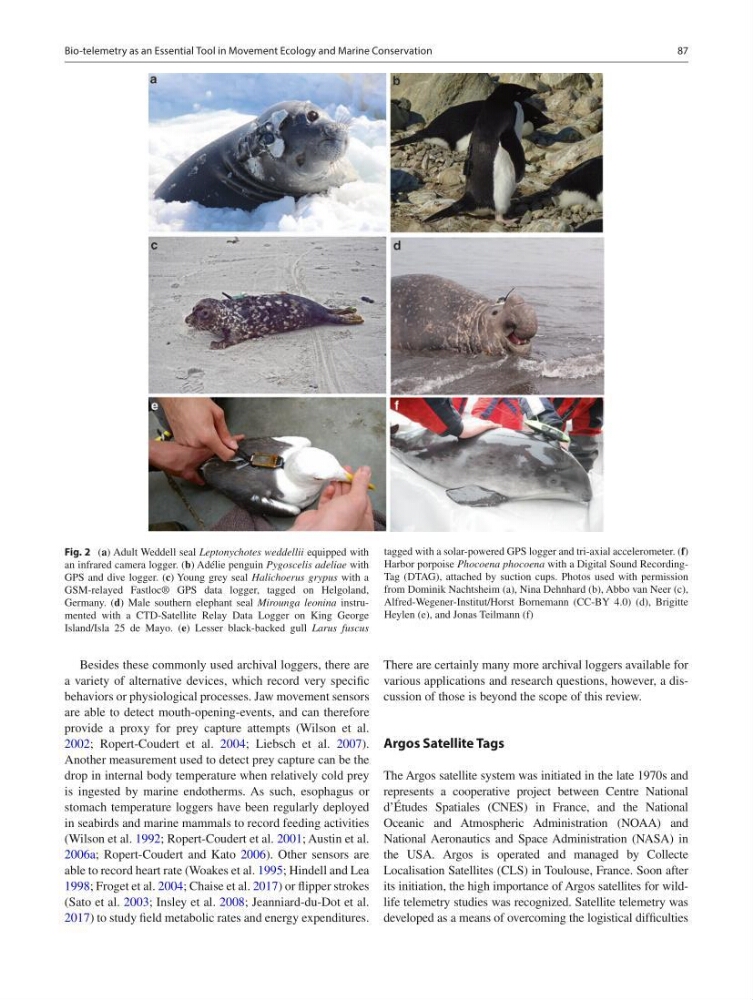
Fig. 2 (a) Adult Weddell seal Leptonychotes weddellii equipped with
an infrared camera logger. (b) Adélie penguin Pygoscelis adeliae with
GPS and dive logger. (c) Young grey seal Halichoerus grypus with a
GSM-relayed Fastloc® GPS data logger, tagged on Helgoland,
Germany. (d) Male southern elephant seal Mirounga leonina instrumented with a CTD-Satellite Relay Data Logger on King George
Island/Isla 25 de Mayo. (e) Lesser black-backed gull Larus fuscus
tagged with a solar-powered GPS logger and tri-axial accelerometer. (f)
Harbor porpoise Phocoena phocoena with a Digital Sound RecordingTag (DTAG), attached by suction cups. Photos used with permission
from Dominik Nachtsheim (a), Nina Dehnhard (b), Abbo van Neer (c),
Alfred-Wegener-Institut/Horst Bornemann (CC-BY 4.0) (d), Brigitte
Heylen (e), and Jonas Teilmann (f)
Bio-telemetry as an Essential Tool in Movement Ecology and Marine Conservation
Besides these commonly used archival loggers, there are
a variety of alternative devices, which record very specific
behaviors or physiological processes. Jaw movement sensors
are able to detect mouth-opening-events, and can therefore
provide a proxy for prey capture attempts (Wilson et al.
2002; Ropert-Coudert et al. 2004; Liebsch et al. 2007).
Another measurement used to detect prey capture can be the
drop in internal body temperature when relatively cold prey
is ingested by marine endotherms. As such, esophagus or
stomach temperature loggers have been regularly deployed
in seabirds and marine mammals to record feeding activities
(Wilson et al. 1992; Ropert-Coudert et al. 2001; Austin et al.
2006a; Ropert-Coudert and Kato 2006). Other sensors are
able to record heart rate (Woakes et al. 1995; Hindell and Lea
1998; Froget et al. 2004; Chaise et al. 2017) or flipper strokes
(Sato et al. 2003; Insley et al. 2008; Jeanniard-du-Dot et al.
2017) to study field metabolic rates and energy expenditures.
There are certainly many more archival loggers available for
various applications and research questions, however, a discussion of those is beyond the scope of this review.
Argos Satellite Tags
The Argos satellite system was initiated in the late 1970s and
represents a cooperative project between Centre National
d’Études Spatiales (CNES) in France, and the National
Oceanic and Atmospheric Administration (NOAA) and
National Aeronautics and Space Administration (NASA) in
the USA. Argos is operated and managed by Collecte
Localisation Satellites (CLS) in Toulouse, France. Soon after
its initiation, the high importance of Argos satellites for wildlife telemetry studies was recognized. Satellite telemetry was
developed as a means of overcoming the logistical difficulties
Fig. 2 (a) Adult Weddell seal Leptonychotes weddellii equipped with
an infrared camera logger. (b) Adélie penguin Pygoscelis adeliae with
GPS and dive logger. (c) Young grey seal Halichoerus grypus with a
GSM-relayed Fastloc® GPS data logger, tagged on Helgoland,
Germany. (d) Male southern elephant seal Mirounga leonina instrumented with a CTD-Satellite Relay Data Logger on King George
Island/Isla 25 de Mayo. (e) Lesser black-backed gull Larus fuscus
tagged with a solar-powered GPS logger and tri-axial accelerometer. (f)
Harbor porpoise Phocoena phocoena with a Digital Sound RecordingTag (DTAG), attached by suction cups. Photos used with permission
from Dominik Nachtsheim (a), Nina Dehnhard (b), Abbo van Neer (c),
Alfred-Wegener-Institut/Horst Bornemann (CC-BY 4.0) (d), Brigitte
Heylen (e), and Jonas Teilmann (f)
Bio-telemetry as an Essential Tool in Movement Ecology and Marine Conservation