

86
expenditure (Wilson et al. 2006, 2008; Shepard et al. 2008;
Sakamoto et al. 2009a). For instance, different at-sea activities (i.e., diving, transiting, resting, and surfacing) during
foraging trips of lactating northern fur seals Callorhinus
ursinus and Antarctic fur seals Arctocephalus gazella were
classified based on accelerometer and dive data. Using these
classified behaviors, time-activity budgets were determined
and activity-specific energy expenditures were accurately
calculated from accelerometer data (Jeanniard-du-Dot et al.
2017). These various applications make accelerometers a
powerful and promising tool for future employments.
Video and still-picture cameras are another example of
archival loggers, commonly deployed on marine top predators (Fig. 2a) (Moll et al. 2007). These devices not only take
photos at regular intervals or record video sequences, but
additional incorporated sensors are also able to gather data
on environmental conditions (e.g., dive depths and ambient
temperature) (Ponganis et al. 2000; Moll et al. 2007; Naito
et al. 2010). Over the years, the quality of video footage and
photographs has increased substantially, with high-definition
cameras being the current status quo (Chapple et al. 2015;
Krause et al. 2015; Machovsky-Capuska et al. 2016). High
quality recordings require enormous memory capacities;
thus the recording time ranges between hours and a few
days, when a duty cycle is activated. Nevertheless, camera
loggers can be extremely valuable tools to obtain direct
observations of difficult to observe, and therefore rarely documented, animal behaviors (Takahashi et al. 2004; Sakamoto
et al. 2009b; Handley and Pistorius 2016). For example, it
could be demonstrated that black-browed albatrosses
Thalassarche melanophris actively follow killer whales
Orcinus orca and possibly feed on prey remains that were
left over by them (Sakamoto et al. 2009b). Such observations
are crucial to understand how far-ranging animals locate
prey patches in the vast ocean. Camera loggers are also frequently deployed to investigate a predator’s foraging behavior in greater detail. Animal-borne imaging can reveal
foraging strategies and hunting behavior (Davis et al. 1999;
Watanuki et al. 2008; Goldbogen et al. 2012; Krause et al.
2015), quantify prey intake (e.g., Ponganis et al. 2000;
Watanabe et al. 2003), or validate prey capture events derived
from accelerometers or dive characteristics (Watanabe and
Takahashi 2013; Volpov et al. 2015, 2016). Furthermore,
cameras attached to diving predators can serve as remote
sensors to monitor the surrounding environment. They can,
for instance, provide information on the behavior and occurrence of prey species (Fuiman et al. 2002), or detect hitherto
unknown faunal communities (Watanabe et al. 2006).
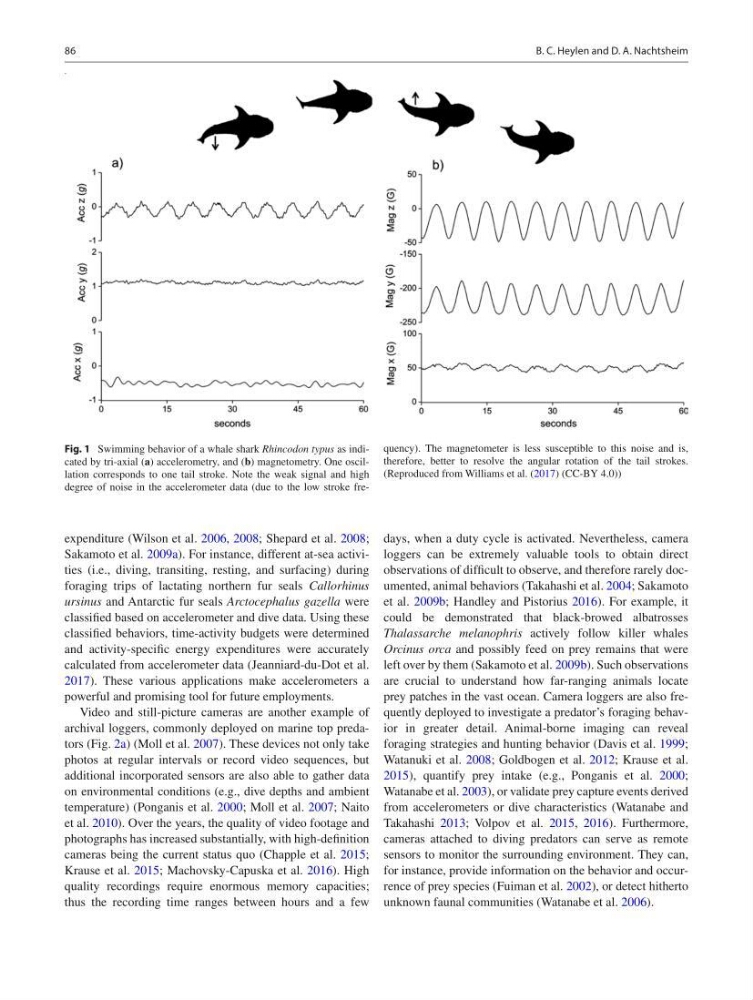
Fig. 1 Swimming behavior of a whale shark Rhincodon typus as indicated by tri-axial (a) accelerometry, and (b) magnetometry. One oscillation corresponds to one tail stroke. Note the weak signal and high
degree of noise in the accelerometer data (due to the low stroke frequency). The magnetometer is less susceptible to this noise and is,
therefore, better to resolve the angular rotation of the tail strokes.
(Reproduced from Williams et al. (2017) (CC-BY 4.0))
B. C. Heylen and D. A. Nachtsheim
expenditure (Wilson et al. 2006, 2008; Shepard et al. 2008;
Sakamoto et al. 2009a). For instance, different at-sea activities (i.e., diving, transiting, resting, and surfacing) during
foraging trips of lactating northern fur seals Callorhinus
ursinus and Antarctic fur seals Arctocephalus gazella were
classified based on accelerometer and dive data. Using these
classified behaviors, time-activity budgets were determined
and activity-specific energy expenditures were accurately
calculated from accelerometer data (Jeanniard-du-Dot et al.
2017). These various applications make accelerometers a
powerful and promising tool for future employments.
Video and still-picture cameras are another example of
archival loggers, commonly deployed on marine top predators (Fig. 2a) (Moll et al. 2007). These devices not only take
photos at regular intervals or record video sequences, but
additional incorporated sensors are also able to gather data
on environmental conditions (e.g., dive depths and ambient
temperature) (Ponganis et al. 2000; Moll et al. 2007; Naito
et al. 2010). Over the years, the quality of video footage and
photographs has increased substantially, with high-definition
cameras being the current status quo (Chapple et al. 2015;
Krause et al. 2015; Machovsky-Capuska et al. 2016). High
quality recordings require enormous memory capacities;
thus the recording time ranges between hours and a few
days, when a duty cycle is activated. Nevertheless, camera
loggers can be extremely valuable tools to obtain direct
observations of difficult to observe, and therefore rarely documented, animal behaviors (Takahashi et al. 2004; Sakamoto
et al. 2009b; Handley and Pistorius 2016). For example, it
could be demonstrated that black-browed albatrosses
Thalassarche melanophris actively follow killer whales
Orcinus orca and possibly feed on prey remains that were
left over by them (Sakamoto et al. 2009b). Such observations
are crucial to understand how far-ranging animals locate
prey patches in the vast ocean. Camera loggers are also frequently deployed to investigate a predator’s foraging behavior in greater detail. Animal-borne imaging can reveal
foraging strategies and hunting behavior (Davis et al. 1999;
Watanuki et al. 2008; Goldbogen et al. 2012; Krause et al.
2015), quantify prey intake (e.g., Ponganis et al. 2000;
Watanabe et al. 2003), or validate prey capture events derived
from accelerometers or dive characteristics (Watanabe and
Takahashi 2013; Volpov et al. 2015, 2016). Furthermore,
cameras attached to diving predators can serve as remote
sensors to monitor the surrounding environment. They can,
for instance, provide information on the behavior and occurrence of prey species (Fuiman et al. 2002), or detect hitherto
unknown faunal communities (Watanabe et al. 2006).
Fig. 1 Swimming behavior of a whale shark Rhincodon typus as indicated by tri-axial (a) accelerometry, and (b) magnetometry. One oscillation corresponds to one tail stroke. Note the weak signal and high
degree of noise in the accelerometer data (due to the low stroke frequency). The magnetometer is less susceptible to this noise and is,
therefore, better to resolve the angular rotation of the tail strokes.
(Reproduced from Williams et al. (2017) (CC-BY 4.0))
B. C. Heylen and D. A. Nachtsheim