

32
the sea ice when reaching it North of Fram Strait and later
meets the other cooled AW branch, which flows down the
Barents Sea shelf slope into the Nansen Basin. Steered by the
topography, the AW flows along the shelf breaks and spreads
all over the Arctic Ocean forming counterclockwise circulations in all deep basins (Fig. 4).
For more details on the Arctic Ocean hydrography and
circulation see Rudels (2009).
Fresh water
As salt is mainly conserved in the present-day oceans, the
only way to change ocean salinity, which determines the
stratification in the Arctic Ocean, is by removing or adding
fresh water. Therefore, fresh water, both liquid and stored in
sea ice, plays a key role in many physical processes in the
Arctic. It is of high relevance for local and global climate and
the thermohaline circulation, as the fresh surface layer in the
Arctic Ocean limits the upward heat transfer from the AW
layer to the atmosphere and sea ice and as a freshening of the
upper Nordic Seas and subpolar North Atlantic may decrease
deep convection due to higher stratification (e.g. Aagard and
Carmack 1989; Haak et al. 2003; Häkkinen 1999; Yang et al.
2016).
By freshwater content or oceanic freshwater transport, we
understand an equivalent amount of fresh water that is
required to dilute water with a reference salinity to obtain the
observed salinity. For the Arctic Ocean most studies use a
reference salinity of 34.8 as it is approximately the average
salinity of the Arctic Ocean (e.g., Aagard and Carmack 1989;
Serreze et al. 2006; Holland et al. 2007; Haine et al. 2015).
Others choose the reference salinity 35 as it is approximately
the salinity of the AW inflow (e.g., Rabe et al. 2011, 2014).
With a changing climate and related ocean changes, the estimates of the average Arctic Ocean salinity and AW inflow
salinity might need to be adjusted. However, there is a starting discussion amongst scientists on the sensible choice of
the reference salinity, challenging the common way to calculate freshwater content and transport (Tsubouchi et al. 2012;
Bacon et al. 2015).
More than 100,000 km
3
of fresh water with respect to a
reference salinity of 34.8 are stored in the Arctic Ocean
(Haine et al. 2015) (Fig. 6). About 95,000 km
3
are stored as
liquid freshwater and about 15,000 km
3
in sea ice (Haine
et al. 2015). Liquid fresh water is added to the Arctic Ocean
by precipitation, continental run-off, glacier/ice sheet/sea ice
melt, and PW inflow and is removed by evaporation, sea ice
formation and advection to the North Atlantic. All these
sources and sinks are affected by the recent climate change
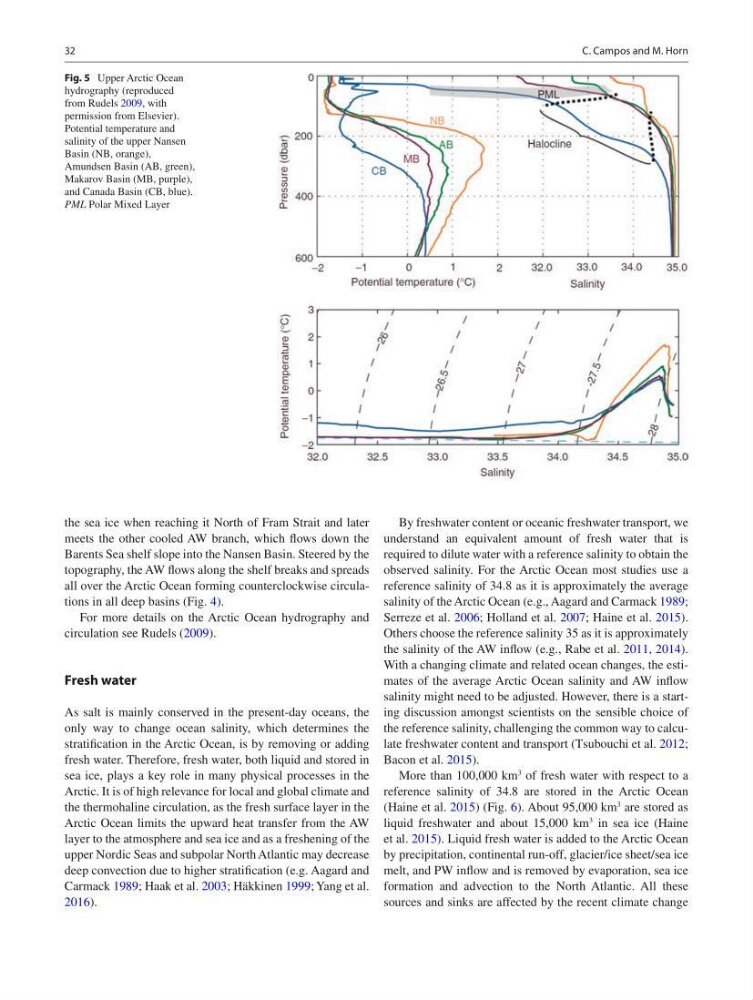
Fig. 5 Upper Arctic Ocean
hydrography (reproduced
from Rudels 2009, with
permission from Elsevier).
Potential temperature and
salinity of the upper Nansen
Basin (NB, orange),
Amundsen Basin (AB, green),
Makarov Basin (MB, purple),
and Canada Basin (CB, blue).
PML Polar Mixed Layer
C. Campos and M. Horn
the sea ice when reaching it North of Fram Strait and later
meets the other cooled AW branch, which flows down the
Barents Sea shelf slope into the Nansen Basin. Steered by the
topography, the AW flows along the shelf breaks and spreads
all over the Arctic Ocean forming counterclockwise circulations in all deep basins (Fig. 4).
For more details on the Arctic Ocean hydrography and
circulation see Rudels (2009).
Fresh water
As salt is mainly conserved in the present-day oceans, the
only way to change ocean salinity, which determines the
stratification in the Arctic Ocean, is by removing or adding
fresh water. Therefore, fresh water, both liquid and stored in
sea ice, plays a key role in many physical processes in the
Arctic. It is of high relevance for local and global climate and
the thermohaline circulation, as the fresh surface layer in the
Arctic Ocean limits the upward heat transfer from the AW
layer to the atmosphere and sea ice and as a freshening of the
upper Nordic Seas and subpolar North Atlantic may decrease
deep convection due to higher stratification (e.g. Aagard and
Carmack 1989; Haak et al. 2003; Häkkinen 1999; Yang et al.
2016).
By freshwater content or oceanic freshwater transport, we
understand an equivalent amount of fresh water that is
required to dilute water with a reference salinity to obtain the
observed salinity. For the Arctic Ocean most studies use a
reference salinity of 34.8 as it is approximately the average
salinity of the Arctic Ocean (e.g., Aagard and Carmack 1989;
Serreze et al. 2006; Holland et al. 2007; Haine et al. 2015).
Others choose the reference salinity 35 as it is approximately
the salinity of the AW inflow (e.g., Rabe et al. 2011, 2014).
With a changing climate and related ocean changes, the estimates of the average Arctic Ocean salinity and AW inflow
salinity might need to be adjusted. However, there is a starting discussion amongst scientists on the sensible choice of
the reference salinity, challenging the common way to calculate freshwater content and transport (Tsubouchi et al. 2012;
Bacon et al. 2015).
More than 100,000 km
3
of fresh water with respect to a
reference salinity of 34.8 are stored in the Arctic Ocean
(Haine et al. 2015) (Fig. 6). About 95,000 km
3
are stored as
liquid freshwater and about 15,000 km
3
in sea ice (Haine
et al. 2015). Liquid fresh water is added to the Arctic Ocean
by precipitation, continental run-off, glacier/ice sheet/sea ice
melt, and PW inflow and is removed by evaporation, sea ice
formation and advection to the North Atlantic. All these
sources and sinks are affected by the recent climate change
Fig. 5 Upper Arctic Ocean
hydrography (reproduced
from Rudels 2009, with
permission from Elsevier).
Potential temperature and
salinity of the upper Nansen
Basin (NB, orange),
Amundsen Basin (AB, green),
Makarov Basin (MB, purple),
and Canada Basin (CB, blue).
PML Polar Mixed Layer
C. Campos and M. Horn