

16
ocean basin; and the zonal distribution of upper ocean heat
content along the equator, with large heat reservoirs and
thick surface layers in the western warm pool, and thin surface layers in the cold tongue region in the east.
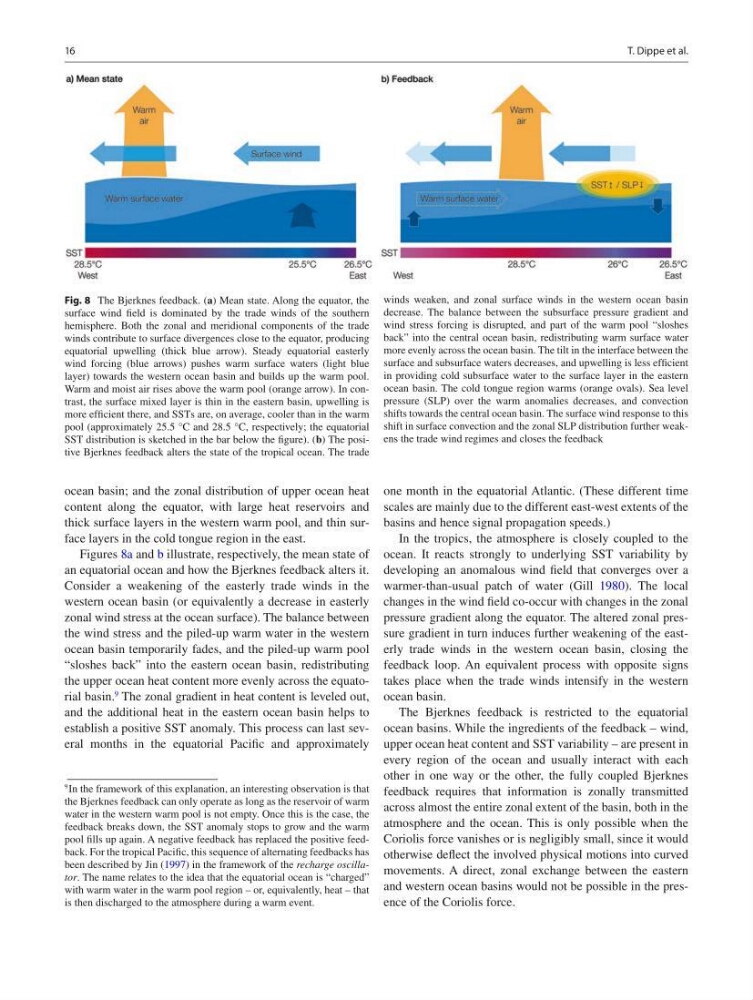
Figures 8a and b illustrate, respectively, the mean state of
an equatorial ocean and how the Bjerknes feedback alters it.
Consider a weakening of the easterly trade winds in the
western ocean basin (or equivalently a decrease in easterly
zonal wind stress at the ocean surface). The balance between
the wind stress and the piled-up warm water in the western
ocean basin temporarily fades, and the piled-up warm pool
“sloshes back” into the eastern ocean basin, redistributing
the upper ocean heat content more evenly across the equatorial basin.
9
The zonal gradient in heat content is leveled out,
and the additional heat in the eastern ocean basin helps to
establish a positive SST anomaly. This process can last several months in the equatorial Pacific and approximately
9 In the framework of this explanation, an interesting observation is that
the Bjerknes feedback can only operate as long as the reservoir of warm
water in the western warm pool is not empty. Once this is the case, the
feedback breaks down, the SST anomaly stops to grow and the warm
pool fills up again. A negative feedback has replaced the positive feedback. For the tropical Pacific, this sequence of alternating feedbacks has
been described by Jin (1997) in the framework of the recharge oscillator. The name relates to the idea that the equatorial ocean is “charged”
with warm water in the warm pool region – or, equivalently, heat – that
is then discharged to the atmosphere during a warm event.
one month in the equatorial Atlantic. (These different time
scales are mainly due to the different east-west extents of the
basins and hence signal propagation speeds.)
In the tropics, the atmosphere is closely coupled to the
ocean. It reacts strongly to underlying SST variability by
developing an anomalous wind field that converges over a
warmer-than-usual patch of water (Gill 1980). The local
changes in the wind field co-occur with changes in the zonal
pressure gradient along the equator. The altered zonal pressure gradient in turn induces further weakening of the easterly trade winds in the western ocean basin, closing the
feedback loop. An equivalent process with opposite signs
takes place when the trade winds intensify in the western
ocean basin.
The Bjerknes feedback is restricted to the equatorial
ocean basins. While the ingredients of the feedback – wind,
upper ocean heat content and SST variability – are present in
every region of the ocean and usually interact with each
other in one way or the other, the fully coupled Bjerknes
feedback requires that information is zonally transmitted
across almost the entire zonal extent of the basin, both in the
atmosphere and the ocean. This is only possible when the
Coriolis force vanishes or is negligibly small, since it would
otherwise deflect the involved physical motions into curved
movements. A direct, zonal exchange between the eastern
and western ocean basins would not be possible in the presence of the Coriolis force.
Fig. 8 The Bjerknes feedback. (a) Mean state. Along the equator, the
surface wind field is dominated by the trade winds of the southern
hemisphere. Both the zonal and meridional components of the trade
winds contribute to surface divergences close to the equator, producing
equatorial upwelling (thick blue arrow). Steady equatorial easterly
wind forcing (blue arrows) pushes warm surface waters (light blue
layer) towards the western ocean basin and builds up the warm pool.
Warm and moist air rises above the warm pool (orange arrow). In contrast, the surface mixed layer is thin in the eastern basin, upwelling is
more efficient there, and SSTs are, on average, cooler than in the warm
pool (approximately 25.5 °C and 28.5 °C, respectively; the equatorial
SST distribution is sketched in the bar below the figure). (b) The positive Bjerknes feedback alters the state of the tropical ocean. The trade
winds weaken, and zonal surface winds in the western ocean basin
decrease. The balance between the subsurface pressure gradient and
wind stress forcing is disrupted, and part of the warm pool “sloshes
back” into the central ocean basin, redistributing warm surface water
more evenly across the ocean basin. The tilt in the interface between the
surface and subsurface waters decreases, and upwelling is less efficient
in providing cold subsurface water to the surface layer in the eastern
ocean basin. The cold tongue region warms (orange ovals). Sea level
pressure (SLP) over the warm anomalies decreases, and convection
shifts towards the central ocean basin. The surface wind response to this
shift in surface convection and the zonal SLP distribution further weakens the trade wind regimes and closes the feedback
T. Dippe et al.
ocean basin; and the zonal distribution of upper ocean heat
content along the equator, with large heat reservoirs and
thick surface layers in the western warm pool, and thin surface layers in the cold tongue region in the east.
Figures 8a and b illustrate, respectively, the mean state of
an equatorial ocean and how the Bjerknes feedback alters it.
Consider a weakening of the easterly trade winds in the
western ocean basin (or equivalently a decrease in easterly
zonal wind stress at the ocean surface). The balance between
the wind stress and the piled-up warm water in the western
ocean basin temporarily fades, and the piled-up warm pool
“sloshes back” into the eastern ocean basin, redistributing
the upper ocean heat content more evenly across the equatorial basin.
9
The zonal gradient in heat content is leveled out,
and the additional heat in the eastern ocean basin helps to
establish a positive SST anomaly. This process can last several months in the equatorial Pacific and approximately
9 In the framework of this explanation, an interesting observation is that
the Bjerknes feedback can only operate as long as the reservoir of warm
water in the western warm pool is not empty. Once this is the case, the
feedback breaks down, the SST anomaly stops to grow and the warm
pool fills up again. A negative feedback has replaced the positive feedback. For the tropical Pacific, this sequence of alternating feedbacks has
been described by Jin (1997) in the framework of the recharge oscillator. The name relates to the idea that the equatorial ocean is “charged”
with warm water in the warm pool region – or, equivalently, heat – that
is then discharged to the atmosphere during a warm event.
one month in the equatorial Atlantic. (These different time
scales are mainly due to the different east-west extents of the
basins and hence signal propagation speeds.)
In the tropics, the atmosphere is closely coupled to the
ocean. It reacts strongly to underlying SST variability by
developing an anomalous wind field that converges over a
warmer-than-usual patch of water (Gill 1980). The local
changes in the wind field co-occur with changes in the zonal
pressure gradient along the equator. The altered zonal pressure gradient in turn induces further weakening of the easterly trade winds in the western ocean basin, closing the
feedback loop. An equivalent process with opposite signs
takes place when the trade winds intensify in the western
ocean basin.
The Bjerknes feedback is restricted to the equatorial
ocean basins. While the ingredients of the feedback – wind,
upper ocean heat content and SST variability – are present in
every region of the ocean and usually interact with each
other in one way or the other, the fully coupled Bjerknes
feedback requires that information is zonally transmitted
across almost the entire zonal extent of the basin, both in the
atmosphere and the ocean. This is only possible when the
Coriolis force vanishes or is negligibly small, since it would
otherwise deflect the involved physical motions into curved
movements. A direct, zonal exchange between the eastern
and western ocean basins would not be possible in the presence of the Coriolis force.
Fig. 8 The Bjerknes feedback. (a) Mean state. Along the equator, the
surface wind field is dominated by the trade winds of the southern
hemisphere. Both the zonal and meridional components of the trade
winds contribute to surface divergences close to the equator, producing
equatorial upwelling (thick blue arrow). Steady equatorial easterly
wind forcing (blue arrows) pushes warm surface waters (light blue
layer) towards the western ocean basin and builds up the warm pool.
Warm and moist air rises above the warm pool (orange arrow). In contrast, the surface mixed layer is thin in the eastern basin, upwelling is
more efficient there, and SSTs are, on average, cooler than in the warm
pool (approximately 25.5 °C and 28.5 °C, respectively; the equatorial
SST distribution is sketched in the bar below the figure). (b) The positive Bjerknes feedback alters the state of the tropical ocean. The trade
winds weaken, and zonal surface winds in the western ocean basin
decrease. The balance between the subsurface pressure gradient and
wind stress forcing is disrupted, and part of the warm pool “sloshes
back” into the central ocean basin, redistributing warm surface water
more evenly across the ocean basin. The tilt in the interface between the
surface and subsurface waters decreases, and upwelling is less efficient
in providing cold subsurface water to the surface layer in the eastern
ocean basin. The cold tongue region warms (orange ovals). Sea level
pressure (SLP) over the warm anomalies decreases, and convection
shifts towards the central ocean basin. The surface wind response to this
shift in surface convection and the zonal SLP distribution further weakens the trade wind regimes and closes the feedback
T. Dippe et al.