

10
1351.16 EJ.
3
That is 13 times the US-American energy consumption of 2014, or 2.6 times the total global energy consumption of 2011.
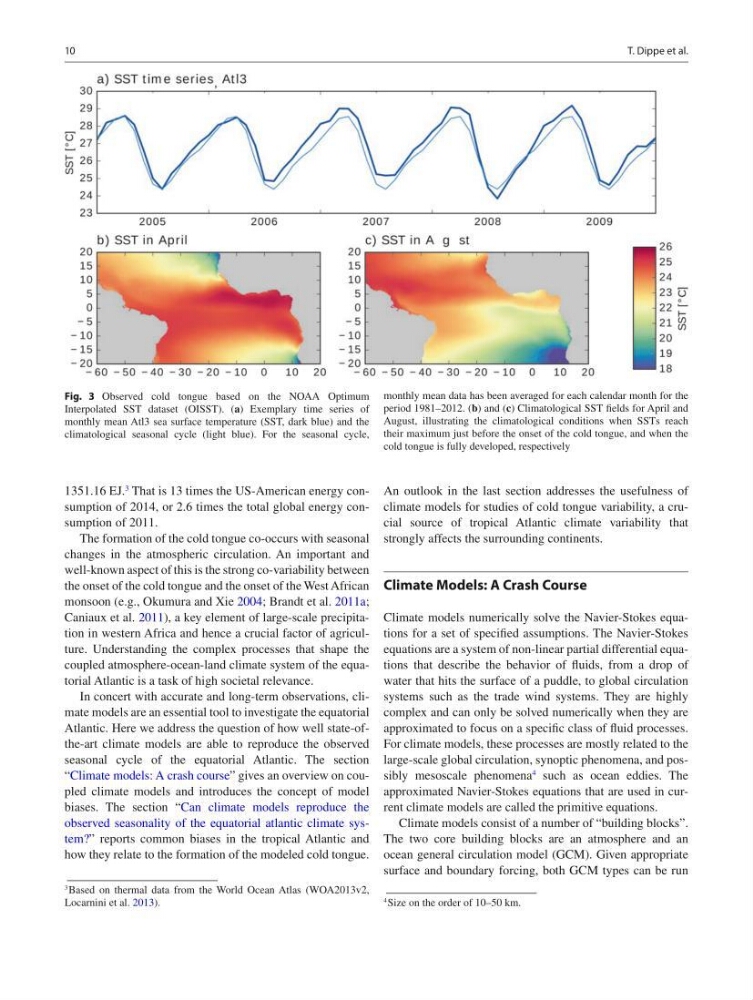
The formation of the cold tongue co-occurs with seasonal
changes in the atmospheric circulation. An important and
well-known aspect of this is the strong co-variability between
the onset of the cold tongue and the onset of the West African
monsoon (e.g., Okumura and Xie 2004; Brandt et al. 2011a;
Caniaux et al. 2011), a key element of large-scale precipitation in western Africa and hence a crucial factor of agriculture. Understanding the complex processes that shape the
coupled atmosphere-ocean-land climate system of the equatorial Atlantic is a task of high societal relevance.
In concert with accurate and long-term observations, climate models are an essential tool to investigate the equatorial
Atlantic. Here we address the question of how well state-ofthe-art climate models are able to reproduce the observed
seasonal cycle of the equatorial Atlantic. The section
“Climate models: A crash course” gives an overview on coupled climate models and introduces the concept of model
biases. The section “Can climate models reproduce the
observed seasonality of the equatorial atlantic climate system?” reports common biases in the tropical Atlantic and
how they relate to the formation of the modeled cold tongue.
3 Based on thermal data from the World Ocean Atlas (WOA2013v2,
Locarnini et al. 2013).
An outlook in the last section addresses the usefulness of
climate models for studies of cold tongue variability, a crucial source of tropical Atlantic climate variability that
strongly affects the surrounding continents.
Climate Models: A Crash Course
Climate models numerically solve the Navier-Stokes equations for a set of specified assumptions. The Navier-Stokes
equations are a system of non-linear partial differential equations that describe the behavior of fluids, from a drop of
water that hits the surface of a puddle, to global circulation
systems such as the trade wind systems. They are highly
complex and can only be solved numerically when they are
approximated to focus on a specific class of fluid processes.
For climate models, these processes are mostly related to the
large-scale global circulation, synoptic phenomena, and possibly mesoscale phenomena
4
such as ocean eddies. The
approximated Navier-Stokes equations that are used in current climate models are called the primitive equations.
Climate models consist of a number of “building blocks”.
The two core building blocks are an atmosphere and an
ocean general circulation model (GCM). Given appropriate
surface and boundary forcing, both GCM types can be run
4 Size on the order of 10–50 km.
Fig. 3 Observed cold tongue based on the NOAA Optimum
Interpolated SST dataset (OISST). (a) Exemplary time series of
monthly mean Atl3 sea surface temperature (SST, dark blue) and the
climatological seasonal cycle (light blue). For the seasonal cycle,
monthly mean data has been averaged for each calendar month for the
period 1981–2012. (b) and (c) Climatological SST fields for April and
August, illustrating the climatological conditions when SSTs reach
their maximum just before the onset of the cold tongue, and when the
cold tongue is fully developed, respectively
T. Dippe et al.
1351.16 EJ.
3
That is 13 times the US-American energy consumption of 2014, or 2.6 times the total global energy consumption of 2011.
The formation of the cold tongue co-occurs with seasonal
changes in the atmospheric circulation. An important and
well-known aspect of this is the strong co-variability between
the onset of the cold tongue and the onset of the West African
monsoon (e.g., Okumura and Xie 2004; Brandt et al. 2011a;
Caniaux et al. 2011), a key element of large-scale precipitation in western Africa and hence a crucial factor of agriculture. Understanding the complex processes that shape the
coupled atmosphere-ocean-land climate system of the equatorial Atlantic is a task of high societal relevance.
In concert with accurate and long-term observations, climate models are an essential tool to investigate the equatorial
Atlantic. Here we address the question of how well state-ofthe-art climate models are able to reproduce the observed
seasonal cycle of the equatorial Atlantic. The section
“Climate models: A crash course” gives an overview on coupled climate models and introduces the concept of model
biases. The section “Can climate models reproduce the
observed seasonality of the equatorial atlantic climate system?” reports common biases in the tropical Atlantic and
how they relate to the formation of the modeled cold tongue.
3 Based on thermal data from the World Ocean Atlas (WOA2013v2,
Locarnini et al. 2013).
An outlook in the last section addresses the usefulness of
climate models for studies of cold tongue variability, a crucial source of tropical Atlantic climate variability that
strongly affects the surrounding continents.
Climate Models: A Crash Course
Climate models numerically solve the Navier-Stokes equations for a set of specified assumptions. The Navier-Stokes
equations are a system of non-linear partial differential equations that describe the behavior of fluids, from a drop of
water that hits the surface of a puddle, to global circulation
systems such as the trade wind systems. They are highly
complex and can only be solved numerically when they are
approximated to focus on a specific class of fluid processes.
For climate models, these processes are mostly related to the
large-scale global circulation, synoptic phenomena, and possibly mesoscale phenomena
4
such as ocean eddies. The
approximated Navier-Stokes equations that are used in current climate models are called the primitive equations.
Climate models consist of a number of “building blocks”.
The two core building blocks are an atmosphere and an
ocean general circulation model (GCM). Given appropriate
surface and boundary forcing, both GCM types can be run
4 Size on the order of 10–50 km.
Fig. 3 Observed cold tongue based on the NOAA Optimum
Interpolated SST dataset (OISST). (a) Exemplary time series of
monthly mean Atl3 sea surface temperature (SST, dark blue) and the
climatological seasonal cycle (light blue). For the seasonal cycle,
monthly mean data has been averaged for each calendar month for the
period 1981–2012. (b) and (c) Climatological SST fields for April and
August, illustrating the climatological conditions when SSTs reach
their maximum just before the onset of the cold tongue, and when the
cold tongue is fully developed, respectively
T. Dippe et al.