

160
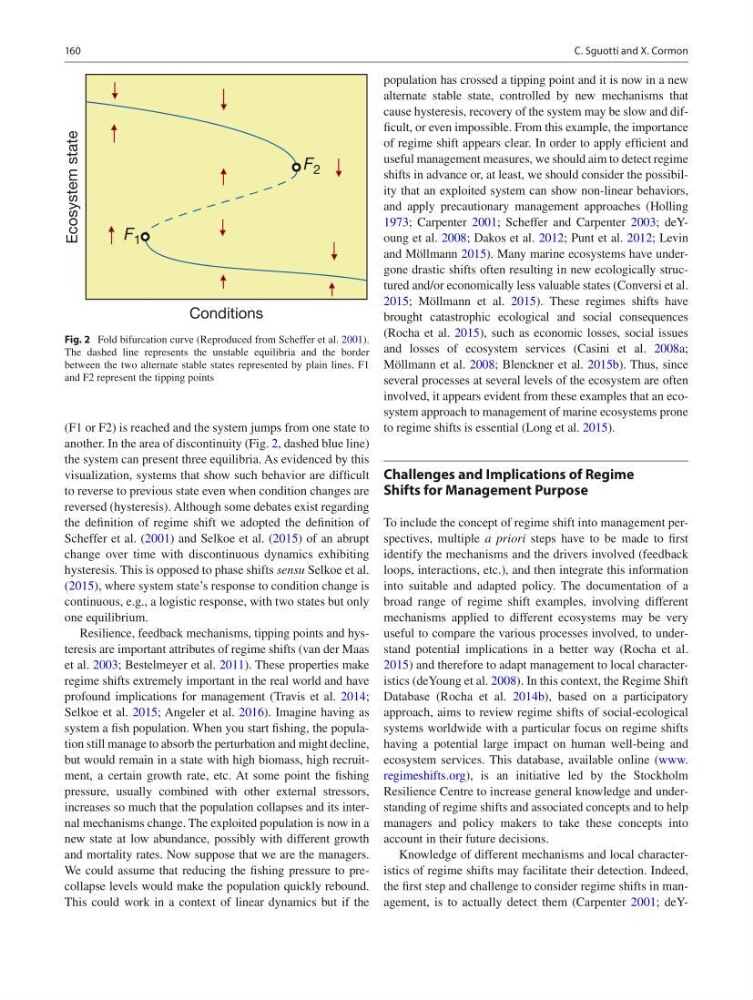
(F1 or F2) is reached and the system jumps from one state to
another. In the area of discontinuity (Fig. 2, dashed blue line)
the system can present three equilibria. As evidenced by this
visualization, systems that show such behavior are difficult
to reverse to previous state even when condition changes are
reversed (hysteresis). Although some debates exist regarding
the definition of regime shift we adopted the definition of
Scheffer et al. (2001) and Selkoe et al. (2015) of an abrupt
change over time with discontinuous dynamics exhibiting
hysteresis. This is opposed to phase shifts sensu Selkoe et al.
(2015), where system state’s response to condition change is
continuous, e.g., a logistic response, with two states but only
one equilibrium.
Resilience, feedback mechanisms, tipping points and hysteresis are important attributes of regime shifts (van der Maas
et al. 2003; Bestelmeyer et al. 2011). These properties make
regime shifts extremely important in the real world and have
profound implications for management (Travis et al. 2014;
Selkoe et al. 2015; Angeler et al. 2016). Imagine having as
system a fish population. When you start fishing, the population still manage to absorb the perturbation and might decline,
but would remain in a state with high biomass, high recruitment, a certain growth rate, etc. At some point the fishing
pressure, usually combined with other external stressors,
increases so much that the population collapses and its internal mechanisms change. The exploited population is now in a
new state at low abundance, possibly with different growth
and mortality rates. Now suppose that we are the managers.
We could assume that reducing the fishing pressure to precollapse levels would make the population quickly rebound.
This could work in a context of linear dynamics but if the
population has crossed a tipping point and it is now in a new
alternate stable state, controlled by new mechanisms that
cause hysteresis, recovery of the system may be slow and difficult, or even impossible. From this example, the importance
of regime shift appears clear. In order to apply efficient and
useful management measures, we should aim to detect regime
shifts in advance or, at least, we should consider the possibility that an exploited system can show non-linear behaviors,
and apply precautionary management approaches (Holling
1973; Carpenter 2001; Scheffer and Carpenter 2003; deYoung et al. 2008; Dakos et al. 2012; Punt et al. 2012; Levin
and Möllmann 2015). Many marine ecosystems have undergone drastic shifts often resulting in new ecologically structured and/or economically less valuable states (Conversi et al.
2015; Möllmann et al. 2015). These regimes shifts have
brought catastrophic ecological and social consequences
(Rocha et al. 2015), such as economic losses, social issues
and losses of ecosystem services (Casini et al. 2008a;
Möllmann et al. 2008; Blenckner et al. 2015b). Thus, since
several processes at several levels of the ecosystem are often
involved, it appears evident from these examples that an ecosystem approach to management of marine ecosystems prone
to regime shifts is essential (Long et al. 2015).
Challenges and Implications of Regime
Shifts for Management Purpose
To include the concept of regime shift into management perspectives, multiple a priori steps have to be made to first
identify the mechanisms and the drivers involved (feedback
loops, interactions, etc.), and then integrate this information
into suitable and adapted policy. The documentation of a
broad range of regime shift examples, involving different
mechanisms applied to different ecosystems may be very
useful to compare the various processes involved, to understand potential implications in a better way (Rocha et al.
2015) and therefore to adapt management to local characteristics (deYoung et al. 2008). In this context, the Regime Shift
Database (Rocha et al. 2014b), based on a participatory
approach, aims to review regime shifts of social-ecological
systems worldwide with a particular focus on regime shifts
having a potential large impact on human well-being and
ecosystem services. This database, available online (www.
regimeshifts.org), is an initiative led by the Stockholm
Resilience Centre to increase general knowledge and understanding of regime shifts and associated concepts and to help
managers and policy makers to take these concepts into
account in their future decisions.
Knowledge of different mechanisms and local characteristics of regime shifts may facilitate their detection. Indeed,
the first step and challenge to consider regime shifts in management, is to actually detect them (Carpenter 2001; deYFig. 2 Fold bifurcation curve (Reproduced from Scheffer et al. 2001).
The dashed line represents the unstable equilibria and the border
between the two alternate stable states represented by plain lines. F1
and F2 represent the tipping points
C. Sguotti and X. Cormon
(F1 or F2) is reached and the system jumps from one state to
another. In the area of discontinuity (Fig. 2, dashed blue line)
the system can present three equilibria. As evidenced by this
visualization, systems that show such behavior are difficult
to reverse to previous state even when condition changes are
reversed (hysteresis). Although some debates exist regarding
the definition of regime shift we adopted the definition of
Scheffer et al. (2001) and Selkoe et al. (2015) of an abrupt
change over time with discontinuous dynamics exhibiting
hysteresis. This is opposed to phase shifts sensu Selkoe et al.
(2015), where system state’s response to condition change is
continuous, e.g., a logistic response, with two states but only
one equilibrium.
Resilience, feedback mechanisms, tipping points and hysteresis are important attributes of regime shifts (van der Maas
et al. 2003; Bestelmeyer et al. 2011). These properties make
regime shifts extremely important in the real world and have
profound implications for management (Travis et al. 2014;
Selkoe et al. 2015; Angeler et al. 2016). Imagine having as
system a fish population. When you start fishing, the population still manage to absorb the perturbation and might decline,
but would remain in a state with high biomass, high recruitment, a certain growth rate, etc. At some point the fishing
pressure, usually combined with other external stressors,
increases so much that the population collapses and its internal mechanisms change. The exploited population is now in a
new state at low abundance, possibly with different growth
and mortality rates. Now suppose that we are the managers.
We could assume that reducing the fishing pressure to precollapse levels would make the population quickly rebound.
This could work in a context of linear dynamics but if the
population has crossed a tipping point and it is now in a new
alternate stable state, controlled by new mechanisms that
cause hysteresis, recovery of the system may be slow and difficult, or even impossible. From this example, the importance
of regime shift appears clear. In order to apply efficient and
useful management measures, we should aim to detect regime
shifts in advance or, at least, we should consider the possibility that an exploited system can show non-linear behaviors,
and apply precautionary management approaches (Holling
1973; Carpenter 2001; Scheffer and Carpenter 2003; deYoung et al. 2008; Dakos et al. 2012; Punt et al. 2012; Levin
and Möllmann 2015). Many marine ecosystems have undergone drastic shifts often resulting in new ecologically structured and/or economically less valuable states (Conversi et al.
2015; Möllmann et al. 2015). These regimes shifts have
brought catastrophic ecological and social consequences
(Rocha et al. 2015), such as economic losses, social issues
and losses of ecosystem services (Casini et al. 2008a;
Möllmann et al. 2008; Blenckner et al. 2015b). Thus, since
several processes at several levels of the ecosystem are often
involved, it appears evident from these examples that an ecosystem approach to management of marine ecosystems prone
to regime shifts is essential (Long et al. 2015).
Challenges and Implications of Regime
Shifts for Management Purpose
To include the concept of regime shift into management perspectives, multiple a priori steps have to be made to first
identify the mechanisms and the drivers involved (feedback
loops, interactions, etc.), and then integrate this information
into suitable and adapted policy. The documentation of a
broad range of regime shift examples, involving different
mechanisms applied to different ecosystems may be very
useful to compare the various processes involved, to understand potential implications in a better way (Rocha et al.
2015) and therefore to adapt management to local characteristics (deYoung et al. 2008). In this context, the Regime Shift
Database (Rocha et al. 2014b), based on a participatory
approach, aims to review regime shifts of social-ecological
systems worldwide with a particular focus on regime shifts
having a potential large impact on human well-being and
ecosystem services. This database, available online (www.
regimeshifts.org), is an initiative led by the Stockholm
Resilience Centre to increase general knowledge and understanding of regime shifts and associated concepts and to help
managers and policy makers to take these concepts into
account in their future decisions.
Knowledge of different mechanisms and local characteristics of regime shifts may facilitate their detection. Indeed,
the first step and challenge to consider regime shifts in management, is to actually detect them (Carpenter 2001; deYFig. 2 Fold bifurcation curve (Reproduced from Scheffer et al. 2001).
The dashed line represents the unstable equilibria and the border
between the two alternate stable states represented by plain lines. F1
and F2 represent the tipping points
C. Sguotti and X. Cormon