

159
resilience of the system state. For instance, even when the
Caribbean coral reef system was stressed by intensive fishing
on grazing fishes, the system maintained its original state
and did not shift because its resilience was high (i.e., the sea
urchins were able to maintain top-down regulation on algae,
Mumby et al. 2007). Indeed, when the valley is large and
deep, the ball/system remains in it, maintaining its structure,
despite the disturbances. Repetitive disturbances such as
overfishing and eutrophication did, however, reduce the system resilience (the valley became narrower and shallower)
and when a strong disturbance occurred (here a disease outbreak), the system shifted abruptly to a new state (i.e., algae
beds). This new state is now resilient, maintained by new
feedback mechanisms that help its stabilization, e.g., the
higher survival of algae and the non-recovery of grazer fishes
(Beisner et al. 2003; Roe 2009; Conversi et al. 2015).
Resilience is defined as the capacity of the system to absorb
disturbances and reorganize, so as to still retain essentially
the same functions, structure, identity and feedback mechanisms (Holling 1973; Beisner et al. 2003; Vasilakopoulos
and Marshall 2015; Folke 2016).
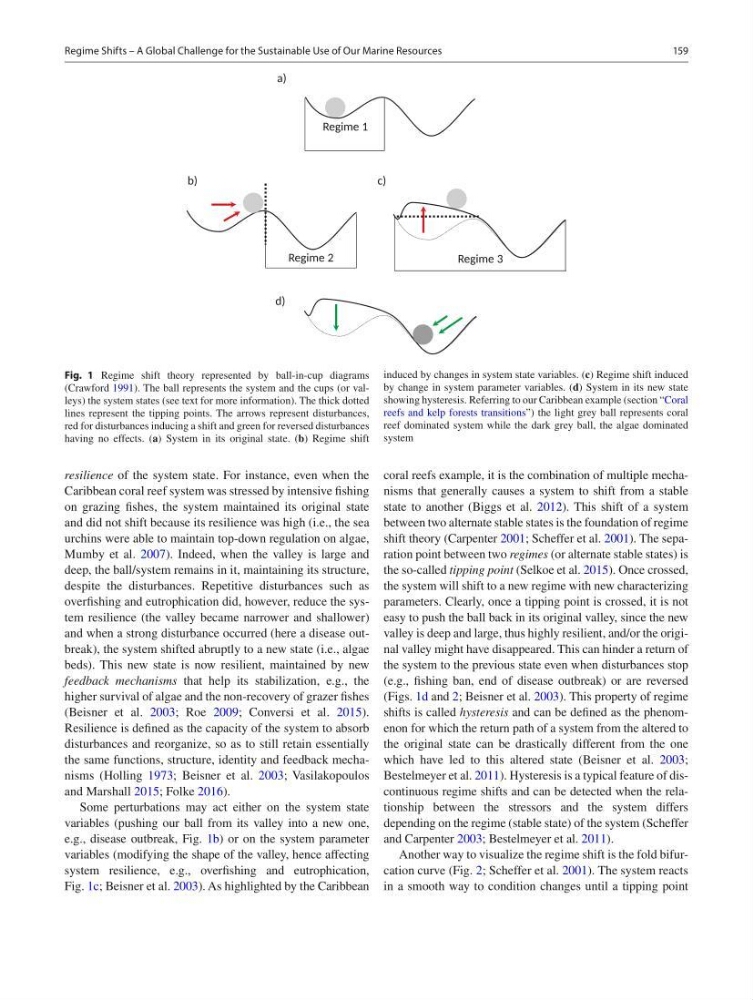
Some perturbations may act either on the system state
variables (pushing our ball from its valley into a new one,
e.g., disease outbreak, Fig. 1b) or on the system parameter
variables (modifying the shape of the valley, hence affecting
system resilience, e.g., overfishing and eutrophication,
Fig. 1c; Beisner et al. 2003). As highlighted by the Caribbean
coral reefs example, it is the combination of multiple mechanisms that generally causes a system to shift from a stable
state to another (Biggs et al. 2012). This shift of a system
between two alternate stable states is the foundation of regime
shift theory (Carpenter 2001; Scheffer et al. 2001). The separation point between two regimes (or alternate stable states) is
the so-called tipping point (Selkoe et al. 2015). Once crossed,
the system will shift to a new regime with new characterizing
parameters. Clearly, once a tipping point is crossed, it is not
easy to push the ball back in its original valley, since the new
valley is deep and large, thus highly resilient, and/or the original valley might have disappeared. This can hinder a return of
the system to the previous state even when disturbances stop
(e.g., fishing ban, end of disease outbreak) or are reversed
(Figs. 1d and 2; Beisner et al. 2003). This property of regime
shifts is called hysteresis and can be defined as the phenomenon for which the return path of a system from the altered to
the original state can be drastically different from the one
which have led to this altered state (Beisner et al. 2003;
Bestelmeyer et al. 2011). Hysteresis is a typical feature of discontinuous regime shifts and can be detected when the relationship between the stressors and the system differs
depending on the regime (stable state) of the system (Scheffer
and Carpenter 2003; Bestelmeyer et al. 2011).
Another way to visualize the regime shift is the fold bifurcation curve (Fig. 2; Scheffer et al. 2001). The system reacts
in a smooth way to condition changes until a tipping point
Fig. 1 Regime shift theory represented by ball-in-cup diagrams
(Crawford 1991). The ball represents the system and the cups (or valleys) the system states (see text for more information). The thick dotted
lines represent the tipping points. The arrows represent disturbances,
red for disturbances inducing a shift and green for reversed disturbances
having no effects. (a) System in its original state. (b) Regime shift
induced by changes in system state variables. (c) Regime shift induced
by change in system parameter variables. (d) System in its new state
showing hysteresis. Referring to our Caribbean example (section “Coral
reefs and kelp forests transitions”) the light grey ball represents coral
reef dominated system while the dark grey ball, the algae dominated
system
Regime Shifts – A Global Challenge for the Sustainable Use of Our Marine Resources
resilience of the system state. For instance, even when the
Caribbean coral reef system was stressed by intensive fishing
on grazing fishes, the system maintained its original state
and did not shift because its resilience was high (i.e., the sea
urchins were able to maintain top-down regulation on algae,
Mumby et al. 2007). Indeed, when the valley is large and
deep, the ball/system remains in it, maintaining its structure,
despite the disturbances. Repetitive disturbances such as
overfishing and eutrophication did, however, reduce the system resilience (the valley became narrower and shallower)
and when a strong disturbance occurred (here a disease outbreak), the system shifted abruptly to a new state (i.e., algae
beds). This new state is now resilient, maintained by new
feedback mechanisms that help its stabilization, e.g., the
higher survival of algae and the non-recovery of grazer fishes
(Beisner et al. 2003; Roe 2009; Conversi et al. 2015).
Resilience is defined as the capacity of the system to absorb
disturbances and reorganize, so as to still retain essentially
the same functions, structure, identity and feedback mechanisms (Holling 1973; Beisner et al. 2003; Vasilakopoulos
and Marshall 2015; Folke 2016).
Some perturbations may act either on the system state
variables (pushing our ball from its valley into a new one,
e.g., disease outbreak, Fig. 1b) or on the system parameter
variables (modifying the shape of the valley, hence affecting
system resilience, e.g., overfishing and eutrophication,
Fig. 1c; Beisner et al. 2003). As highlighted by the Caribbean
coral reefs example, it is the combination of multiple mechanisms that generally causes a system to shift from a stable
state to another (Biggs et al. 2012). This shift of a system
between two alternate stable states is the foundation of regime
shift theory (Carpenter 2001; Scheffer et al. 2001). The separation point between two regimes (or alternate stable states) is
the so-called tipping point (Selkoe et al. 2015). Once crossed,
the system will shift to a new regime with new characterizing
parameters. Clearly, once a tipping point is crossed, it is not
easy to push the ball back in its original valley, since the new
valley is deep and large, thus highly resilient, and/or the original valley might have disappeared. This can hinder a return of
the system to the previous state even when disturbances stop
(e.g., fishing ban, end of disease outbreak) or are reversed
(Figs. 1d and 2; Beisner et al. 2003). This property of regime
shifts is called hysteresis and can be defined as the phenomenon for which the return path of a system from the altered to
the original state can be drastically different from the one
which have led to this altered state (Beisner et al. 2003;
Bestelmeyer et al. 2011). Hysteresis is a typical feature of discontinuous regime shifts and can be detected when the relationship between the stressors and the system differs
depending on the regime (stable state) of the system (Scheffer
and Carpenter 2003; Bestelmeyer et al. 2011).
Another way to visualize the regime shift is the fold bifurcation curve (Fig. 2; Scheffer et al. 2001). The system reacts
in a smooth way to condition changes until a tipping point
Fig. 1 Regime shift theory represented by ball-in-cup diagrams
(Crawford 1991). The ball represents the system and the cups (or valleys) the system states (see text for more information). The thick dotted
lines represent the tipping points. The arrows represent disturbances,
red for disturbances inducing a shift and green for reversed disturbances
having no effects. (a) System in its original state. (b) Regime shift
induced by changes in system state variables. (c) Regime shift induced
by change in system parameter variables. (d) System in its new state
showing hysteresis. Referring to our Caribbean example (section “Coral
reefs and kelp forests transitions”) the light grey ball represents coral
reef dominated system while the dark grey ball, the algae dominated
system
Regime Shifts – A Global Challenge for the Sustainable Use of Our Marine Resources