

127
mobile organisms transition between ecosystems to forage,
spawn, as part of seasonal migrations, or through ontogenesis
(Parrish 1989; Cocheret de la Morinière et al. 2002; Mumby
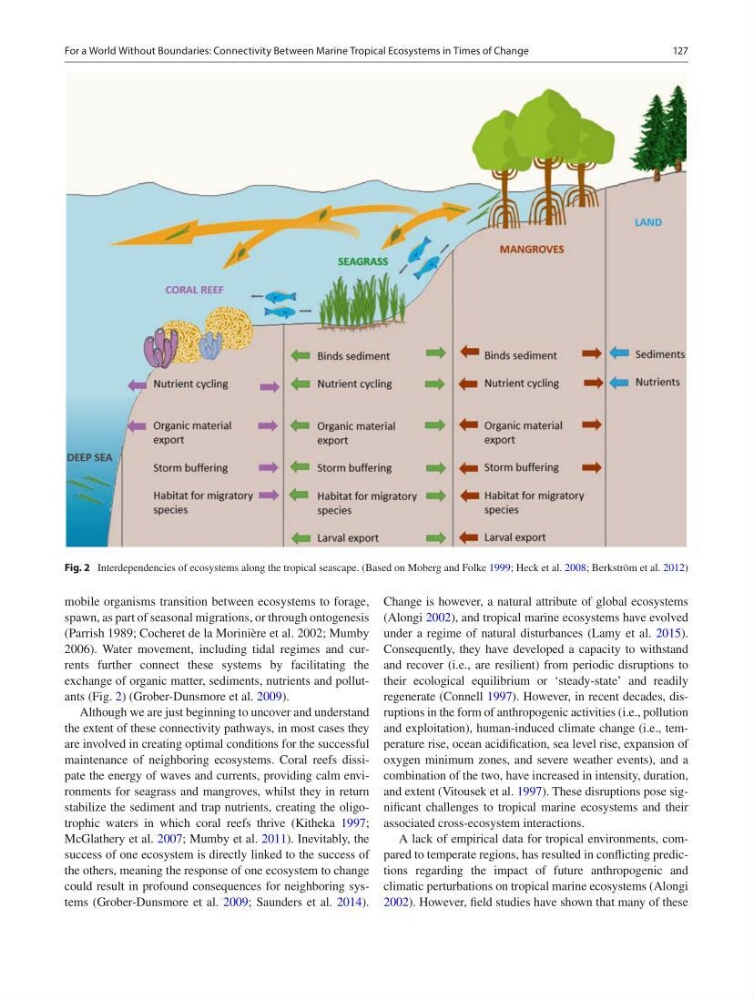
2006). Water movement, including tidal regimes and currents further connect these systems by facilitating the
exchange of organic matter, sediments, nutrients and pollutants (Fig. 2) (Grober-Dunsmore et al. 2009).
Although we are just beginning to uncover and understand
the extent of these connectivity pathways, in most cases they
are involved in creating optimal conditions for the successful
maintenance of neighboring ecosystems. Coral reefs dissipate the energy of waves and currents, providing calm environments for seagrass and mangroves, whilst they in return
stabilize the sediment and trap nutrients, creating the oligotrophic waters in which coral reefs thrive (Kitheka 1997;
McGlathery et al. 2007; Mumby et al. 2011). Inevitably, the
success of one ecosystem is directly linked to the success of
the others, meaning the response of one ecosystem to change
could result in profound consequences for neighboring systems (Grober-Dunsmore et al. 2009; Saunders et al. 2014).
Change is however, a natural attribute of global ecosystems
(Alongi 2002), and tropical marine ecosystems have evolved
under a regime of natural disturbances (Lamy et al. 2015).
Consequently, they have developed a capacity to withstand
and recover (i.e., are resilient) from periodic disruptions to
their ecological equilibrium or ‘steady-state’ and readily
regenerate (Connell 1997). However, in recent decades, disruptions in the form of anthropogenic activities (i.e., pollution
and exploitation), human-induced climate change (i.e., temperature rise, ocean acidification, sea level rise, expansion of
oxygen minimum zones, and severe weather events), and a
combination of the two, have increased in intensity, duration,
and extent (Vitousek et al. 1997). These disruptions pose significant challenges to tropical marine ecosystems and their
associated cross-ecosystem interactions.
A lack of empirical data for tropical environments, compared to temperate regions, has resulted in conflicting predictions regarding the impact of future anthropogenic and
climatic perturbations on tropical marine ecosystems (Alongi
2002). However, field studies have shown that many of these
Fig. 2 Interdependencies of ecosystems along the tropical seascape. (Based on Moberg and Folke 1999; Heck et al. 2008; Berkström et al. 2012)
For a World Without Boundaries: Connectivity Between Marine Tropical Ecosystems in Times of Change
mobile organisms transition between ecosystems to forage,
spawn, as part of seasonal migrations, or through ontogenesis
(Parrish 1989; Cocheret de la Morinière et al. 2002; Mumby
2006). Water movement, including tidal regimes and currents further connect these systems by facilitating the
exchange of organic matter, sediments, nutrients and pollutants (Fig. 2) (Grober-Dunsmore et al. 2009).
Although we are just beginning to uncover and understand
the extent of these connectivity pathways, in most cases they
are involved in creating optimal conditions for the successful
maintenance of neighboring ecosystems. Coral reefs dissipate the energy of waves and currents, providing calm environments for seagrass and mangroves, whilst they in return
stabilize the sediment and trap nutrients, creating the oligotrophic waters in which coral reefs thrive (Kitheka 1997;
McGlathery et al. 2007; Mumby et al. 2011). Inevitably, the
success of one ecosystem is directly linked to the success of
the others, meaning the response of one ecosystem to change
could result in profound consequences for neighboring systems (Grober-Dunsmore et al. 2009; Saunders et al. 2014).
Change is however, a natural attribute of global ecosystems
(Alongi 2002), and tropical marine ecosystems have evolved
under a regime of natural disturbances (Lamy et al. 2015).
Consequently, they have developed a capacity to withstand
and recover (i.e., are resilient) from periodic disruptions to
their ecological equilibrium or ‘steady-state’ and readily
regenerate (Connell 1997). However, in recent decades, disruptions in the form of anthropogenic activities (i.e., pollution
and exploitation), human-induced climate change (i.e., temperature rise, ocean acidification, sea level rise, expansion of
oxygen minimum zones, and severe weather events), and a
combination of the two, have increased in intensity, duration,
and extent (Vitousek et al. 1997). These disruptions pose significant challenges to tropical marine ecosystems and their
associated cross-ecosystem interactions.
A lack of empirical data for tropical environments, compared to temperate regions, has resulted in conflicting predictions regarding the impact of future anthropogenic and
climatic perturbations on tropical marine ecosystems (Alongi
2002). However, field studies have shown that many of these
Fig. 2 Interdependencies of ecosystems along the tropical seascape. (Based on Moberg and Folke 1999; Heck et al. 2008; Berkström et al. 2012)
For a World Without Boundaries: Connectivity Between Marine Tropical Ecosystems in Times of Change