

126
offshore habitat, coral reefs provide coastal protection, sustain fisheries, and drive tourism activities which are valued
globally at US$ 30 billion per annum (Stone 2007; Khan and
Larrosa 2008).
Although these ecosystems can thrive in isolation (Parrish
1989), in regions where they occur together, the value of the
services provided is enhanced. For example, each ecosystem
alone provides a form of coastal protection (Koch et al.
2009), but together the three have been shown to supply
more protection compared to any one ecosystem alone, or
any combination of two ecosystems (Guannel et al. 2016).
These services are, in part, the result of highly complex
cross-ecosystem interactions occurring on physical, chemical and biological levels (Ogden 1980; Nagelkerken 2009;
Gillis et al. 2014). Early research, such as the mangrove ‘outwelling’ hypothesis proposed by Odum (1968), and Odum
and Heald (1972) highlighted the importance of research
beyond ecosystem boundaries. This hypothesis postulated
that a fraction of organic matter, ~50%, produced by mangroves is exported to the coastal ocean (Dittmar et al. 2006),
where it is either stored as carbon in marine sediments
(Jennerjahn and Ittekkot 2002), or provides essential habitat
and food resources to adjacent ecosystems including coral
reefs (Bouillon et al. 2008; Granek et al. 2009). Since then, a
wealth of studies have investigated individual connectivity
pathways between tropical marine ecosystems. Biologically,
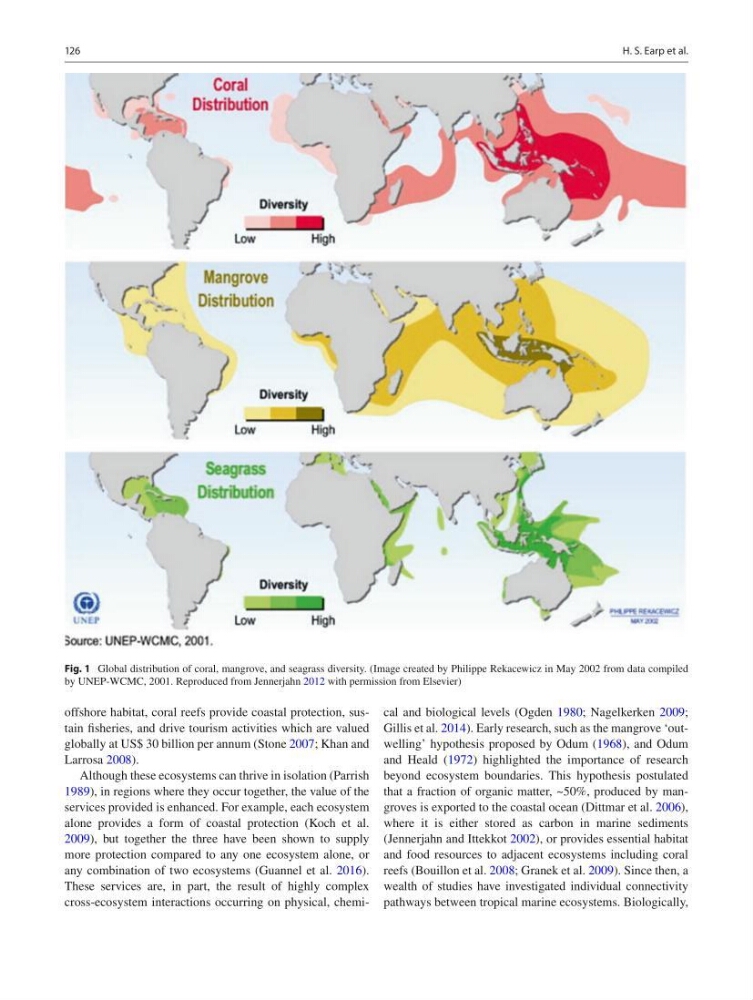
Fig. 1 Global distribution of coral, mangrove, and seagrass diversity. (Image created by Philippe Rekacewicz in May 2002 from data compiled
by UNEP-WCMC, 2001. Reproduced from Jennerjahn 2012 with permission from Elsevier)
H. S. Earp et al.
offshore habitat, coral reefs provide coastal protection, sustain fisheries, and drive tourism activities which are valued
globally at US$ 30 billion per annum (Stone 2007; Khan and
Larrosa 2008).
Although these ecosystems can thrive in isolation (Parrish
1989), in regions where they occur together, the value of the
services provided is enhanced. For example, each ecosystem
alone provides a form of coastal protection (Koch et al.
2009), but together the three have been shown to supply
more protection compared to any one ecosystem alone, or
any combination of two ecosystems (Guannel et al. 2016).
These services are, in part, the result of highly complex
cross-ecosystem interactions occurring on physical, chemical and biological levels (Ogden 1980; Nagelkerken 2009;
Gillis et al. 2014). Early research, such as the mangrove ‘outwelling’ hypothesis proposed by Odum (1968), and Odum
and Heald (1972) highlighted the importance of research
beyond ecosystem boundaries. This hypothesis postulated
that a fraction of organic matter, ~50%, produced by mangroves is exported to the coastal ocean (Dittmar et al. 2006),
where it is either stored as carbon in marine sediments
(Jennerjahn and Ittekkot 2002), or provides essential habitat
and food resources to adjacent ecosystems including coral
reefs (Bouillon et al. 2008; Granek et al. 2009). Since then, a
wealth of studies have investigated individual connectivity
pathways between tropical marine ecosystems. Biologically,
Fig. 1 Global distribution of coral, mangrove, and seagrass diversity. (Image created by Philippe Rekacewicz in May 2002 from data compiled
by UNEP-WCMC, 2001. Reproduced from Jennerjahn 2012 with permission from Elsevier)
H. S. Earp et al.