

118
of imports via quarantine bans or tariffs (Lovell et al. 2006).
Despite regulations, trade among the North Atlantic Free
Trade Area (NAFTA) countries spreads invasive species
that were introduced as a result of trade with countries outside of NAFTA (Perrault et al. 2003). It is in this manner
that NIS can be introduced and widely distributed among
trade partners who themselves adhere to stringent treaty
regulations.
A mere handful of marine focused management recommendations have been suggested and are summarized by
Secord (2003). Recommendations are centered around prevention and control. The least disturbing to the environment
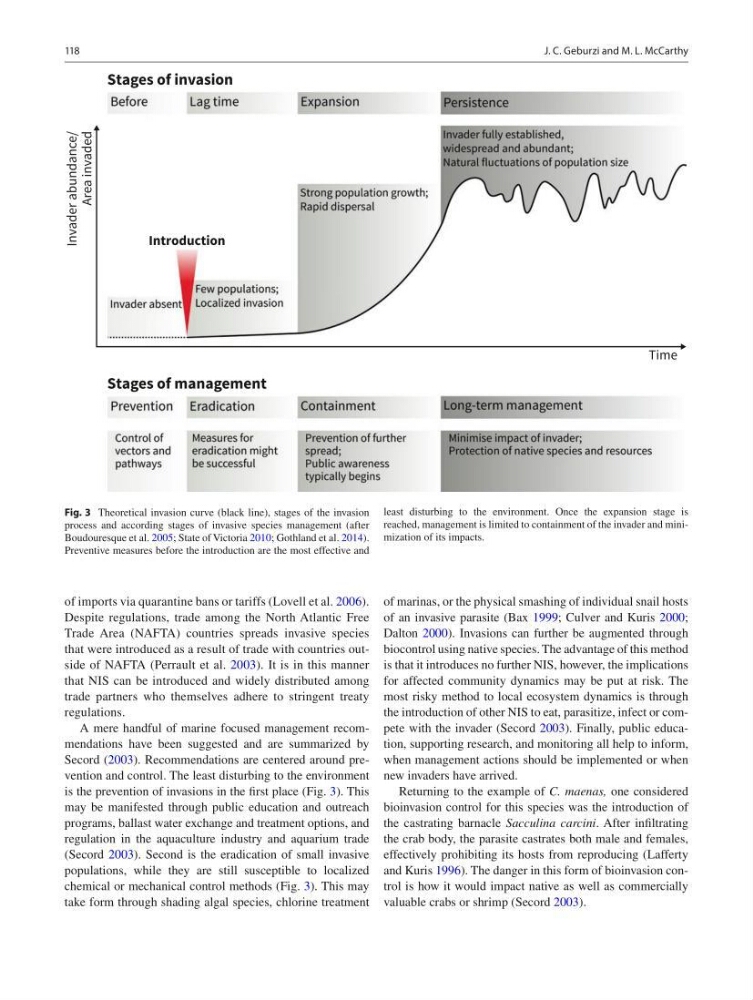
is the prevention of invasions in the first place (Fig. 3). This
may be manifested through public education and outreach
programs, ballast water exchange and treatment options, and
regulation in the aquaculture industry and aquarium trade
(Secord 2003). Second is the eradication of small invasive
populations, while they are still susceptible to localized
chemical or mechanical control methods (Fig. 3). This may
take form through shading algal species, chlorine treatment
of marinas, or the physical smashing of individual snail hosts
of an invasive parasite (Bax 1999; Culver and Kuris 2000;
Dalton 2000). Invasions can further be augmented through
biocontrol using native species. The advantage of this method
is that it introduces no further NIS, however, the implications
for affected community dynamics may be put at risk. The
most risky method to local ecosystem dynamics is through
the introduction of other NIS to eat, parasitize, infect or compete with the invader (Secord 2003). Finally, public education, supporting research, and monitoring all help to inform,
when management actions should be implemented or when
new invaders have arrived.
Returning to the example of C. maenas, one considered
bioinvasion control for this species was the introduction of
the castrating barnacle Sacculina carcini. After infiltrating
the crab body, the parasite castrates both male and females,
effectively prohibiting its hosts from reproducing (Lafferty
and Kuris 1996). The danger in this form of bioinvasion control is how it would impact native as well as commercially
valuable crabs or shrimp (Secord 2003).
Fig. 3 Theoretical invasion curve (black line), stages of the invasion
process and according stages of invasive species management (after
Boudouresque et al. 2005; State of Victoria 2010; Gothland et al. 2014).
Preventive measures before the introduction are the most effective and
least disturbing to the environment. Once the expansion stage is
reached, management is limited to containment of the invader and minimization of its impacts.
J. C. Geburzi and M. L. McCarthy
of imports via quarantine bans or tariffs (Lovell et al. 2006).
Despite regulations, trade among the North Atlantic Free
Trade Area (NAFTA) countries spreads invasive species
that were introduced as a result of trade with countries outside of NAFTA (Perrault et al. 2003). It is in this manner
that NIS can be introduced and widely distributed among
trade partners who themselves adhere to stringent treaty
regulations.
A mere handful of marine focused management recommendations have been suggested and are summarized by
Secord (2003). Recommendations are centered around prevention and control. The least disturbing to the environment
is the prevention of invasions in the first place (Fig. 3). This
may be manifested through public education and outreach
programs, ballast water exchange and treatment options, and
regulation in the aquaculture industry and aquarium trade
(Secord 2003). Second is the eradication of small invasive
populations, while they are still susceptible to localized
chemical or mechanical control methods (Fig. 3). This may
take form through shading algal species, chlorine treatment
of marinas, or the physical smashing of individual snail hosts
of an invasive parasite (Bax 1999; Culver and Kuris 2000;
Dalton 2000). Invasions can further be augmented through
biocontrol using native species. The advantage of this method
is that it introduces no further NIS, however, the implications
for affected community dynamics may be put at risk. The
most risky method to local ecosystem dynamics is through
the introduction of other NIS to eat, parasitize, infect or compete with the invader (Secord 2003). Finally, public education, supporting research, and monitoring all help to inform,
when management actions should be implemented or when
new invaders have arrived.
Returning to the example of C. maenas, one considered
bioinvasion control for this species was the introduction of
the castrating barnacle Sacculina carcini. After infiltrating
the crab body, the parasite castrates both male and females,
effectively prohibiting its hosts from reproducing (Lafferty
and Kuris 1996). The danger in this form of bioinvasion control is how it would impact native as well as commercially
valuable crabs or shrimp (Secord 2003).
Fig. 3 Theoretical invasion curve (black line), stages of the invasion
process and according stages of invasive species management (after
Boudouresque et al. 2005; State of Victoria 2010; Gothland et al. 2014).
Preventive measures before the introduction are the most effective and
least disturbing to the environment. Once the expansion stage is
reached, management is limited to containment of the invader and minimization of its impacts.
J. C. Geburzi and M. L. McCarthy