

111
Promoters of Successful Spread
and Establishment
Vectors, Pathways and Altered Habitats –
Human Impacts
Anthropogenic activities are, by definition, major prerequisites for the occurrence of marine NIS, as only they allow
species to reach regions beyond their natural range and dispersal limits. Besides obvious examples of direct species
transportation, either intentional or unintentional, human
impacts on marine habitats can also indirectly act as strong
promoters of the spread and establishment of marine NIS.
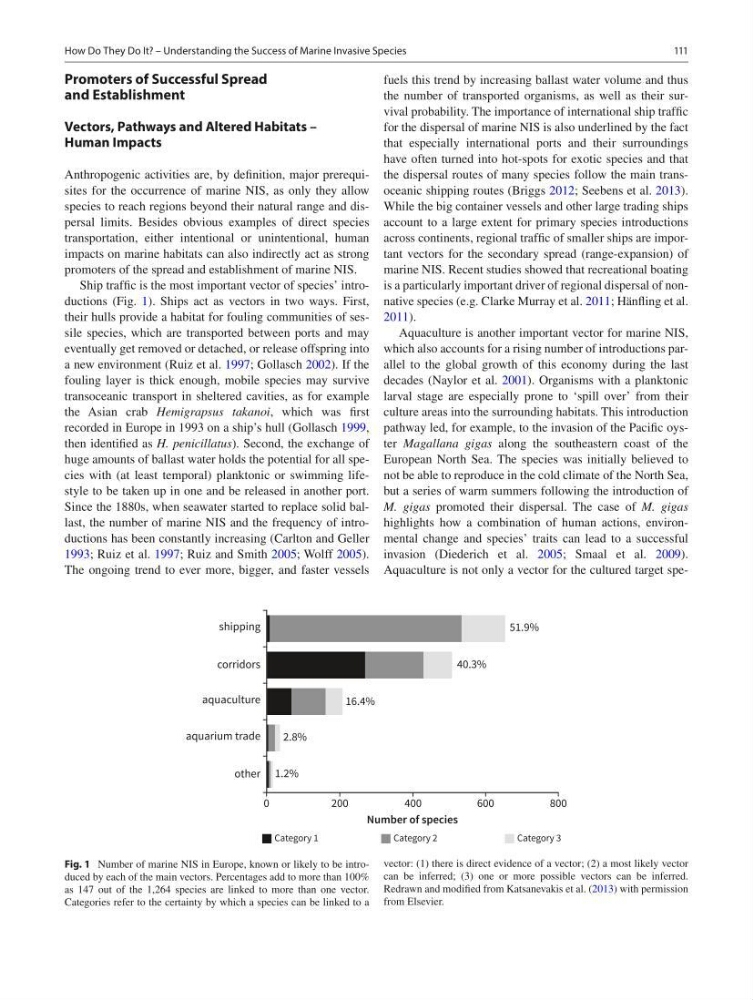
Ship traffic is the most important vector of species’ introductions (Fig. 1). Ships act as vectors in two ways. First,
their hulls provide a habitat for fouling communities of sessile species, which are transported between ports and may
eventually get removed or detached, or release offspring into
a new environment (Ruiz et al. 1997; Gollasch 2002). If the
fouling layer is thick enough, mobile species may survive
transoceanic transport in sheltered cavities, as for example
the Asian crab Hemigrapsus takanoi, which was first
recorded in Europe in 1993 on a ship’s hull (Gollasch 1999,
then identified as H. penicillatus). Second, the exchange of
huge amounts of ballast water holds the potential for all species with (at least temporal) planktonic or swimming lifestyle to be taken up in one and be released in another port.
Since the 1880s, when seawater started to replace solid ballast, the number of marine NIS and the frequency of introductions has been constantly increasing (Carlton and Geller
1993; Ruiz et al. 1997; Ruiz and Smith 2005; Wolff 2005).
The ongoing trend to ever more, bigger, and faster vessels
fuels this trend by increasing ballast water volume and thus
the number of transported organisms, as well as their survival probability. The importance of international ship traffic
for the dispersal of marine NIS is also underlined by the fact
that especially international ports and their surroundings
have often turned into hot-spots for exotic species and that
the dispersal routes of many species follow the main transoceanic shipping routes (Briggs 2012; Seebens et al. 2013).
While the big container vessels and other large trading ships
account to a large extent for primary species introductions
across continents, regional traffic of smaller ships are important vectors for the secondary spread (range-expansion) of
marine NIS. Recent studies showed that recreational boating
is a particularly important driver of regional dispersal of nonnative species (e.g. Clarke Murray et al. 2011; Hänfling et al.
2011).
Aquaculture is another important vector for marine NIS,
which also accounts for a rising number of introductions parallel to the global growth of this economy during the last
decades (Naylor et al. 2001). Organisms with a planktonic
larval stage are especially prone to ‘spill over’ from their
culture areas into the surrounding habitats. This introduction
pathway led, for example, to the invasion of the Pacific oyster Magallana gigas along the southeastern coast of the
European North Sea. The species was initially believed to
not be able to reproduce in the cold climate of the North Sea,
but a series of warm summers following the introduction of
M. gigas promoted their dispersal. The case of M. gigas
highlights how a combination of human actions, environmental change and species’ traits can lead to a successful
invasion (Diederich et al. 2005; Smaal et al. 2009).
Aquaculture is not only a vector for the cultured target speFig. 1 Number of marine NIS in Europe, known or likely to be introduced by each of the main vectors. Percentages add to more than 100%
as 147 out of the 1,264 species are linked to more than one vector.
Categories refer to the certainty by which a species can be linked to a
vector: (1) there is direct evidence of a vector; (2) a most likely vector
can be inferred; (3) one or more possible vectors can be inferred.
Redrawn and modified from Katsanevakis et al. (2013) with permission
from Elsevier.
How Do They Do It? – Understanding the Success of Marine Invasive Species
Promoters of Successful Spread
and Establishment
Vectors, Pathways and Altered Habitats –
Human Impacts
Anthropogenic activities are, by definition, major prerequisites for the occurrence of marine NIS, as only they allow
species to reach regions beyond their natural range and dispersal limits. Besides obvious examples of direct species
transportation, either intentional or unintentional, human
impacts on marine habitats can also indirectly act as strong
promoters of the spread and establishment of marine NIS.
Ship traffic is the most important vector of species’ introductions (Fig. 1). Ships act as vectors in two ways. First,
their hulls provide a habitat for fouling communities of sessile species, which are transported between ports and may
eventually get removed or detached, or release offspring into
a new environment (Ruiz et al. 1997; Gollasch 2002). If the
fouling layer is thick enough, mobile species may survive
transoceanic transport in sheltered cavities, as for example
the Asian crab Hemigrapsus takanoi, which was first
recorded in Europe in 1993 on a ship’s hull (Gollasch 1999,
then identified as H. penicillatus). Second, the exchange of
huge amounts of ballast water holds the potential for all species with (at least temporal) planktonic or swimming lifestyle to be taken up in one and be released in another port.
Since the 1880s, when seawater started to replace solid ballast, the number of marine NIS and the frequency of introductions has been constantly increasing (Carlton and Geller
1993; Ruiz et al. 1997; Ruiz and Smith 2005; Wolff 2005).
The ongoing trend to ever more, bigger, and faster vessels
fuels this trend by increasing ballast water volume and thus
the number of transported organisms, as well as their survival probability. The importance of international ship traffic
for the dispersal of marine NIS is also underlined by the fact
that especially international ports and their surroundings
have often turned into hot-spots for exotic species and that
the dispersal routes of many species follow the main transoceanic shipping routes (Briggs 2012; Seebens et al. 2013).
While the big container vessels and other large trading ships
account to a large extent for primary species introductions
across continents, regional traffic of smaller ships are important vectors for the secondary spread (range-expansion) of
marine NIS. Recent studies showed that recreational boating
is a particularly important driver of regional dispersal of nonnative species (e.g. Clarke Murray et al. 2011; Hänfling et al.
2011).
Aquaculture is another important vector for marine NIS,
which also accounts for a rising number of introductions parallel to the global growth of this economy during the last
decades (Naylor et al. 2001). Organisms with a planktonic
larval stage are especially prone to ‘spill over’ from their
culture areas into the surrounding habitats. This introduction
pathway led, for example, to the invasion of the Pacific oyster Magallana gigas along the southeastern coast of the
European North Sea. The species was initially believed to
not be able to reproduce in the cold climate of the North Sea,
but a series of warm summers following the introduction of
M. gigas promoted their dispersal. The case of M. gigas
highlights how a combination of human actions, environmental change and species’ traits can lead to a successful
invasion (Diederich et al. 2005; Smaal et al. 2009).
Aquaculture is not only a vector for the cultured target speFig. 1 Number of marine NIS in Europe, known or likely to be introduced by each of the main vectors. Percentages add to more than 100%
as 147 out of the 1,264 species are linked to more than one vector.
Categories refer to the certainty by which a species can be linked to a
vector: (1) there is direct evidence of a vector; (2) a most likely vector
can be inferred; (3) one or more possible vectors can be inferred.
Redrawn and modified from Katsanevakis et al. (2013) with permission
from Elsevier.
How Do They Do It? – Understanding the Success of Marine Invasive Species