

94
Various spatiotemporal scales of movement are tied to
different life-history functions (Bestley et al. 2009; Block
et al. 2011; Putman et al. 2014). Many top predators have
evolved life histories that involve travelling large distances
between predator-free breeding colonies and areas with large
prey abundance (Corkeron and Connor 1999; Costa et al.
2012; Weimerskirch et al. 2012). For example, chinook
salmon Oncorhynchus tshawytscha hatch in freshwater, then
migrate to the sea where they spend most of their adult life,
to ultimately migrate back to freshwater where they spawn
and die (Quinn 2005). Long-term observations of these predators’ movements provide not only information on the spatial extent of their populations and potential rates of exchange
among them, but also expose detailed characteristics of the
habitats they use and clues to their navigation abilities (Block
et al. 2011; Costa et al. 2012). Bio-telemetry represents a
crucial approach to gain this valuable knowledge on migration routes and patterns.
Environmental features undoubtedly influence migration.
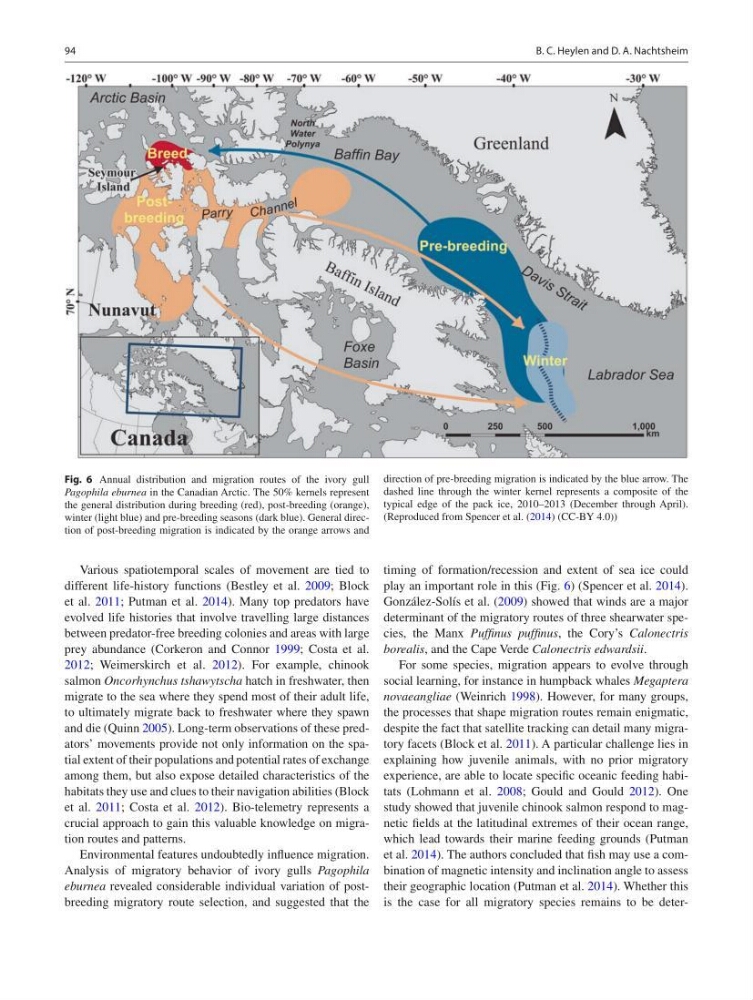
Analysis of migratory behavior of ivory gulls Pagophila
eburnea revealed considerable individual variation of postbreeding migratory route selection, and suggested that the
timing of formation/recession and extent of sea ice could
play an important role in this (Fig. 6) (Spencer et al. 2014).
González-Solís et al. (2009) showed that winds are a major
determinant of the migratory routes of three shearwater species, the Manx Puffinus puffinus, the Cory’s Calonectris
borealis, and the Cape Verde Calonectris edwardsii.
For some species, migration appears to evolve through
social learning, for instance in humpback whales Megaptera
novaeangliae (Weinrich 1998). However, for many groups,
the processes that shape migration routes remain enigmatic,
despite the fact that satellite tracking can detail many migratory facets (Block et al. 2011). A particular challenge lies in
explaining how juvenile animals, with no prior migratory
experience, are able to locate specific oceanic feeding habitats (Lohmann et al. 2008; Gould and Gould 2012). One
study showed that juvenile chinook salmon respond to magnetic fields at the latitudinal extremes of their ocean range,
which lead towards their marine feeding grounds (Putman
et al. 2014). The authors concluded that fish may use a combination of magnetic intensity and inclination angle to assess
their geographic location (Putman et al. 2014). Whether this
is the case for all migratory species remains to be deterFig. 6 Annual distribution and migration routes of the ivory gull
Pagophila eburnea in the Canadian Arctic. The 50% kernels represent
the general distribution during breeding (red), post-breeding (orange),
winter (light blue) and pre-breeding seasons (dark blue). General direction of post-breeding migration is indicated by the orange arrows and
direction of pre-breeding migration is indicated by the blue arrow. The
dashed line through the winter kernel represents a composite of the
typical edge of the pack ice, 2010–2013 (December through April).
(Reproduced from Spencer et al. (2014) (CC-BY 4.0))
B. C. Heylen and D. A. Nachtsheim
Various spatiotemporal scales of movement are tied to
different life-history functions (Bestley et al. 2009; Block
et al. 2011; Putman et al. 2014). Many top predators have
evolved life histories that involve travelling large distances
between predator-free breeding colonies and areas with large
prey abundance (Corkeron and Connor 1999; Costa et al.
2012; Weimerskirch et al. 2012). For example, chinook
salmon Oncorhynchus tshawytscha hatch in freshwater, then
migrate to the sea where they spend most of their adult life,
to ultimately migrate back to freshwater where they spawn
and die (Quinn 2005). Long-term observations of these predators’ movements provide not only information on the spatial extent of their populations and potential rates of exchange
among them, but also expose detailed characteristics of the
habitats they use and clues to their navigation abilities (Block
et al. 2011; Costa et al. 2012). Bio-telemetry represents a
crucial approach to gain this valuable knowledge on migration routes and patterns.
Environmental features undoubtedly influence migration.
Analysis of migratory behavior of ivory gulls Pagophila
eburnea revealed considerable individual variation of postbreeding migratory route selection, and suggested that the
timing of formation/recession and extent of sea ice could
play an important role in this (Fig. 6) (Spencer et al. 2014).
González-Solís et al. (2009) showed that winds are a major
determinant of the migratory routes of three shearwater species, the Manx Puffinus puffinus, the Cory’s Calonectris
borealis, and the Cape Verde Calonectris edwardsii.
For some species, migration appears to evolve through
social learning, for instance in humpback whales Megaptera
novaeangliae (Weinrich 1998). However, for many groups,
the processes that shape migration routes remain enigmatic,
despite the fact that satellite tracking can detail many migratory facets (Block et al. 2011). A particular challenge lies in
explaining how juvenile animals, with no prior migratory
experience, are able to locate specific oceanic feeding habitats (Lohmann et al. 2008; Gould and Gould 2012). One
study showed that juvenile chinook salmon respond to magnetic fields at the latitudinal extremes of their ocean range,
which lead towards their marine feeding grounds (Putman
et al. 2014). The authors concluded that fish may use a combination of magnetic intensity and inclination angle to assess
their geographic location (Putman et al. 2014). Whether this
is the case for all migratory species remains to be deterFig. 6 Annual distribution and migration routes of the ivory gull
Pagophila eburnea in the Canadian Arctic. The 50% kernels represent
the general distribution during breeding (red), post-breeding (orange),
winter (light blue) and pre-breeding seasons (dark blue). General direction of post-breeding migration is indicated by the orange arrows and
direction of pre-breeding migration is indicated by the blue arrow. The
dashed line through the winter kernel represents a composite of the
typical edge of the pack ice, 2010–2013 (December through April).
(Reproduced from Spencer et al. (2014) (CC-BY 4.0))
B. C. Heylen and D. A. Nachtsheim